
Livraison le jour même ou le lendemain

Qualité garantie

Débloquez vos offres de bienvenue: Livraison GRATUITE | Jusqu'à -80 % | 30 jours d'essai gratuits à JoyPlus
Téléchargez l'application
A dead battery, an underinflated tyre... an unexpected problem is all it takes to turn a trip into a nightmare, especially when you're far from help. To handle these hassles and drive with peace of mind, the jump starter with an air compressor is the ideal all-in-one solution. This compact device combines a portable car jump starter and a tyre inflator, giving you complete autonomy.
In this guide, we break down the essential criteria for choosing the right model and present our selection of the best devices currently available.
To find the multifunction jump starter that perfectly matches your vehicle and your needs, let's review a few key technical specifications.
Peak amperage (expressed in amps, A) is the crucial factor. It determines whether the booster has enough "juice" to restart a stubborn engine.
The tyre inflator function should not be overlooked. The maximum pressure, measured in PSI (Pounds per Square Inch) or Bars, indicates the inflation capacity. Most models offer a pressure of 150 PSI, which is more than sufficient for all types of passenger vehicle tyres. Another point to check is the air flow rate (in litres per minute), which directly affects inflation speed. An automatic shut-off feature that stops once the target pressure is reached is a real bonus, and even an essential option to prevent over-inflation.
These devices often go far beyond their two main functions. Here are a few options that can make a difference:
Here are a few models that stand out for their performance and versatility, allowing you to hit the road with complete peace of mind.
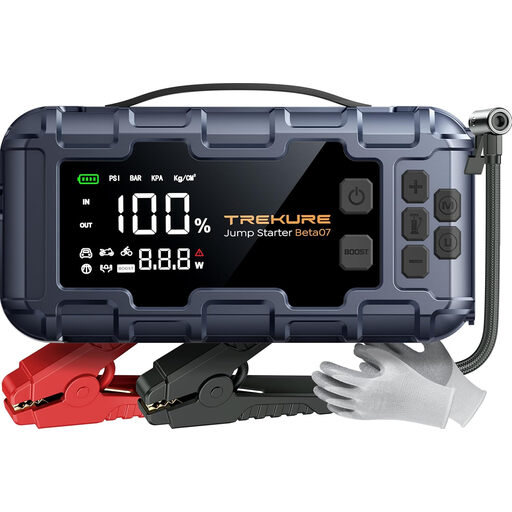
Why it stands out: The TREKURE Beta07 is built for the most demanding situations. With a peak current of 6000A, it can start very large 12V vehicles, including diesel engines up to 12L. Its 160 PSI compressor and PD 45W fast-charging port make it a particularly high-performance tool.
Pros:
Who is it for? For owners of large SUVs, RVs, boats, or commercial vehicles who need a powerful and versatile solution to be prepared for any eventuality.
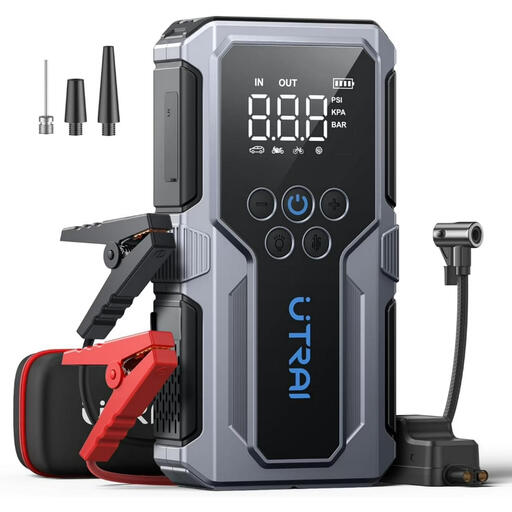
Why it stands out: The UTRAI JS-9 offers an excellent balance of power, features, and compactness. Its 3000A peak current is suitable for the vast majority of gasoline (up to 8.5L) and diesel (up to 6.5L) vehicles. Its LCD screen and multiple smart protections make it simple and safe to use.
Pros:
Who is it for? For drivers who want a reliable and versatile portable car jump starter for regular use, whether for a family car, a motorcycle, or for outdoor activities.
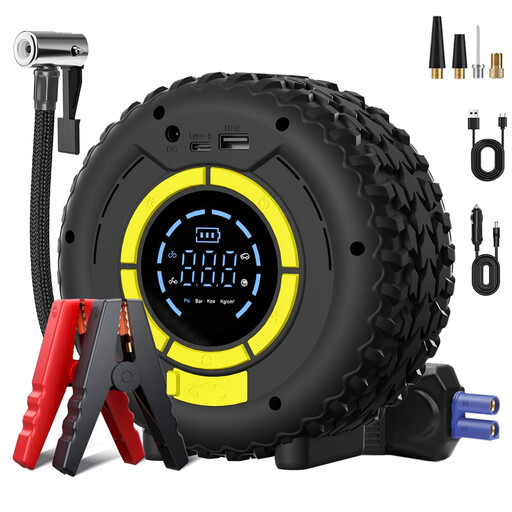
Why it stands out: This model from COCCKO focuses on compactness and portability. With a feather-light weight of just 600g and a power of 120W, it's the perfect car emergency kit to slip into a glove box or a backpack.
Pros:
Who is it for? For drivers of compact cars, motorcycles, or scooters who prioritise light weight and easy storage, without sacrificing essential features for emergencies.
Keeping your vehicle road-ready isn't just about emergencies. Want to modernise your car's interior with the latest navigation or entertainment technology? Other equipment might interest you.
? Discover our selection of Car Screens to enhance your driving comfort.
1. How do I safely use a jump starter with an air compressor? Always read the user manual. For jump-starting, make sure both the booster and the vehicle's ignition are off before connecting the clamps: the red one to the positive (+) terminal of the battery, the black one to the negative (-) terminal or an unpainted metal part of the chassis. Turn on the booster, then try to start the vehicle. For the compressor, screw the nozzle securely onto the tyre valve before starting inflation.
2. What power level should I choose for my jump starter? It all depends on your engine. For a standard gasoline car, 1500A to 2000A is sufficient. For a diesel engine, an SUV, or a van, aim for at least 2500A to 3000A. Models rated at 4000A and above are recommended for very large engines (trucks, boats).
3. Can I leave a booster in my car permanently? Yes, but with a few precautions. Avoid exposing it to extreme temperatures (high heat in summer, freezing in winter) which could damage its internal battery. Remember to recharge it every 3 to 6 months to maintain its capacity, even if you don't use it.