
Livraison le jour même ou le lendemain

Qualité garantie

Débloquez vos offres de bienvenue: Livraison GRATUITE | Jusqu'à -80 % | 30 jours d'essai gratuits à JoyPlus
Téléchargez l'application
A dead battery on a cold morning or a deflating tire far from any service station?: these are the nightmares every driver dreads. A jump starter with an air compressor promises an all-in-one solution for these unexpected setbacks. However, the market is flooded with marketing claims that can be seriously misleading.
Before you make a purchase, it's crucial to understand the common pitfalls that can turn a supposed bargain into a useless gadget when you need it most.
To help you cut through the noise, we've analysed the technical specs that truly matter.
The primary function of a portable car starter is to deliver the electrical jolt needed to wake up your engine. To do this, you need to watch two key values?:
A jump starter for gas and diesel cars should be chosen based on your engine's displacement. Due to their higher compression ratios, diesel engines require significantly more starting power than gas engines of a similar size. As a rule of thumb, a booster with 600A to 800A of starting current will suffice for most passenger cars, but large SUVs or diesel vans will demand a more powerful model.
An integrated jump starter with an air compressor is a real bonus, as long as it isn't underpowered. The maximum pressure (PSI or Bars) gives you an idea of its strength, but it's the air flow rate (L/min) that determines its speed.
An air flow rate below 20 L/min will be sluggish for a car tire. To avoid waiting forever, aim for a rate of at least 30-35 L/min. Practical features like an automatic shut-off at the desired pressure and preset modes (car, motorcycle, bicycle) make this portable tire inflator a truly convenient and safe tool, preventing any risk of over-inflation.
The battery capacity, often expressed in mAh, gives an idea of its endurance. A more reliable metric is watt-hours (Wh), which accounts for both capacity and voltage. A high capacity will allow you to perform multiple jump-starts or fully recharge your smartphone several times.
Extra features can transform a simple emergency starter into a true Swiss Army knife for any driver?:
Instead of an endless list, here is our selection of models that tick all the right boxes for specific needs.
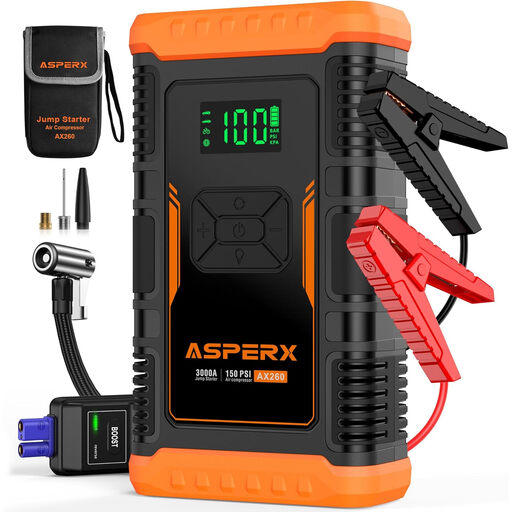
Why we love it : It's the perfect Swiss Army knife for most drivers (mid-size gas or diesel cars). It handles the two most common headaches (dead battery, flat tire) and is compact enough to be tucked away in the trunk or glove box.
Its clearly stated air flow rate of 35 L/min ensures a fast and effective inflation for a car tire (not just a beach ball). With 3000A peak current, it's built for engines up to 10L gas or 8L diesel—a realistic and fulfilled promise.
The perfect balance between serious starting power and a cordless compressor that actually gets the job done, complete with handy preset modes and an automatic shut-off.
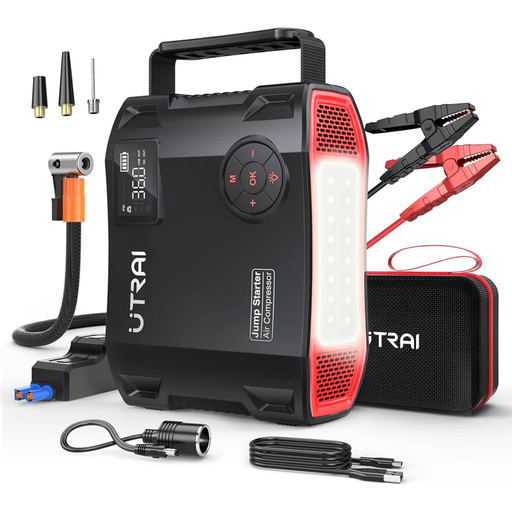
Why we love it : Designed for owners of SUVs, vans, or large diesel engines who can't afford any downtime. Its raw power and 27000mAh battery are calibrated for the most critical situations.
With 6000A peak current and stated compatibility for diesel engines up to 10.0L, it delivers power where it's needed most. Its compressor, with an air flow rate of 45 L/min, is one of the fastest on the market and won't let you down.
Serious firepower for both jump-starting and inflation, with the added bonus of a 160W DC output to plug in a cooler or a 12V vacuum.
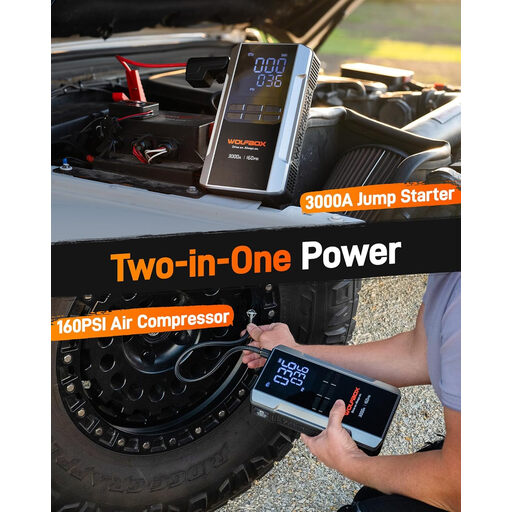
Why we love it : The perfect companion for road trips, camping, or outdoor excursions. More than just a starter, it's a true portable power station for recharging all your devices at lightning speed.
It stands out with its 65W two-way fast charging. Not only does it recharge your devices at top speed, but it also recharges itself in record time—a game-changing feature when every minute on the road counts.
Its 65W fast charging makes it a super-powerful car power bank, capable of bringing a laptop back to life as easily as a smartphone.
Discover our full selection of products that meet our performance criteria and current safety standards.
The lifespan depends on the battery (usually lithium-ion) and how well you care for it. To preserve it, remember to recharge the jump starter every 3 to 4 months, even if you don't use it. Avoid deep discharges and store it away from extreme heat and moisture.
The easiest way is to check your engine's displacement (gas or diesel). The technical specs for jump starters always indicate compatibility (e.g., "for up to 8.0L gas and 6.0L diesel engines"). When in doubt, choose a model that's slightly more powerful than you need; it's a good safety margin, especially if your car is older or you live in a cold region.
Most models can withstand extreme temperatures (often from -20°C to 60°C / -4°F to 140°F). However, permanently leaving the device in a car during the scorching summer heat or freezing winter will eventually damage the battery. Ideally, keep it in the passenger cabin rather than the trunk to protect it from the harshest temperatures.