
Livraison le jour même ou le lendemain

Qualité garantie

Débloquez vos offres de bienvenue: Livraison GRATUITE | Jusqu'à -80 % | 30 jours d'essai gratuits à JoyPlus
Téléchargez l'application
A dead battery first thing in the morning or a flat tyre on a country road: these are situations every driver dreads. The jump starter with an air compressor presents itself as the all-in-one solution to get you back on the road independently. However, the market is flooded with marketing promises, where the disappointing sits alongside the excellent. Our mission: to help you decode the spec sheets to make a truly informed choice.
Before you commit, watch out for these 3 common pitfalls that can render a device completely ineffective, or even useless:
To avoid these pitfalls, focus on a few key technical specifications. These are what determine the real-world performance and reliability of your future portable car starter.
This is the number one criterion. The required power depends directly on your vehicle's engine size.
The capacity, expressed in mAh, determines the device's autonomy: the number of jump starts possible on a single charge, or the number of times you can recharge your smartphone. A model with 20,000?mAh or more offers a good energy reserve.
Also, check the charging technology. A USB-C Power Delivery (PD) port, for example at 45W, allows you to recharge the booster itself much faster, but also to power your compatible devices (laptops, tablets) at high speed. This is a major advantage for a modern car power bank.
A portable air compressor is evaluated on two criteria:
Rather than an exhaustive list, we have selected three devices that meet specific user profiles, based on our performance and reliability criteria.
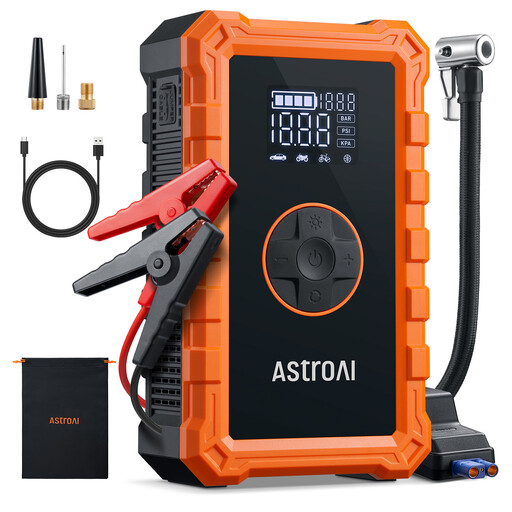
Why we chose it: Ideal for drivers of petrol or small diesel cars looking for a reliable and simple device. It offers an excellent balance between the jump-starting function and an efficient compressor for daily or emergency use, without unnecessary frills.
It clearly states its compatibility (up to 6.0L petrol / 3.0L diesel for 1500A), avoiding the trap of oversized and unrealistic power figures for this category.
Its large 2.4-inch screen clearly displays pressure and battery status. Its clever design includes integrated storage for accessories, which prevents them from getting lost.
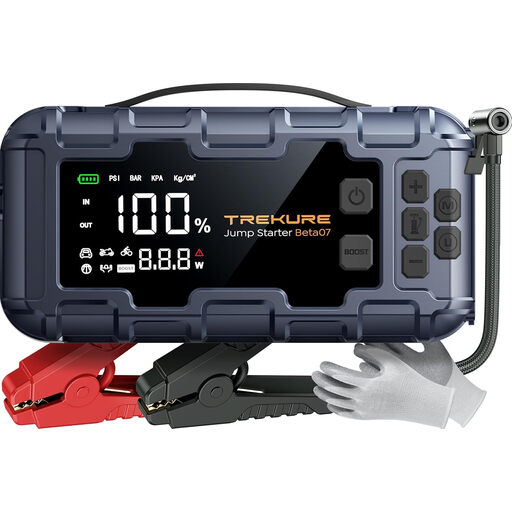
Why we chose it: Designed for heavy-duty users and owners of demanding engines. Its high starting power is suitable for diesel engines up to 12L, and its fast PD 45W charging ensures it's quickly ready for action.
It overcomes the underpowered pitfall by offering a 6000A peak current tailored for large-displacement engines, a crucial piece of information for buyers in this category.
The PD 45W fast charging allows the device to be fully recharged in record time. The 160 PSI compressor with a 45 L/min flow rate ensures rapid inflation, even for high-volume tyres.
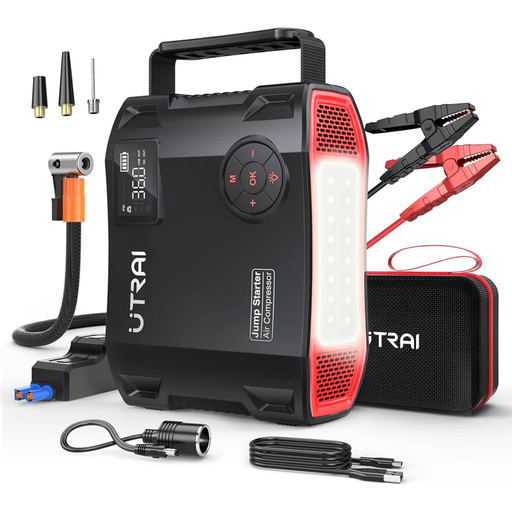
Why we chose it: More than just a jump starter, this is a true portable power station. Its 160W DC output can power camping equipment like a cooler or a vacuum cleaner, making it a versatile tool for outdoor activities.
It stands out from devices with gimmicky features by offering a powerful and genuinely usable DC output, a solid technical argument that justifies its 'Swiss Army knife' positioning.
The 160W DC output is its major asset. Combined with 6000A of starting power and a large 27,000 mAh capacity, it becomes a powerful ally for off-grid power autonomy.
Discover our full selection of products that meet our rigorous selection criteria and European safety standards.
The lifespan of such a device is typically between 3 and 5 years. It heavily depends on the quality of the lithium-ion battery cells, the frequency of use, and storage conditions. To preserve the battery, it is recommended to fully recharge it every 2 to 3 months, even if you don't use it.
A few simple steps can significantly extend the life of your multifunction starter. Store it in a cool, dry place, away from extreme temperatures. Avoid leaving it in your car in direct sunlight or freezing conditions. Before each use, visually inspect the clamps and cables for any signs of wear. Finally, strictly follow the recharging cycles recommended by the manufacturer.
It all depends on your engine's displacement. For a small to medium-sized diesel engine (up to 4.0L-5.0L), a 3000A booster may be sufficient. However, for larger displacement diesel engines (vans, large SUVs, motorhomes), it's safer to opt for a model offering 4000A, 6000A, or more. Always refer to the manufacturer's specifications and compare them to your vehicle's needs.