
Livraison le jour même ou le lendemain

Qualité garantie

Débloquez vos offres de bienvenue: Livraison GRATUITE | Jusqu'à -80 % | 30 jours d'essai gratuits à JoyPlus
Téléchargez l'application
A dead battery, a flat tire... These common breakdowns can quickly turn a simple trip into a real nightmare. The jump starter with air compressor has become the essential all-in-one tool for driving with peace of mind. But be careful: faced with an overwhelming number of options and often confusing spec sheets, it's easy to make a bad choice.
As a product expert at Joybuy, my mission is to help you cut through the noise. Let's forget the marketing jargon and focus on the criteria that truly matter to make an informed choice and, most importantly, avoid nasty surprises.
The jump starter market is saturated with marketing promises. Here are the three most common mistakes that can cost you dearly and leave you stranded on the side of the road at the worst possible moment.
To ensure you invest in a reliable device that won't let you down, focus on these three key points.
Don't rely solely on peak current. Always check the advertised compatibility with your engine's displacement.
The capacity, expressed in milliamp-hours (mAh), determines the number of possible jump-starts on a single charge, as well as the runtime of the power bank function.
A good integrated compressor must be both powerful and practical.
Rather than an endless list, here are three products that tick all the boxes for performance and reliability, each tailored to a specific user profile.
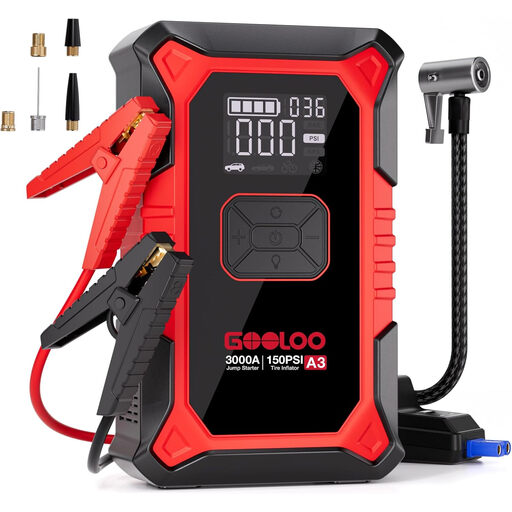
Ideal for: Perfect for drivers of sedans, SUVs, and light-duty vans who want a reliable and complete device for daily commutes and road trips. It covers all the essentials without going overboard.
Its 150 PSI compressor with automatic shut-off is no mere gadget. It can reinflate a tire quickly, thus avoiding the trap of anemic compressors.
Balanced power: 3000A peak current to start petrol engines up to 9.0L and diesel up to 6.5L. Smart display: The highly readable LED screen for pressure and inflation modes greatly simplifies its use.
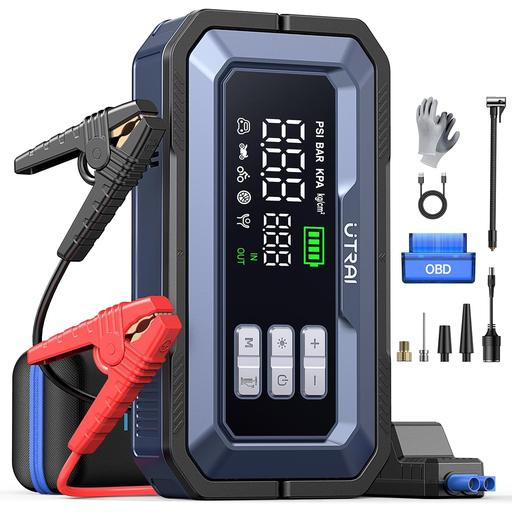
Ideal for: Built for owners of RVs, trucks, 4x4s, and farm equipment. Its raw power is simply essential for starting large diesel engines, even in extreme cold.
It doesn't just display an impressive number. Its compatibility is clearly stated for diesel engines up to 14L, which helps avoid the pitfall of purely marketing-driven peak amps.
Extreme power: 7000A peak and 1000A starting current for unwavering reliability on large engines. Versatility: 2000-lumen work light and a 160W DC output to power other 12V devices.

Ideal for: Perfect for those who want a "set it and forget it" device for the glove box. Its sodium-ion battery technology ensures it will be ready to go even after months, or even years, without a recharge.
It directly tackles the problem of self-discharge. With a rate of just 1% per month, it avoids the trap of a dead battery at the crucial moment—a major flaw in conventional lithium models.
Sodium-ion technology: Near-zero self-discharge, record-breaking lifespan (≥ 6000 cycles), and enhanced safety (no risk of thermal runaway). Extreme temperature range: Operates from -40°C to 80°C and can therefore be left in the car all year round without fear.
We have curated a complete selection of products that meet our demanding specifications for performance and safety.
It depends on the battery technology. A jump starter with a standard lithium-ion battery should be recharged every 3 to 6 months to ensure its effectiveness. Newer models, like those with sodium-ion batteries, have very low self-discharge and can hold their charge for several years.
Yes, but with some precautions. Most models are designed to operate between -20°C and 60°C. However, leaving the device in direct sunlight behind a windshield can push the temperature beyond this limit. Models with advanced thermal protection or sodium-ion batteries (stable up to 80°C) are much better suited for permanent storage in a vehicle.
Yes, it is most likely excessive. While it poses no risk to your vehicle (the jump starter only supplies the current requested by the battery), you would be paying for power you will never use. A model between 1500A and 2000A will be more compact, lighter, and more economical for a city car or petrol sedan. The golden rule: always match the power to your engine's displacement.