
Livraison le jour même ou le lendemain

Qualité garantie

Débloquez vos offres de bienvenue: Livraison GRATUITE | Jusqu'à -80 % | 30 jours d'essai gratuits à JoyPlus
Téléchargez l'application
A silent winter morning. Your car refuses to start. Even worse: a flat tyre on a country road, miles from anywhere. These breakdowns, the dread of every driver, can quickly turn a simple trip into an ordeal. It's precisely for these unexpected situations that a jump starter with an air compressor proves to be an indispensable safety accessory.
The problem is, the market is flooded with confusing marketing promises. Between wildly inflated power figures and gimmicky features, it's easy to make the wrong purchase. As the Head of the Equipment section, my role is to help you decode this jargon. Together, let's analyse the pitfalls to avoid and the real criteria that matter for choosing a reliable device that will give you complete peace of mind.
Emergency equipment isn't something you choose lightly. Here are three classic mistakes that can render your jump starter completely useless on the day you actually need it.
To make the right choice, ignore the marketing hype and focus on the objective specifications that guarantee performance and reliability.
Forget peak current and focus on the starting current (sometimes listed as cranking amps). This, and this alone, determines the jump starter's ability to effectively restart your engine.
Capacity, expressed in watt-hours (Wh), is a much more reliable indicator than milliampere-hours (mAh), as it measures the total energy actually stored. A high capacity will allow you to perform multiple jump-starts or recharge your devices (using the power bank function) without draining the unit.
Also, pay attention to the battery technology?:
For the compressor, there are two figures to watch?:
Rather than an endless list, here are three models that meet specific needs, all selected based on our strict criteria for performance and reliability.

Why we chose it : This is the "set it and forget it" model. Its sodium-ion technology ensures it will be ready to go even if you haven't charged it for months, or even years. The very definition of peace of mind.
It tackles the self-discharge pitfall head-on. Its sodium-ion battery reportedly loses only 1% of its charge per month (compared to 5-10% for lithium), allowing it to remain on standby for several years.
Its exceptional thermal stability (-40°C to 80°C) allows it to be left in the car all year round without risk. Advertised lifespan: up to 6000 cycles.
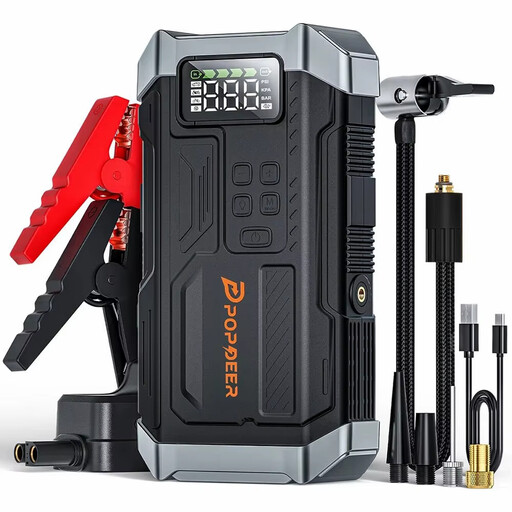
Why we chose it : Built for owners of SUVs, vans, or large-displacement cars who demand colossal and flawless starting power. Its raw power is its best selling point for the most critical situations.
It avoids the marketing pitfall of peak current by delivering massive, real-world power, capable of starting petrol engines up to 10 L and diesel engines up to 8 L, where less ambitious models would throw in the towel.
Very high starting power (advertised peak current of 5000 A) and a high-performance compressor with an air flow rate of 35 L/min for rapid inflation.

Why we chose it : The excellent all-rounder for the family car and daily commutes. Powerful enough for most vehicles, it's also a versatile Swiss Army knife with its power bank function and LED light. A balanced and reassuring choice.
It avoids the pitfall of the underpowered compressor. Its 150 PSI inflator with 5 preset modes and automatic shut-off is practical and genuinely effective when needed, not just a gimmick for the spec sheet.
Its balance of power and versatility. Its 10 levels of protection (reverse polarity, overcharge, etc.) make it very safe to use, even for novices.
Our editorial team has analysed dozens of products to select only those that meet our strict criteria for performance and safety.
It all depends on your engine. For most petrol cars under 3.0?L, a starting current (not peak current) of 400?A to 600?A is sufficient. For diesel engines or large-displacement engines, aim for 800?A or more. When in doubt, opt for a model that's slightly more powerful than you need; it's better to have too much power than not enough, and there's no risk to your vehicle.
This depends heavily on the technology. A standard lithium-ion model should be checked and recharged every three to six months. Newer sodium-ion models, however, can hold a charge for several years. In any case, make it a habit to check its charge level before any long trip.
It is essential to check the operating temperature range specified by the manufacturer. Most lithium jump starters operate optimally between -20°C and +60°C. Leaving them in a superheated car interior in summer or a freezing one in winter can degrade their battery and reduce their lifespan. Some devices, particularly those with sodium-ion technology, can withstand much more extreme ranges (e.g., -40°C to +80°C) and are therefore designed to be permanently stored in a vehicle.