
Livraison le jour même ou le lendemain

Qualité garantie

Débloquez vos offres de bienvenue: Livraison GRATUITE | Jusqu'à -80 % | 30 jours d'essai gratuits à JoyPlus
Téléchargez l'application
A dead battery or a flat tyre at the worst possible moment?is every driver's nightmare. When faced with these unexpected events, a jump starter with an air compressor stands out as the ultimate multi-tool. The problem? The market is flooded with models that have dazzling spec sheets but are often disappointing in the field. To help you see things more clearly, our editorial team has broken down the common pitfalls and the features that truly matter.
As a Product Recommendation Manager at Joybuy, my mission is simple?: to help you separate the wheat from the chaff and invest in reliable equipment rather than an overhyped gadget.
Don't be fooled by impressive numbers that mask mediocre performance. Here are the points to watch closely to avoid regretting your purchase.
To make sure you get it right, here are the three technical points you should never overlook.
The capacity, expressed in mAh, is your device's energy tank. For a portable car starter, a minimum of 8000?mAh is the bare minimum to ensure multiple starts or to serve as a car power bank worthy of the name. Also, remember to check compatibility with your engine type (most models are designed for 12V petrol and diesel engines up to a certain displacement).
Don't be blinded by the 150?PSI displayed on the box. Opt for a model with a readable digital screen that allows you to pre-select the target pressure in different units (PSI, BAR, KPA). The automatic shut-off is not a gimmick?: it's your guarantee against over-inflating your tyres and allows you to do something else with peace of mind during the process.
The little extras can change everything. An SOS LED light for your car with multiple modes (steady light, strobe, SOS) is a real asset for your safety during a nighttime intervention. Likewise, USB ports with a decent output (e.g., 5V/2A) are essential for charging a smartphone at an acceptable speed, turning your booster into a true portable power station.
Rather than an impersonal list, we've matched products to specific needs to help you find the equipment that's right for you.
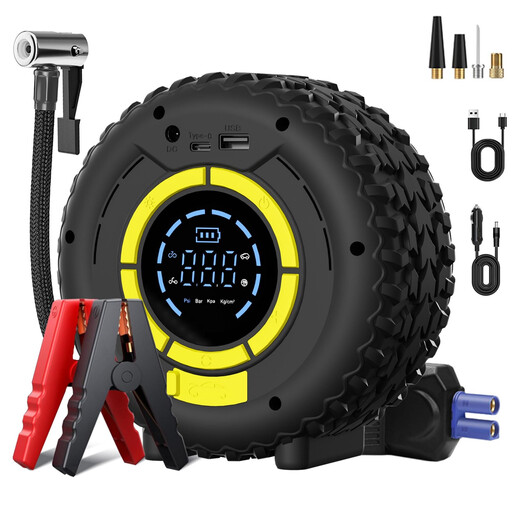
Why this choice : For those who leave nothing to chance. This model is the driver's Swiss Army knife : it handles the two most common breakdowns in a format that fits in the boot. Essential for holiday trips or simply for daily peace of mind.
It doesn't try to be a poor jack-of-all-trades. Its performance is clear and balanced : a genuine 150 PSI compressor with 4 smart modes and an effective 120W booster. No nasty surprises.
Its readable LCD screen that displays pressure and battery life, its safety LED light, and its 8000 mAh battery make it a complete and reliable tool.
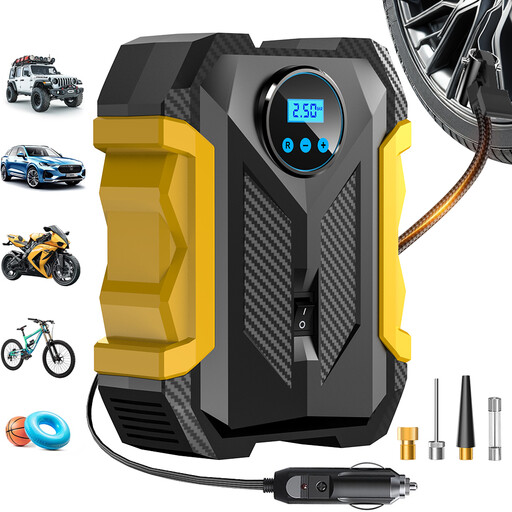
Why this choice : For those who get straight to the point. If your main concern isn't the battery but tyre pressure (which is essential for safety and fuel economy), this specialised inflator is the smart choice. Simpler and more economical.
It does one thing, but it does it perfectly. No more sluggish compressors : plugged into the 12V socket, it delivers constant power for fast, effortless inflation.
Simple and effective. Its digital display is a breeze to use, and its 3-metre cable easily reaches all four tyres. No battery to recharge, it's always ready to go.
Why this choice : For road warriors and smartphone addicts. Beyond its function as a car rescue tool, it's a true XXL power bank for charging all your devices (phone, tablet, etc.) during your van life weekends or road trips.
Here, the power bank feature isn't just an afterthought. With its genuine 8000 mAh, it can recharge a smartphone multiple times, unlike gadgets that die after just a few minutes.
The ultimate 2-in-1 : it looks after your car and the battery life of your gadgets. It's the ideal travel companion to stay worry-free and connected.
Our commitment to quality doesn't stop with automotive products. We also track down the best innovative products for your home. Take a look at one of our flagship categories.
It all depends on the quality of its lithium battery. A good model will withstand several hundred charge cycles. The secret to its longevity? Recharge it every 3 to 6 months, even without using it, and store it away from extreme temperatures (neither in a car under the scorching sun nor in freezing cold).
That's a very bad idea. The high heat of summer and the freezing cold of winter are the battery's worst enemies. They can damage it irreversibly and drastically reduce its performance. The best practice is to keep it at home, at room temperature, and only take it with you on long journeys.
For the majority of 12V passenger cars (city cars, saloons, SUVs) with a petrol engine, 8000?mAh is more than enough for several starting attempts. However, for a large diesel engine or in sub-zero temperatures, a more robust model will provide more peace of mind. In any case, always check the maximum engine displacement recommended by the manufacturer.