
Livraison le jour même ou le lendemain

Qualité garantie

Débloquez vos offres de bienvenue: Livraison GRATUITE | Jusqu'à -80 % | 30 jours d'essai gratuits à JoyPlus
Téléchargez l'application
A dead battery on a cold morning or a flat tire on a country road: two scenarios every driver dreads. The jump starter with air compressor has emerged as the all-in-one solution to handle any roadside emergency. The problem? The market is flooded with marketing promises that often conceal unreliable devices. As product experts, our mission is to help you avoid these pitfalls and make a truly informed decision.
To prevent a promising purchase from turning into a major disappointment, here are the critical flaws you need to know.
The Illusion of Power: Peak Amps Are a Misleading Figure Many manufacturers highlight spectacular peak amp ratings (e.g., 3000A, 4000A). However, this number only represents an electrical burst lasting a few milliseconds. The only metric that truly matters is the starting amperage (or cranking amps), which is much more rarely disclosed. This is what determines the real ability to start an engine, especially for a diesel car jump starter in cold weather. High peak amps without sufficient starting current? That's a guarantee of a starter that will fail on a large engine.
The "Gadget" Compressor: Slow and Prone to Overheating The car tire inflator function is a major selling point, but its quality varies wildly. Low-end models are often equipped with anemic compressors that take forever to inflate a tire, overheat after a few minutes, and shut down, leaving you stranded. Let's be clear: a compressor unable to fully reinflate a tire without needing a 10-minute cooldown is a completely useless gadget.
Fatal Self-Discharge: A Dead Battery at the Worst Possible Moment This is arguably the most frustrating pitfall. You charge your portable car starter, store it in your trunk, and six months later, when you need it most in an emergency, it's dead. This is due to poor-quality lithium batteries with a high self-discharge rate, making them totally ineffective for use as an emergency jump starter.
To avoid falling into these traps, here are the technical specifications to scrutinize.
Starting Power and Engine Compatibility: Check the advertised compatibility with your engine's displacement (e.g., up to 8.0L Gas / 6.0L Diesel). A high peak amp rating (over 1500A) is a good indicator for standard cars, but for SUVs and diesels, you should aim higher and choose models specifically designed for these engines.
Compressor Performance (PSI and L/min): A compressor worth its salt must be able to reach a pressure of at least 150 PSI (about 10 bar) to handle all tire types. Its air flow rate, in liters per minute (L/min), indicates its speed. The automatic shut-off feature at the desired pressure isn't a gimmick; it's a real bonus for accuracy and safety.
Battery Technology and Capacity (mAh): The capacity, in milliampere-hours (mAh), determines the number of possible starts and the runtime in power bank mode. But the battery technology is just as crucial. Beyond traditional lithium-ion, sodium-ion is emerging. Its advantages? A longer lifespan, better resistance to extreme temperatures, and, most importantly, a near-zero self-discharge rate. This ensures your device is always ready to go.
Because every driver has different needs, here are our recommendations to find the model that's right for you, without falling for the usual tricks.
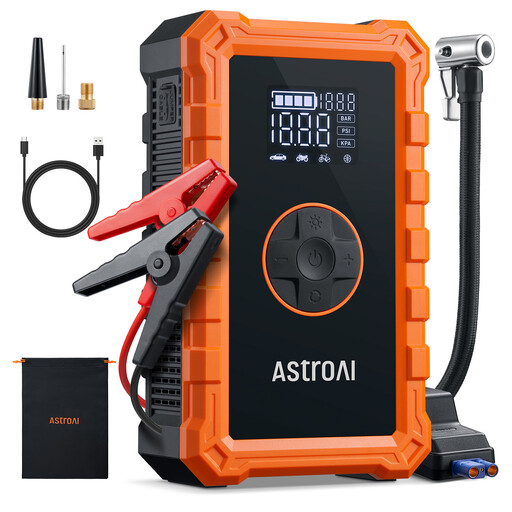
Why we chose it: A balanced all-in-one solution for city cars and compacts (up to 6.0L gas and 3.0L diesel engines). It offers real peace of mind for daily driving without breaking the bank.
Its compressor with automatic shut-off at a preset pressure prevents overheating and inaccurate inflation, a typical flaw of entry-level models.
Its clear and readable 2.4-inch digital screen displays real-time pressure and battery level. A truly user-friendly feature, even for novices.
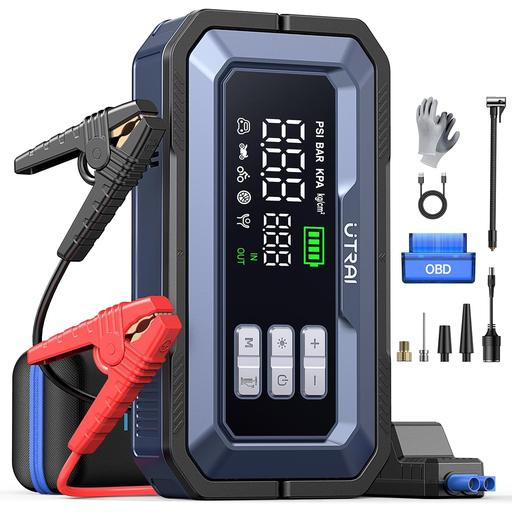
Why we chose it: Built for owners of SUVs, vans, or large-displacement diesel engines who can't afford to compromise on starting power.
With advertised compatibility for diesel engines up to 14L, it avoids the trap of overrated amperage that often leaves large engines dead in the water.
Its 160W DC output (via a cigarette lighter socket) can power 12V devices (coolers, vacuums), while its 2000-lumen work light is invaluable for nighttime repairs.

Why we chose it: Ideal for those seeking a long-term investment, maximum safety, and who are tired of having to recharge their device every few months.
Thanks to its sodium-ion battery, it knocks out the self-discharge problem. According to the manufacturer, a single charge keeps it operational for years, whereas lithium batteries drain in months.
Thermal stability (-40°C to 80°C) and chemical safety (no fire risk even if damaged) mean it can be left in the car year-round with complete peace of mind.
Discover our full selection of jump starters and chargers, all tested and approved according to our criteria for reliability and safety.
It all depends on the battery technology and maintenance. A standard lithium-ion model has a lifespan of three to five years. To preserve its performance, it's advisable to recharge it every three to six months, even if unused. Newer sodium-ion models, like the GOKKCL GK01, promise a much longer lifespan (up to 6000 charge cycles) and such low self-discharge that maintenance recharges become almost unnecessary.
It depends on the engine's displacement. A 1500A peak jump starter might be enough for a small diesel engine (under 3.0L) in mild weather. However, diesel engines are more demanding to start, especially in winter. For a mid-to-large size diesel SUV or sedan, it is much safer to opt for models rated at 2000A or more peak, such as the GOOLOO GP2000 or the UTRAI JS-9.
That's an excellent question. Traditional lithium-ion batteries do not handle extreme temperatures well. Excessive heat (over 60°C) can damage them and pose a safety risk, while intense cold (below -10°C) cripples their effectiveness. Fortunately, some models are designed to withstand a wide temperature range (from -20°C to 60°C). This is where sodium-ion battery devices pull ahead of the pack: with an advertised operating range of -40°C to 80°C, they are perfect for being left in a vehicle year-round, worry-free.