
Livraison le jour même ou le lendemain

Qualité garantie

Débloquez vos offres de bienvenue: Livraison GRATUITE | Jusqu'à -80 % | 30 jours d'essai gratuits à JoyPlus
Téléchargez l'application
A dead battery or a flat tyre at the worst possible moment can turn any trip into a nightmare. To handle these unexpected situations, the jump starter with air compressor is an essential piece of kit. This all-in-one tool, combining an emergency starter and a portable inflator, is your ticket to getting back on the road with peace of mind.
The problem?is that the market is flooded with models making tempting promises that often fall short. To help you see things more clearly, we've broken down the common pitfalls to avoid and the criteria that truly matter before you buy.
Buying this kind of safety equipment isn't something to be taken lightly. You need to read between the lines on spec sheets and be wary of marketing claims that can hide major weaknesses.
To ensure your emergency car jump starter kit will be up to the task when you need it most, focus on these three essential parameters.
Forget peak amps?! The only real criterion is the jump starter's compatibility with your engine's displacement (in litres). A reputable manufacturer will always clearly state the compatible engine sizes (e.g., "up to 9.0L petrol / 8.0L diesel"). This is the most reliable indicator of whether the jump starter has enough power for your vehicle. A powerful diesel jump starter will naturally need to offer far greater starting capacity than a model for a small petrol city car.
A good built-in 12V air compressor should be able to reach at least 150 PSI (about 10.3 bar), which is more than enough pressure for any passenger vehicle tyre. The features to look for are?:
A portable car starter worth its salt is much more than just a battery these days. It must include built-in protections to avoid damaging your car's onboard electronics or, worse, causing an accident. Make sure it has at least the following safety features?:
The power bank function (with USB ports to charge a smartphone) and the built-in LED light (often with an SOS mode) are always welcome bonuses.
There's a jump starter for every driver. Here is our selection, designed for different profiles and needs.
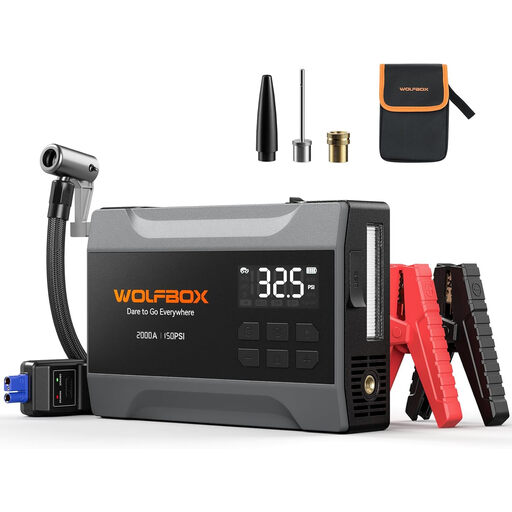
Why it's perfect for this use : Compact and powerful enough for small petrol engines (up to 5.0L), it slips easily into a glove box or under a seat. The perfect emergency solution that you'll forget is even there.
No over-the-top claims about peak amps. The manufacturer clearly states its compatibility (petrol engines up to 5.0L) — far more useful and honest information for a city car owner.
An excellent balance of compactness and features. It packs a 150 PSI compressor and an LED light into an almost pocket-sized format.

Why it's perfect for this use : Highly versatile, its powerful output (up to 9.0L petrol / 8.0L diesel) covers most family cars, SUVs, and minivans. Its multiple safety features and power bank function make it a reassuring companion for long journeys.
It solves the problem of underpowered compressors with a smart digital inflator (5 preset modes and auto-shutoff). Its active cooling system is a mark of durability, an often-overlooked point.
Its arsenal of 10 smart protections makes it ultra-safe to use, even for a novice. Connecting the clamps is foolproof, with no risk of sparks.
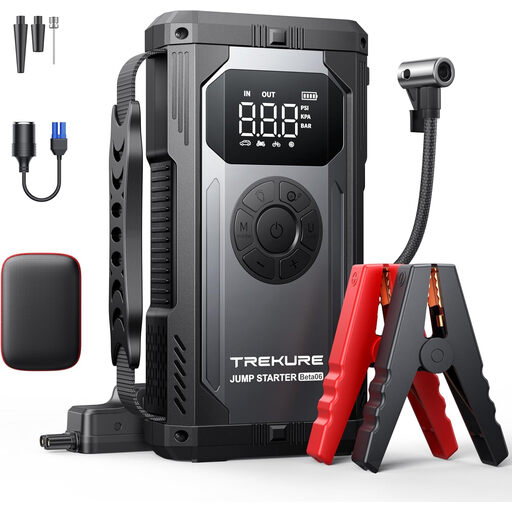
Why it's perfect for this use : Capable of starting diesel engines up to 10.0L, it's built for large SUVs, vans, and utility vehicles. Its DC output (cigarette lighter style) can even power other 12V devices, making it a true work tool.
It tackles the problem of under-dimensioned starters for large engines head-on. Its spec sheet is unambiguous about its ability to handle the most demanding vehicles. A reliable choice for professional or heavy-duty use.
Its colossal starting power (up to 5500 A peak) and its 12V DC output transform it into a portable power station, going far beyond simple roadside assistance.
Explore our full selection of products that meet our selection criteria and European safety standards.
Don't focus on "peak amps". Instead, rely on the compatibility with your engine's displacement (in litres)?— it's a much more reliable indicator. A jump starter for a 2.0L petrol engine won't have the same requirements as one for a 3.0L diesel. Always refer to the manufacturer's specifications.
Most modern lithium-battery jump starters hold their charge for several months. However, to ensure it's effective when you need it, it's recommended to fully charge it every 3 to 6 months, even if you haven't used it. A full charge typically takes 3 to 5 hours via a USB port.
No, as long as you choose a quality jump starter. Reputable models are equipped with multiple protections (reverse polarity, anti-spark, overload...) designed for risk-free use. These safety features block the current if the clamps are connected incorrectly, thereby protecting the onboard computer and all sensitive vehicle electronics. Our advice?: never use a device that lacks these essential protections.