
Livraison le jour même ou le lendemain

Qualité garantie

Débloquez vos offres de bienvenue: Livraison GRATUITE | Jusqu'à -80 % | 30 jours d'essai gratuits à JoyPlus
Téléchargez l'application
A dead battery on a frosty morning, a tire slowly losing air miles from the nearest gas station… These worst-case scenarios are familiar to every driver. In the face of these predicaments, the jump starter with air compressor has emerged as the ultimate all-in-one solution. A single device to get you back on the road and out of a tight spot, all without having to call for help.
The only problem?: the market is flooded with models making often unrealistic claims. As a product expert for Joybuy, my mission is simple?: to teach you how to read between the lines of spec sheets to find the device that truly meets your needs, rather than falling for marketing hype.
It's tough to navigate this jungle of options. Some devices, beneath their rugged exteriors, hide flaws that only reveal themselves once you're stranded on the side of the road. Here are the most common pitfalls.
Many manufacturers flaunt staggering numbers like 3000A, 5000A, or even higher. While high peak amps are necessary for large engines, this value alone is misleading. It only represents the maximum discharge for a fraction of a second. The starting current (cranking amps), a far more telling metric but one that's strangely discreet on the packaging, is the actual power delivered over several seconds. In practice?? A booster that boasts 5000A peak but can't sustain that power won't even make a large diesel engine sputter.
The tire inflator function is a major asset, but on some low-end models, it's practically useless. The signs of an inefficient compressor are?:
The battery capacity, expressed in milliampere-hours (mAh), is another spec to be taken with a grain of salt. A high capacity on paper means nothing if the battery cells are poor quality. A bad jump starter can lose over 50?% of its charge in just a few months in your trunk, turning it into a useless brick when you need it most. This rampant self-discharge is the hidden flaw of many entry-level models.
To make the right choice, forget the marketing jargon and focus on these key specifications. They are the only things that guarantee a portable car starter is reliable and compatible with your vehicle.
Forget peak amperage for a moment and check the recommended engine compatibility for the device.
The maximum pressure, often 150 PSI, is a standard on paper. But the real deciding factor is the airflow, measured in litres per minute (L/min). A decent airflow (e.g., 35-45 L/min) means faster inflation. A good compressor should be able to reinflate a standard car tire (from 25 to 36 PSI) in under 5 minutes. The inclusion of preset modes and an automatic shut-off is a real bonus for convenience and safety.
A good multi-function jump starter should be more than just an emergency tool.
Rather than a simple laundry list, we've matched user profiles with products that check all the boxes for reliability and performance.
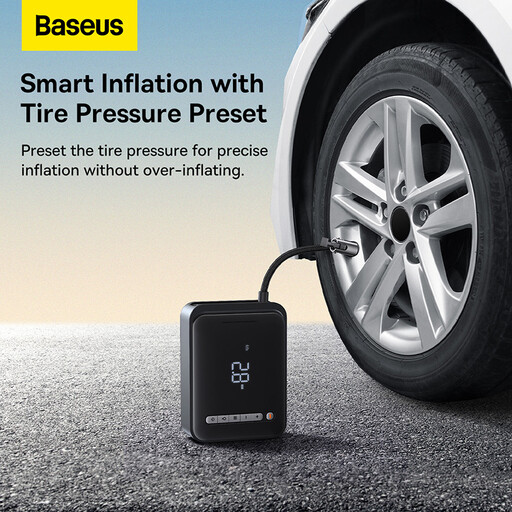
Why we recommend it : A compact and well-designed solution for owners of city cars and compact gasoline sedans. It provides the essentials (jump-starting and inflation) in a format that fits easily in the glove compartment.
It doesn't fall into the oversized amperage trap. Its 1000A is tailored to its target, and its compressor is designed for occasional use, avoiding the disappointment of a "gimmick" feature.
Its highly integrated 2-in-1 design and light weight (around 1.36 kg) make it a discreet and practical travel companion for everyday needs.
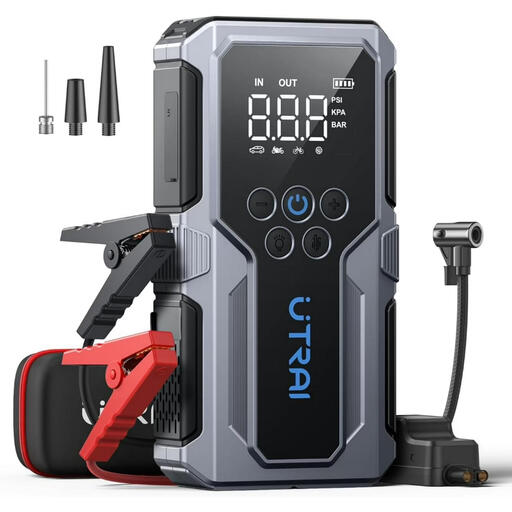
Why we recommend it : An excellent balance of power and features. Its 3000A is sufficient for most SUVs and minivans (gas up to 8.5L, diesel up to 6.5L), and its compressor with an LCD screen is a real bonus.
It counters the gimmick compressor pitfall with its LCD screen, which allows you to preset the pressure and monitor inflation. This prevents overheating and ensures correct pressure without constant supervision.
The 2-inch LED screen clearly displays the battery level and pressure, offering full control. The jump-start function is complemented by a true portable power station.
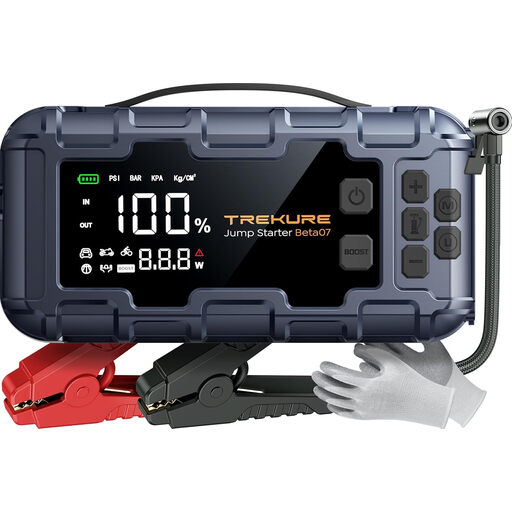
Why we recommend it : Built for the most demanding situations. Its 6000A power can start diesel engines up to 12L. The 45W PD fast charging and 45 L/min compressor airflow make it a top-tier tool for frequent travellers, RV owners, or boaters.
It justifies its high amperage with real-world compatibility for very large engines. The 45W PD fast charging allows it to be fully recharged in record time, effectively combating the risk of a dead device at the crucial moment.
In short, this is the heavy-duty solution for those who refuse to compromise : 6000A of peak power, a large 3.3-inch smart screen, and a high-performance compressor.
We've put together a complete selection of products that meet our strict requirements for performance and safety.
It depends entirely on your vehicle. For a small gasoline car, 1000A to 1500A is enough. For an SUV or a mid-size sedan with a gasoline engine, opt for 2000A to 3000A. If you have a diesel engine, especially one larger than 2.0L, a model with 3000A or more is a safer bet to ensure an effective start, particularly in cold weather.
Charge retention varies greatly depending on the battery quality. Entry-level models can lose a significant portion of their charge in 2 to 3 months. Higher-quality devices can hold a charge for 6 months to a year. It is recommended to check and recharge your jump starter every 3 to 4 months to ensure it's fully operational when you need it.
Yes, most jump starters are designed for this, but you should check their operating temperature range, which should ideally be between -20?°C and +60?°C (-4°F and 140°F). Leaving the device in a car in direct summer sun can expose the battery to extreme temperatures and reduce its lifespan. It's better to store it in the glove compartment or under a seat rather than on the dashboard.