
Livraison le jour même ou le lendemain

Qualité garantie

Débloquez vos offres de bienvenue: Livraison GRATUITE | Jusqu'à -80 % | 30 jours d'essai gratuits à JoyPlus
Téléchargez l'application
By Joybuy, our product expert – August 27, 2026
A dead battery or a flat tyre: every driver's nightmare. When faced with this hassle, a jump starter with an air compressor emerges as the perfect solution. However, the market is flooded with marketing promises that often hide disappointing products. Before you pull out your credit card, it's crucial to know the pitfalls to avoid so you can get a device that won't let you down when it matters most.
The idea of a compact device that solves all your problems is appealing. But beware of inflated specs and hidden flaws that can render your purchase useless at the worst possible moment.
To find a reliable ally against dead batteries and a portable tyre pump that actually delivers, focus on the features that truly matter.
Ignore the peak current and look for the starting current. This is the power the jump starter can deliver continuously for several seconds to crank the engine.
The internal battery technology is the heart of the device. It determines the reliability, safety, and longevity of your portable car starter.
To ensure the compressor is more than just a gimmick, check these points:
Rather than a laundry list of options, we've selected models that cater to specific needs, based on the reliability and performance criteria we've just discussed.
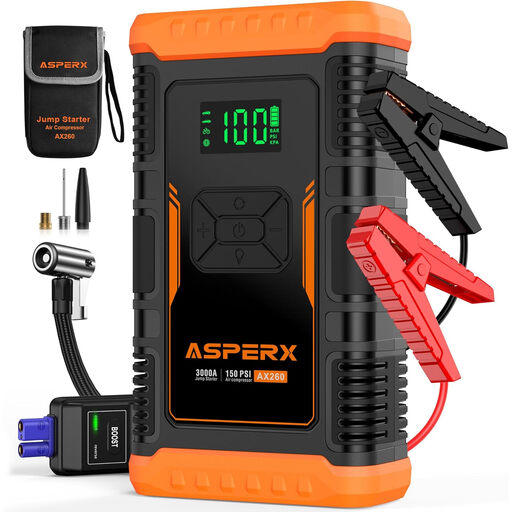
Why we recommend it: For the driver of a standard car (petrol or mid-size diesel) looking for an all-in-one emergency tool at a fair price. It offers enough starting power for most breakdowns and an effective compressor for slow leaks.
Its 150 PSI compressor with preset and auto-shutoff functions avoids the 'gimmick pump' trap. The advertised 35 L/min flow rate is suitable for effective emergency use.
Its excellent balance of features (starter, compressor, power bank, and flashlight). A complete kit for driving with peace of mind.

Why we recommend it: The ideal device for those who want to put it in their trunk and forget about it. Perfect for the car at a second home, a classic car that is rarely driven, or for drivers who face extreme climates and demand rock-solid reliability.
It shatters the battery degradation trap. Its sodium-ion technology ensures years of standby on a single charge and resistance to extreme temperatures (-40 °C to 80 °C), where lithium-ion gives up.
A colossal lifespan (up to 6000 cycles) and unmatched chemical safety (no risk of thermal runaway). This is an investment for the decade, not just the year.
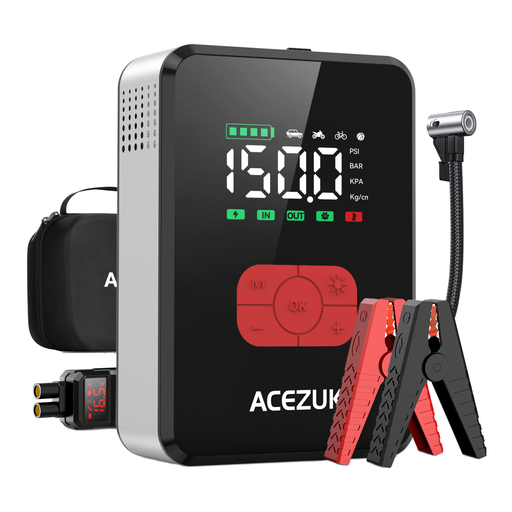
Why we recommend it: Designed for owners of large SUVs, pickup trucks, or diesel vehicles up to 12L. Its raw power is calibrated to ensure you're never caught off guard, even with the most power-hungry engines.
Here, the peak current promise isn't just marketing hype. Its real power is calibrated for the most demanding engines, including diesels up to 12L. It provides a comfortable safety margin, even for the toughest cases.
Exceptional starting power and a smart compressor with a large 3.3-inch screen for optimal readability. Its smart clamps, which feature their own screen, add a welcome layer of safety and clarity.
We have put together a complete selection of products that meet our strict selection criteria and European safety standards.
This depends heavily on the battery technology. A standard lithium-ion model should be recharged every 2 to 4 months to remain operational. In contrast, a sodium-ion jump starter has such a low self-discharge rate that it can hold its charge for several years, making it much more reliable if you tend to forget about it.
That's an excellent question, and the answer is crucial for your safety. Lithium-ion batteries are sensitive to extreme temperatures. Leaving them in a car in direct sunlight during summer (where temperatures can exceed 60?°C) can accelerate their degradation and, in rare cases, pose a risk. Intense cold also reduces their effectiveness. Sodium-ion based models are designed to operate stably and safely over a much wider range (typically -40?°C to 80?°C), making them better suited for permanent storage in a vehicle.
That 3000?A figure refers to the peak current, which is an unreliable marketing metric. For a diesel SUV, it's more important to check the engine compatibility specified by the manufacturer (e.g., "up to 8.0L Diesel") and, if possible, the starting current. A 3000?A peak current device might be sufficient for a mid-size diesel, but for a large engine or in very cold weather, a more robust model or one equipped with a force start ("boost") mode would be a more prudent choice.