
Livraison le jour même ou le lendemain

Qualité garantie

Débloquez vos offres de bienvenue: Livraison GRATUITE | Jusqu'à -80 % | 30 jours d'essai gratuits à JoyPlus
Téléchargez l'application
A dead battery on a cold morning, a flat tire far from any service station… these are the headaches every driver knows and dreads. On paper, the jump starter with air compressor is the silver bullet, the all-in-one tool to get you back on the road with peace of mind. But in the jungle of available models, marketing promises often hide disappointing performance.
As a product expert at Joybuy, my mission is to guide you through this jungle. Together, let's break down the pitfalls to avoid and the criteria that truly matter for choosing a reliable device—a travel companion that will never let you down.
Before you fall for the first model on sale, watch out for the hidden flaws that can turn a smart purchase into a gadget destined for the trash.
To avoid making a mistake, focus on these few objective characteristics. This is where the performance and reliability of your future ally are decided.
Forget peak current and look at the real compatibility: is the device suitable for your car's engine size (in litres) and fuel type (gasoline or diesel)? A diesel engine, for example, requires much more power to start than a gasoline engine of the same size. The smart move: always aim for a model designed for a slightly larger engine size than yours. This safety margin will make all the difference in cold weather when batteries are struggling.
A compressor worthy of the name should be able to reach a maximum pressure of at least 100-150 PSI (or 7 to 10 bars), enough to cover the needs of most cars. But two features are real game-changers:
A good integrated portable tire inflator must be more than just an accessory; it must be a reliable tool.
A modern portable car starter must be more than just a battery rescuer. Make sure it includes these essentials:
The perfect one-size-fits-all jump starter doesn't exist. The best model is the one that meets your needs. Here are our recommendations, designed for different types of drivers.
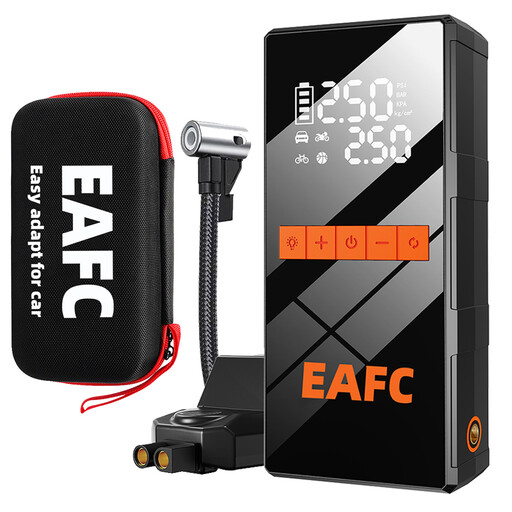
Why we recommend it: It's the driver's Swiss Army knife. Powerful enough for most city cars and sedans (up to 4.0L gasoline, 2.0L diesel), it tackles the two most common headaches (battery and tires) in a format compact enough to slip into the glove box.
Its 150 PSI compressor with auto-shutoff isn't a gimmick; it's a real asset. It allows for precise, unattended, and safe inflation.
Its 4-in-1 versatility (jump starter, compressor, power bank, LED light). An excellent feature-to-price ratio for driving with peace of mind.
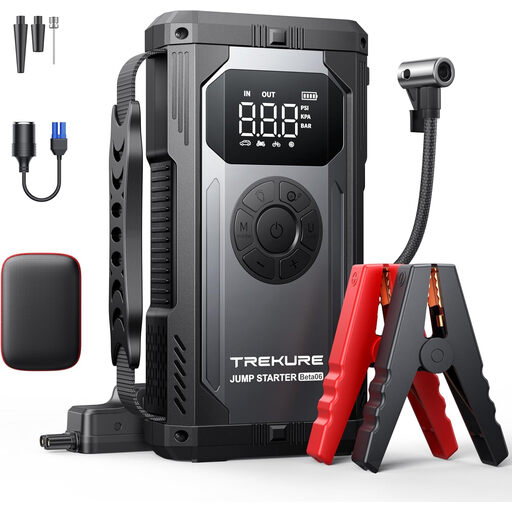
Why we recommend it: Built for power. Compatible with large engines (up to 10.0L gasoline and diesel), it's the safe choice for owners of SUVs, 4x4s, utility vehicles, or for high-mileage drivers. Its power reserve provides reassurance, even in the most demanding conditions.
It avoids the trap of being underpowered. By clearly stating its compatibility with large engines, it eliminates the risk of investing in an undersized model that will prove useless when you need it most.
The firepower: high starting power for large engines, a compressor with a generous airflow (advertised 35 L/min) for rapid inflation, and a high-capacity battery (23800 mAh).
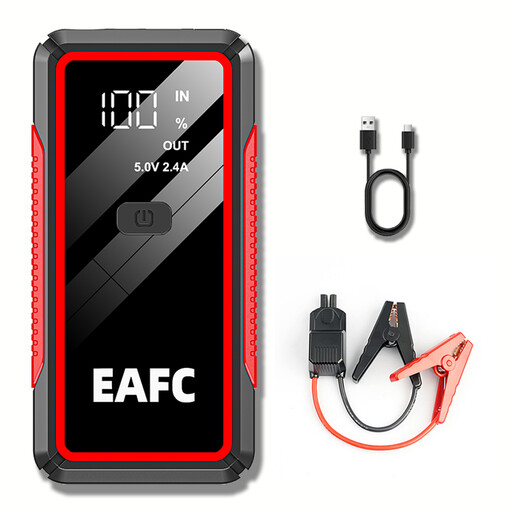
Why we recommend it: If your only worry is a dead battery and you're on a tighter budget (or you already own a compressor), this model is a smart choice. It gets straight to the point—the jump-starting function—without sacrificing performance.
By focusing on its primary mission, it avoids the pitfall of a low-quality "gimmick" compressor. The result: a powerful and reliable jump-starting solution at a more affordable price.
Efficiency above all. A dedicated jump-starting solution that's compact but tough (compatible with 6.0L gasoline / 4.0L diesel), and doesn't forget the useful power bank and LED light functions.
The light function on these jump starters is a real safety bonus. Discover our complete selection of emergency lights, all chosen according to strict criteria to ensure you're never left in the dark.
What is the lifespan of a jump starter with an air compressor? The lifespan mainly depends on the quality of its internal battery and its maintenance. A good model can handle several hundred charge cycles. To keep it in top shape, remember to recharge it every 3 to 6 months, even if you don't use it, and store it away from extreme temperatures.
How do I use a portable car starter safely? Thanks to modern safety features, using one is very simple and risk-free. The key steps are:
Can I leave the jump starter in my car during winter or summer? Yes, but with some precautions. Most models can withstand a wide temperature range (e.g., from -20°C to +60°C / -4°F to 140°F). However, permanently leaving the jump starter in a car that turns into an oven in the summer or a freezer in the winter will inevitably degrade its battery faster. The ideal solution is to store it at home and take it with you before you hit the road.