
Livraison le jour même ou le lendemain

Qualité garantie

Débloquez vos offres de bienvenue: Livraison GRATUITE | Jusqu'à -80 % | 30 jours d'essai gratuits à JoyPlus
Téléchargez l'application
The turn of a key in a dead ignition, a dashboard that stays stubbornly dark, the frustrating silence of an engine that refuses to start… A dead battery is every driver's nightmare, especially when every minute counts. Fortunately, the days of bulky jumper cables and searching for a good Samaritan are long gone. The battery booster, also known as a portable jump starter, has become an indispensable ally.
Compact, powerful, and often multifunctional, this device gives you back your freedom when the unexpected happens. But with an overwhelming number of options on the market, how do you find the right one? This guide is here to break down the essential criteria and present a selection of the best models to help you make an informed choice.
Before making your choice, here are a few key points to check to find the jump starter perfectly suited to your needs.
This is THE number one criterion. Expressed in amps (A), the peak power determines the booster's ability to bring your engine back to life. A small petrol engine won't have the same requirements as a large diesel one.
Modern boosters are much more than simple starters; they are true power multi-tools. Assess which features will be genuinely useful to you:
A good jump starter must be simple and safe to handle. Check for essential safety features: reverse polarity, short-circuit, overload, and overheat protection. An LCD screen displaying the charge level and device status is a significant plus for intuitive, risk-free use.
We have selected three models that stand out from the crowd, each meeting a specific need.
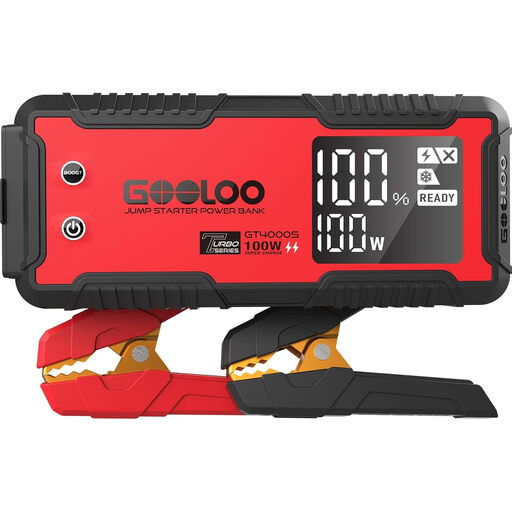
Why it stands out: Its main advantage is its 100W two-way fast-charging technology. According to the manufacturer, it fully recharges in just 1 hour and 12 minutes, and a mere 5 minutes of charging is enough to perform an emergency jump-start. Its peak power of 4000 A makes it capable of starting almost any 12V vehicle on the market.
Key Features:
Who is it for? This model is particularly suited for owners of large vehicles (SUVs, 4x4s, RVs, boats) and professionals who need a reliable and ultra-fast starting solution. It's also an excellent choice for those who refuse to wait hours for their device to recharge.
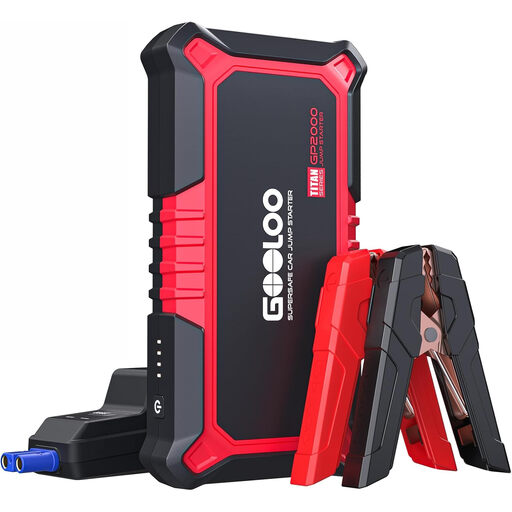
Why it stands out: The GP2000 offers an excellent balance of performance, portability, and price. With a peak current of 2000 A, it meets the needs of most car and motorcycle owners. Its feather-light weight (around 540 g) and small size allow it to be easily stored in a glove box.
Key Features:
Who is it for? Ideal for the everyday driver who owns a car, a mid-size SUV, or a motorcycle. It's the perfect backup solution for those looking for an effective, simple, and discreet device that gets straight to the point.
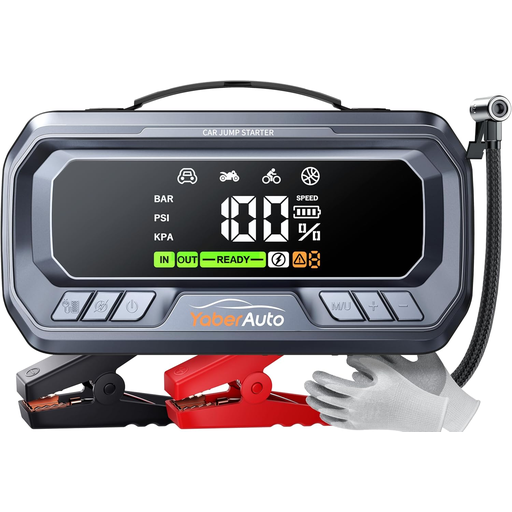
Why it stands out: The YaberAuto YA90 is a true survival kit. Beyond its impressive 6500 A starting power, it integrates a booster with a 160 PSI compressor to reinflate a flat tyre. Its large 3.3-inch LCD screen and PD 65W fast charging make it a complete technological ally.
Key Features:
Who is it for? This model is for the forward-thinking driver who wants a single device to handle multiple types of breakdowns (battery and tyres). It's perfect for tech enthusiasts, high-mileage drivers, and those who demand the most comprehensive emergency equipment possible.
Our selection covers a range of needs, but the jump starter market is vast. Every vehicle and every driver has specific requirements.
To discover a wider range of starters and find the model that precisely matches your vehicle and budget, explore our full category: Battery Jump Starters.
1. Can you use a battery booster on a diesel engine? Yes, absolutely, provided you choose a diesel battery booster with sufficient peak amperage. Diesel engines require more power to start, especially in cold weather. It is therefore essential to check the booster's compatibility with your engine's size, as indicated by the manufacturer.
2. How long does a battery booster hold its charge? Most modern lithium-battery boosters have very low self-discharge. Some manufacturers, like GOOLOO, claim a standby time of up to 24 months. However, it is recommended to check your device's charge level every 3 to 6 months and recharge it if necessary, to ensure it's ready when you need it most.
3. Can a battery booster damage my car's electronics? When used correctly, modern battery boosters are very safe. They are equipped with multiple protection systems (against reverse polarity, short circuits, overvoltage, etc.) that protect your vehicle's sensitive electronics. The golden rule: always read the user manual and follow the safety instructions for a risk-free jump-start.