
Livraison le jour même ou le lendemain

Qualité garantie

Débloquez vos offres de bienvenue: Livraison GRATUITE | Jusqu'à -80 % | 30 jours d'essai gratuits à JoyPlus
Téléchargez l'application
By the Joybuy Team, Your Product ExpertsUpdated August 27, 2026
A dead battery: every driver's nightmare. That sinister little click from the ignition, followed by dead silence, has a way of turning a normal day into a real headache. This is precisely where a jump starter becomes your greatest ally. But be warned: the market is flooded with models making often-misleading marketing claims. To help you see things more clearly, we've decoded the common traps to avoid before you buy.
The Peak Amps Mirage: Don't be blinded by the astronomical figures (3000?A, 4000?A...) advertised by manufacturers. This peak amperage only corresponds to a maximum discharge over a fraction of a second. The only metric that truly matters is the starting amperage (or Cranking Amps)—the real, continuous power delivered to start the engine. A high peak number is no guarantee of an effective start, especially on a freezing morning.
Overstated Engine Compatibility: Be wary of a compact booster that claims it can start "all gas engines up to 9.0?L and diesel up to 8.0?L." Diesel engines, which are more demanding, require significantly more starting torque. Such an appealing promise often hides a harsh disappointment on the first cold snap with a large engine.
Poor-Quality "Swiss Army Knife" Features: A jump starter that also works as an air compressor, flashlight, and power bank is tempting. The problem? If the primary function, jump-starting, is underpowered, the extra gadgets will be little consolation. A compressor that takes forever to inflate a tire or a power bank that dies after a single smartphone charge isn't worth the investment.
To make the right choice, forget the marketing jargon and focus on the few technical specs that make all the difference in performance and reliability.
First step: know your vehicle's engine size.
The internal battery's capacity (in mAh) determines how many start attempts are possible before the booster needs recharging. Between 10,000 and 20,000?mAh offers a good balance for typical use.
A good jump starter must include an arsenal of safety features to prevent any mishaps. Make sure it has at least the following protections:
Sturdy clamps, sufficiently long cables, and a readable screen are also tell-tale signs of quality that will make your life easier.
If you fall for a multi-function model, check that the extra options are actually useful.
Here are a few models that caught our eye, each suited to a specific user profile and meeting our standards for performance and reliability.
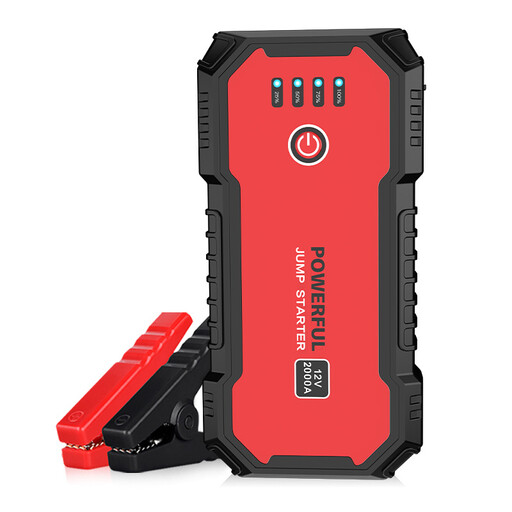
Why it's a great choice: Perfect for drivers of city cars or compact gas sedans. Its small footprint allows it to be slipped into the glove box: a discreet backup solution, always within reach.
It doesn't promise to start a semi-truck. Its 1500 A peak power is consistent for light vehicles and focuses on the essentials, without the marketing hype.
Excellent balance of size, power, and price. The power bank function with QC3.0 fast charging is a real bonus for everyday devices.

Why it's a great choice: Designed for large vehicles (SUVs, RVs, vans) and adventure enthusiasts. Its high starting power combined with an air compressor makes it a versatile tool for the road and the great outdoors.
It avoids the useless-gadget trap. The integrated compressor is powerful (150 PSI) with preset modes and auto-shutoff, making it a genuinely useful secondary function, not just a marketing ploy.
Combines two essential emergency tools into one robust device. Its compatibility with large engines (up to 9.0 L gas / 8.0 L diesel) is a major asset.

Why it's a great choice: For those with large-displacement vehicles (especially diesel) or who want maximum power reserve. Its ability to start engines up to 10.0 L diesel makes it a top-tier choice for the harshest conditions.
It justifies its high power rating with credible engine compatibility and robust, all-metal clamps designed to handle intense current. It doesn't just display a number; it provides the means to use it.
Colossal starting power, suitable for extreme conditions and large engines. The "BOOST" function forces a start on very weak batteries, where other units would give up.
Discover our full selection of products that meet our quality criteria and current safety standards.
The lifespan of a jump starter depends on its technology (most often lithium-ion) and its maintenance. On average, a quality device remains effective for 3 to 5 years. Most models can handle several hundred charge/discharge cycles.
Absolutely. It's crucial. Lithium batteries slowly lose their charge over time (this is called self-discharge). To ensure your booster is ready to go when you need it, remember to check its charge and fully recharge it every 3 to 6 months. Letting it completely drain over a long period can irreversibly damage its battery.
No, a quality jump starter used correctly poses no risk. Modern models integrate multiple protections (against polarity reversal, sparks, over-voltage...) that protect your vehicle's sensitive electronics. The key is to choose a device equipped with these safety features and to follow the instructions carefully. Using a low-end model without these protections is much riskier.