
Livraison le jour même ou le lendemain

Qualité garantie

Débloquez vos offres de bienvenue: Livraison GRATUITE | Jusqu'à -80 % | 30 jours d'essai gratuits à JoyPlus
Téléchargez l'application
A click, then silence. It's the soundtrack to a dead battery—the dread of every driver and the promise of a ruined day. A portable jump starter seems like the obvious solution to get back on the road without calling for roadside assistance. The problem is, the market is flooded with models making tempting promises, and it's easy to fall into a trap.
Before you pull out your credit card, it's crucial to learn how to spot the bad deals disguised as good ones. Here are the most common pitfalls that could turn your purchase into a useless paperweight when you need it most?:
To avoid these disappointments, it's better to rely on objective technical specs than on marketing hype.
Choosing a reliable car starter isn't just about comparing numbers on a product sheet. You need to understand what's behind them to ensure true peace of mind.
A jump starter's power is based on two key values?:
For a petrol city car, a booster capable of delivering 300 to 500?A of starting current is generally sufficient. However, for a diesel jump starter or a large-engine vehicle (SUV, utility vehicle), it's wiser to aim for models offering 800?A or more of starting current for an effective jump-start, especially in the dead of winter.
Capacity, expressed in milliampere-hours (mAh), determines the number of starts possible on a single charge, as well as the device's runtime as a power bank for recharging your devices (smartphone, tablet).
But the internal battery technology is even more crucial, as it dictates its durability and reliability?:
Modern jump starters are often transforming into Swiss Army knives. Here's how to separate the useful from the useless?:
Rather than an endless list, we've selected models that cater to specific user profiles, based on the reliability and performance criteria we've just discussed.
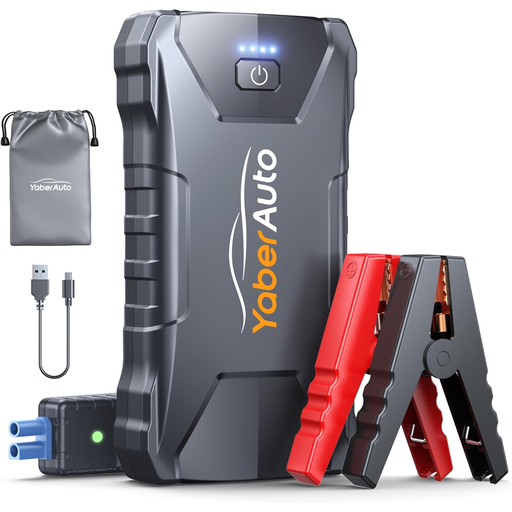
Why it stands out : Perfect for drivers of city cars and sedans looking for a simple and effective backup solution. Its ultra-compact design allows it to slip into the glove box without taking up space, while still delivering the necessary power for most petrol and small diesel engines.
This model gets straight to the point: starting your car and charging your smartphone. It avoids the "all-in-one gadget" trap by offering reliable, well-designed functions without the frills.
Its extreme compactness (barely 340 g) and its smart clamps equipped with 10 safety protections, ensuring maximum safety even for complete novices.

Why it stands out : Built for owners of SUVs, minivans, motorhomes, or vehicles with large diesel engines (up to 8.0L). Its high starting power and digital compressor make it the perfect road trip companion for long journeys, family holidays, or outdoor adventures.
It avoids the "fragile gadget" trap by integrating a high-performance air compressor (150 PSI) with preset modes and automatic shut-off. This isn't an afterthought; it's a genuinely reliable tool for tyre maintenance.
A true all-in-one solution that combines colossal starting power (4500 A peak) with an effective digital compressor, all in a rugged casing with a highly readable LCD screen.

Why it stands out : For those who want to make absolutely no compromises on long-term safety and reliability. Its sodium-ion battery technology allows it to be stored in the vehicle year-round, whether it's freezing at -40 °C or the cabin turns into an oven, without degradation or risk.
It completely solves the "phantom battery" problem. Thanks to near-zero self-discharge (up to 5 years of standby time, according to the manufacturer) and extreme temperature resistance, it's designed to be ready at a moment's notice, even after years of being forgotten.
Its sodium-ion battery technology offers an exceptional lifespan and unparalleled safety (over 6000 cycles, no fire risk). It's the ultimate peace-of-mind investment.
We've put together a complete selection of products that meet our strict selection criteria and current safety standards.
It all depends on its battery technology. A standard lithium-ion model will gradually lose its charge, so it's advisable to recharge it every 3 to 6 months to ensure it's effective. In contrast, newer sodium-ion models have such a low self-discharge rate that they can hold their charge for several years, which greatly simplifies maintenance.
This is a critical question. Conventional lithium-ion batteries do not like extremes: they can be damaged or lose performance if exposed to very low (below -10?°C) or very high (above 45?°C) temperatures. If you live in a region with harsh winters or scorching summers, it is imperative to choose a model designed to withstand these conditions, such as those equipped with sodium-ion batteries.
Diesel engines are more demanding to start due to their higher compression ratio. As a general rule?: