
Livraison le jour même ou le lendemain

Qualité garantie

Débloquez vos offres de bienvenue: Livraison GRATUITE | Jusqu'à -80 % | 30 jours d'essai gratuits à JoyPlus
Téléchargez l'application
A dead battery. It's every driver's nightmare, especially when you're in a hurry or stranded far from help. The jump starter has become an indispensable tool, making traditional jumper cables a relic of the past. The problem is, the market is flooded with models that often make wildly exaggerated claims.
As our editorial team's product expert, my mission is to help you navigate this jungle. After poring over dozens of technical specifications and user reviews, we've identified the 3?common pitfalls that lead to a purchase you'll deeply regret.
To avoid these disappointments, focus on the technical specifications that truly matter. They will determine whether a portable car starter is suited for your needs.
This is THE non-negotiable criterion. Forget Peak Amps. Look for the Cranking Amps (sometimes listed as "Starting Current") and, most importantly, trust the manufacturer's stated engine compatibility (in litres of displacement).
A modern, compact lithium jump starter can easily deliver this power.
A good emergency starter must be foolproof when it comes to safety. Make sure it includes these essential protections:
As for the clamps, they must be solid, with strong-gripping jaws and cables of a sufficient gauge to handle the high current without melting.
If you opt for a multi-function model, make sure the extras aren't just gimmicks.
Rather than an endless list, we've selected products that meet specific needs, all while avoiding the pitfalls we've just discussed.
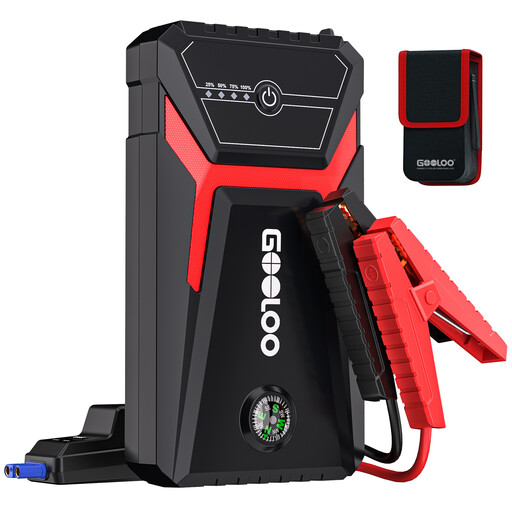
Who is it for? For the driver of a city car, a compact gasoline vehicle, or a small diesel who wants a reliable, simple, and no-frills emergency solution.
No inflated marketing numbers. Its 1500A power is perfectly calibrated for the most common engines (up to 6.0L gasoline / 4.0L diesel), so you don't pay for superfluous power.
The perfect balance of compact size, useful power, and an affordable price. All this, complete with the 10 essential safety protections.

Who is it for? Essential for owners of large SUVs, vans, RVs, or large-displacement diesel vehicles. Its massive power reserve ensures a flawless start, even in extreme cold.
Here, the power is real and capable of starting the most demanding engines (up to 10.0L diesel). Its "BOOST" mode can force a start on a completely dead battery, a vital feature for large vehicles.
Absolute peace of mind, regardless of the vehicle. Its massive, all-metal clamps are built to last and withstand repeated use.

Who is it for? For families, road-trippers, and anyone who wants a single device to handle any roadside emergency. It combines an ultra-powerful jump starter with a genuinely effective digital air compressor.
Unlike disappointing "all-in-one" gadgets, its 150 PSI compressor is truly effective on a car tire, and its 4500A of power isn't afraid of large engines (up to 9.0L gasoline / 8.0L diesel).
A true 5-in-1 power station: jump starter, compressor, power bank, and a powerful flashlight. Its large LCD screen makes operation intuitive.
Explore our full selection of products that meet our strictest quality and safety criteria.
A quality lithium jump starter is designed to last for several years (between 500 and 1000 charge cycles). Its maintenance is simple but vital: to preserve the battery, fully charge it every 3 to 6 months, even if you don't use it. Most importantly, never leave it completely discharged for an extended period.
It all depends on the engine's displacement. A 1500A model may be sufficient for a small diesel engine (up to about 4.0L). However, for 2.0L and larger diesels, which are very common in sedans and SUVs, a 2000A model (or higher) provides an essential safety margin, especially in winter when batteries are weaker. When in doubt, always follow the manufacturer's recommendations.
Yes, but with a few precautions. Most models can withstand extreme temperatures (often from -20°C to +60°C). However, leaving your jump starter in a scorching hot car in the summer or in extreme cold in the winter will eventually degrade its battery. Ideally, you should store it at room temperature and only put it in your car when you might need it, such as before a long trip.