
Livraison le jour même ou le lendemain

Qualité garantie

Débloquez vos offres de bienvenue: Livraison GRATUITE | Jusqu'à -80 % | 30 jours d'essai gratuits à JoyPlus
Téléchargez l'application
A flat battery or a deflated tyre at the wrong moment can turn a routine trip into a major headache. The jump starter with a compressor is the all-in-one solution for handling these unexpected events. However, with an overwhelming number of options and spec sheets filled with impressive numbers, it's easy to make the wrong choice.
As the Head of Product Recommendations at Joybuy, my role is to help you cut through the noise and make the right choice. Let's forget the marketing jargon and focus on what really matters. Here are the 3 most common pitfalls to avoid and the essential criteria for selecting a reliable device.
To avoid falling into these traps, focus on these three key parameters during your selection.
Rather than focusing solely on peak amps, check the device's explicit compatibility. Reputable spec sheets always mention the maximum supported engine displacement, distinguishing between petrol and diesel engines (e.g., "up to 9.0L petrol / 8.0L diesel"). A high-performance petrol and diesel jump starter must be able to supply sufficient starting current, even when the vehicle's battery is very low. This is what separates a simple gadget from a true portable car starter.
A good integrated electric tyre inflator must be both powerful and practical. Here's what to check for?:
The battery is the heart of your device. Its technology determines its reliability, lifespan, and safety.
To help you make an informed decision, here are a few models that cater to different user profiles, based on the objective criteria we've just discussed.

Why it's the right choice : Ideal for drivers of sedans, SUVs, and city cars looking for a versatile and balanced device. It offers ample power for most vehicles on the road, without an overkill of unnecessary features.
Instead of relying on an abstract number, it makes its capabilities clear : compatible with up to 9.0L petrol and 8.0L diesel engines. Its digital compressor with auto-stop makes it a real tool, not just a gimmick.
Smart Compressor : 5 preset modes and auto-stop for stress-free inflation. Maximum Safety : 10 levels of protection, including against reverse polarity and sparks.
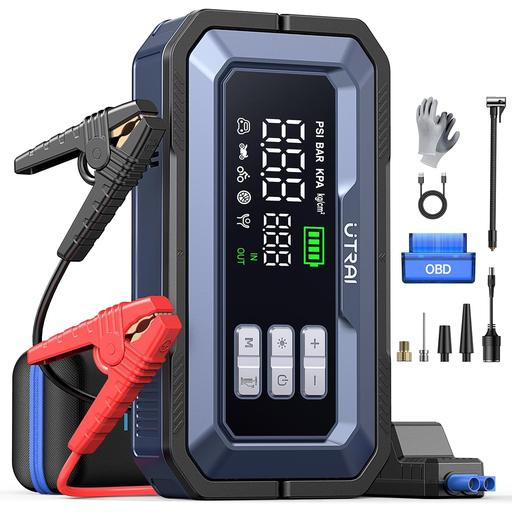
Why it's the right choice : Built for owners of RVs, large SUVs, vans, or diesel utility vehicles. Its colossal power and advanced features make it a comprehensive roadside tool for the most demanding engines.
The advertised compatibility for diesel engines up to 14L is a testament to its real-world performance. It doesn't just boast a peak current figure but translates it into tangible capability for heavy-duty vehicles.
160W DC Output : Allows you to power 12V appliances (cool box, vacuum cleaner). 2000-Lumen Work Light : Powerful, adjustable lighting for nighttime repairs. OBD2 Fault Code Reader : A bonus feature for diagnosing engine problems.

Why it's the right choice : For those who want a maintenance-free, "ready-to-go" device. Ideal if you're worried about forgetting to recharge your jump starter or leaving it in a car exposed to extreme temperatures.
It directly tackles the self-discharge pitfall. Its sodium-ion battery promises a negligible self-discharge rate (~1% per month), allowing it to remain operational for years, unlike conventional lithium batteries.
Sodium-Ion Technology : Record-breaking thermal stability (-40 °C to 80 °C) and enhanced safety. Longevity : The manufacturer claims up to 6000 charge cycles, a lifespan far superior to lithium batteries.
Our editorial team has tested and selected other models that meet our criteria for reliability and safety.
This mainly depends on your engine's displacement and type. A diesel engine requires more starting power than a petrol engine of the same size. Instead of aiming for the highest amp rating, rely on the jump starter manufacturer's recommendations, which clearly state the maximum compatible engine displacement (e.g., "for petrol engines up to 8.0L and diesel up to 6.5L"). For a city car or a compact sedan, a mid-range model is often more than sufficient.
Yes, most models are designed for this, but it's crucial to check their operating temperature range, which is usually specified by the manufacturer (e.g., from -20?°C to 60?°C). Leaving the device in a vehicle exposed to extreme temperatures outside this range can damage the battery and reduce its lifespan. Models with more stable technologies, like sodium-ion batteries, offer much better resistance to temperature fluctuations.
Inflation time varies depending on the tyre size, its initial pressure, and the compressor's air flow rate. A high-performance compressor can typically inflate a standard car tyre (e.g., from 25 to 36 PSI, or about 1.7 to 2.5 Bar) in 3 to 5 minutes. For larger tyres (SUV, 4x4), the time will be longer. Be wary of entry-level models that will take forever (over 10 minutes) and risk overheating before even reaching the target pressure.