
Livraison le jour même ou le lendemain

Qualité garantie

Débloquez vos offres de bienvenue: Livraison GRATUITE | Jusqu'à -80 % | 30 jours d'essai gratuits à JoyPlus
Téléchargez l'application
By our Joybuy Product Experts – Published on August 27, 2026
That dreaded silence when you turn the key, a dashboard that remains stubbornly dark… It's every driver's nightmare: a dead battery. The jump starter, also known as a portable starter, has become the essential accessory to get you back on the road without waiting for a tow truck. But in a saturated market filled with misleading marketing claims, it's hard to know what to choose. To avoid buyer's remorse, here are the pitfalls to watch out for.
Here are the 3 most common mistakes that make a purchase useless?:
To ensure your jump starter is a reliable ally and not just dead weight in the trunk, focus on these three essential criteria.
Forget peak amps. The only value that truly matters is the cranking amps (often listed as starting current or cranking amps). This is the power the booster can deliver continuously for several seconds to turn the starter motor.
Expressed in milliampere-hours (mAh) or watt-hours (Wh), the capacity determines your booster's autonomy. It dictates the number of possible starts on a single charge, as well as its effectiveness as a power bank for your smartphones and tablets.
Check that the technical specifications clearly state the compatible engine displacements. A mention like "For petrol engines up to 8.0L and diesel up to 6.0L" is a much more reliable indicator of quality than a simple mAh capacity figure.
Safety first: a good emergency starter must be foolproof. Verify that it includes essential protections: reverse polarity, overload, overheat, and short-circuit protection. Sturdy, well-insulated clamps are also an excellent indicator of quality.
In terms of features, a built-in air compressor is a real plus for inflating a tyre anywhere. Likewise, a powerful LED light with multiple modes (torch, strobe, SOS) will quickly prove indispensable during a breakdown at night.
We've scrutinised dozens of models to select only those that meet these criteria. Here is our selection, tailored for every need.
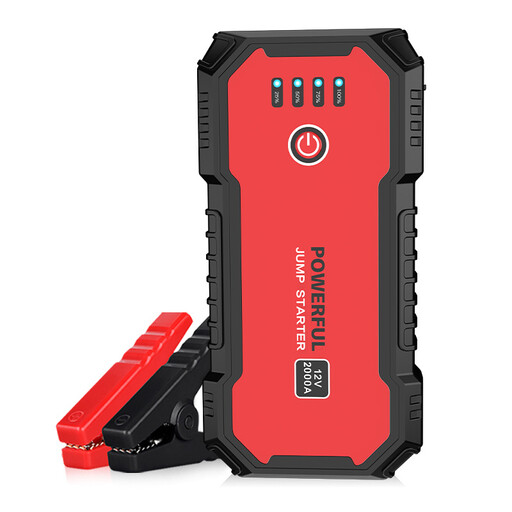
Profile : Ideal for drivers of city cars and compact saloons, whether petrol or small diesel. Its compact size allows it to be stored in the glove box, and its QC3.0 fast-charging function is a real plus for charging a smartphone in an emergency.
This model gets straight to the point. It focuses on its primary mission: providing a reliable starting current for everyday vehicles, without making you pay for superfluous gadgets.
Compact and lightweight (430 g) : Stores anywhere and is effortless to handle. 18W QC3.0 Fast Charging : An effective power bank when you need it.
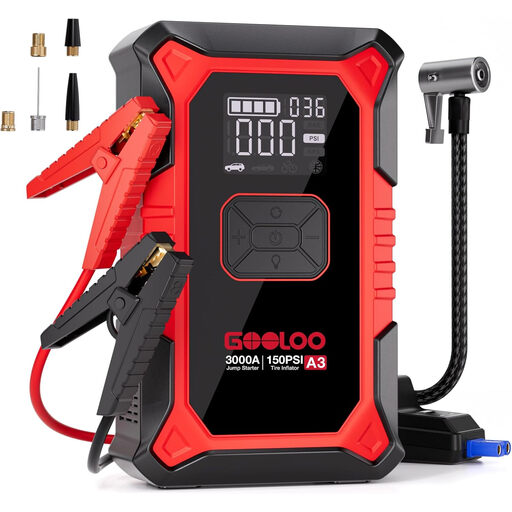
Profile : Perfect for families, campers, and SUV owners. It combines high starting power (up to 9.0L petrol / 6.5L diesel) with a genuinely effective 150 PSI digital air compressor for car tyres, bike tyres, or air mattresses.
Unlike cheap "all-in-one" gadgets, its compressor is powerful (35L/min) and features preset modes with automatic shut-off. It's a true multi-purpose tool, not just a marketing gimmick.
True 7-in-1 multi-tool : Starter, compressor, power bank, light, pump, and pressure gauge. High Power : 3000A peak, compatible with the vast majority of vehicles.

Profile : Built for demanding users: owners of large diesel engines (up to 10.0L), utility vehicles, motorhomes, or boats. Its 4000A peak power and massive all-metal clamps ensure a flawless start, even in the harshest conditions.
It directly tackles the incompatibility trap. Where more modest models fail, its power is calibrated for the most torque-hungry diesel engines. Absolute peace of mind.
Raw Power : Capable of starting all petrol engines and diesel engines up to 10.0L. Reliability and Robustness : 100% metal clamps and a reinforced casing for unbeatable durability.
We have compiled a complete selection of jump starters that meet our quality criteria and European safety standards.
Modern lithium-ion models have very low self-discharge. They can retain over 80% of their capacity for 6 to 12 months without issue. As a precaution, we still recommend checking and topping up the charge every 3 to 4 months to ensure it's ready when you need it.
Yes, but with some precautions. Most boosters are designed for a temperature range of -20°C to +60°C (-4°F to +140°F). However, extremes (a car in direct sunlight, intense frost) can reduce the battery's lifespan in the long term. It's best to keep it in the glove box or trunk, shielded from thermal shock.
No, provided you choose a quality device. Good jump starters integrate smart safety features that make any damage impossible. Their reverse polarity, short-circuit, and over-voltage protection systems block any mishandling that could blow a fuse or damage the car's computer (ECU). This is an essential selection criterion.