
Livraison le jour même ou le lendemain

Qualité garantie

Débloquez vos offres de bienvenue: Livraison GRATUITE | Jusqu'à -80 % | 30 jours d'essai gratuits à JoyPlus
Téléchargez l'application
A dead battery: every driver's worst nightmare. That sinister little click when you turn the key, followed by dead silence... a hassle we'd all rather avoid, especially in the dead of winter or before a crucial appointment. The jump starter, also known as a portable car starter, is the lifesaving accessory that gets you back on the road in minutes, without having to rely on the kindness of another driver.
However, the market is flooded with often-misleading marketing claims. Before you invest, it's essential to know how to decipher spec sheets so you don't end up with a device that's ineffective or, worse, dangerous.
To make the right choice, focus on the technical specifications that truly make a difference. Here are the three points to check scrupulously.
Don't be fooled by peak current. The starting current is THE key metric that determines the booster's ability to bring your engine back to life.
Choosing a 12V booster that is properly sized for your engine ensures an effective start, even in the middle of winter when batteries struggle the most.
Expressed in mAh, the capacity determines the number of jump-starts possible on a single charge, but more importantly, its versatility as a power bank.
Also, remember to check for fast-charging USB ports (like QC 3.0) if you plan to use your portable car battery charger to power up your gadgets.
This is one area where you should make no compromises. A good portable starter always comes with so-called "smart" clamps, which are packed with safety features. The most important ones are:
These safeguards make the process simple and completely safe, even for a total novice in mechanics.
Rather than an endless list, here are jump starters that cater to specific use cases.
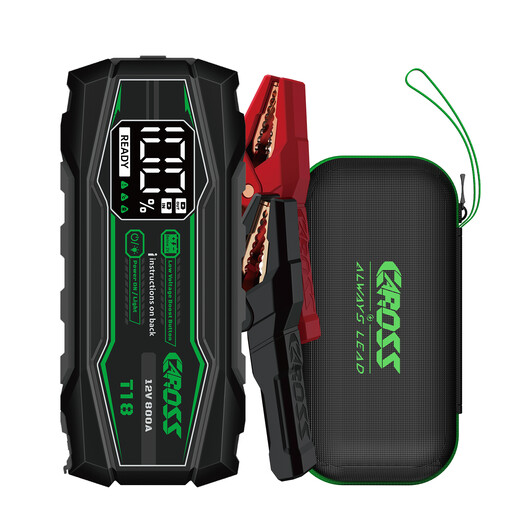
Why we chose it: The perfect solution for drivers of city cars or petrol saloons who want a simple, effective device. Compact enough to slip into the glove box, it delivers just the right amount of power for common breakdowns without being weighed down by unnecessary gadgets.
No inflated marketing numbers here. Its 800 A output is calibrated for petrol engines up to 6.0L. The LCD screen, which confirms a proper clamp connection, is a real bonus for safety.
Its pocket-sized form factor, carrying case, and comprehensive protections (reverse polarity, anti-spark) make it an ideal travel companion. The Boost function is a great asset for completely dead batteries.
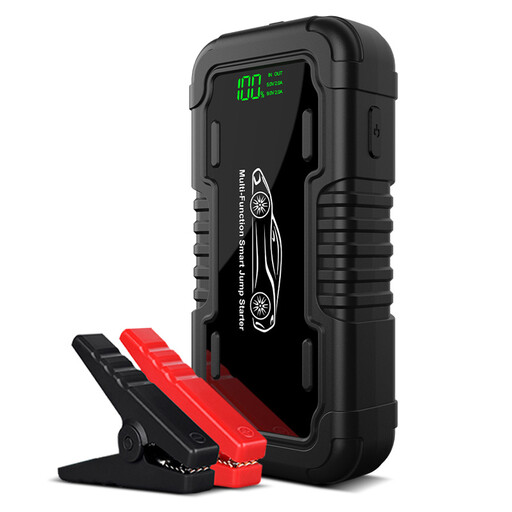
Why we chose it: The ideal travel companion for families and high-mileage drivers. Its generous 20,000 mAh capacity and QC 3.0 ports allow it to not only jump-start the car but also rapidly charge the whole family's smartphones and tablets.
Here, the 20,000 mAh isn't just a number on the box: it provides real-world endurance as a power bank, which justifies its size. The LCD screen is handy for knowing exactly how much charge is left.
A true Swiss Army knife: powerful enough to start large engines (2000A peak) and highly effective for charging portable devices thanks to its 18W QC 3.0 fast-charging output.
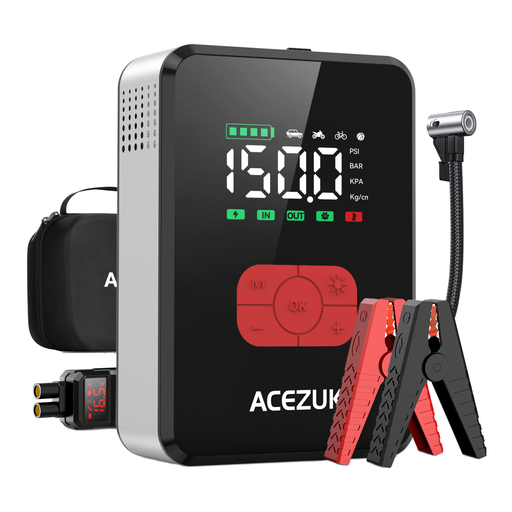
Why we chose it: Now we're entering the heavyweight category. With its serious firepower, it's built for large SUVs, vans, and diesel engines up to 12.0L. The integrated 150 PSI air compressor is far more than a gimmick: it's a real asset for topping up tyre pressure or inflating a camping mattress.
The advertised power is no bluff: it's necessary for its target of large vehicles. Its real strength is being an excellent 2-in-1, combining an ultra-powerful starter with a genuinely usable digital compressor.
The ultimate combo: colossal starting power and a 150 PSI compressor with a pressure gauge and auto-stop. The smart clamps with their own dedicated screen are the icing on the cake.
Explore our full selection of jump starters that meet our quality criteria and current safety standards.
It all depends on your engine's displacement and fuel type. As a general rule:
A conventional lithium-ion booster naturally loses its charge (a phenomenon called self-discharge) at a rate of about 5% to 10% per month. Remember to recharge it every 3 to 6 months so it's always ready to use. It's worth noting that new battery technologies (sodium-ion, etc.) promise much lower self-discharge rates (around 1% per month) for maximum peace of mind.
Yes, these devices are designed for that. You just need to respect the operating temperature range specified by the manufacturer (often between -20°C and +60°C). In short: avoid leaving it baking in the sun on your dashboard in August. The glove box or the boot are its preferred spots.