
Livraison le jour même ou le lendemain

Qualité garantie

Débloquez vos offres de bienvenue: Livraison GRATUITE | Jusqu'à -80 % | 30 jours d'essai gratuits à JoyPlus
Téléchargez l'application
By the Joybuy Team, our product experts | Updated August 27, 2026
It's an all-too-common, unfortunate scenario: you turn the ignition key only to hear a faint "click-click-click". A dead battery is one of the most common and frustrating problems a driver can face. Fortunately, a modern battery booster, also known as a portable car jump starter, can get you back on the road in minutes, without needing another vehicle or a tow truck.
The problem is, the market is flooded with models making tempting promises that often fall short. To help you make a truly informed choice, our editorial team has broken down the spec sheets and identified the pitfalls to avoid before you buy.
Ending up with an ineffective device at the worst possible moment is the last thing anyone wants. Here are the three most common pitfalls to watch out for:
To ensure you choose a reliable device, focus on these three fundamental aspects.
This is the number one criterion. The power must be perfectly matched to the engine size (in litres) and type of your vehicle.
A good booster must include an intelligent safety module. Check that it has at least the following protections:
Sturdy clamps, preferably all-metal, and cables of sufficient gauge are also a sign of durability and safety.
Many models also serve as a power bank with USB ports to charge smartphones and tablets. Some even include a jump starter with an air compressor to reinflate a flat tyre. These features are a welcome bonus, as long as they don't come at the expense of the booster's primary mission: starting your vehicle. Check that the battery capacity (in mAh) is sufficient to support these multiple uses.
Based on these criteria, we have reviewed several models to offer you a selection suited to different needs and budgets.
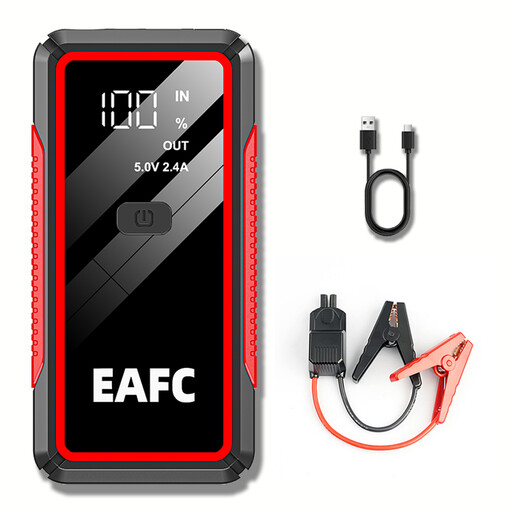
Why we chose it: Ideal for drivers of small to medium-sized petrol vehicles looking for a reliable and affordable backup solution. Its compact design allows it to be easily stored in the glove box, always within reach for emergencies.
It avoids the pitfall of exaggerated promises. Its 2000A power is clearly positioned for petrol engines up to 6.0L and small diesels, offering honest performance for its segment without making misleading claims of universality.
Excellent power-to-price ratio. Smart clamps with integrated safety protections. Power bank function and LED light included.

Why we chose it: Designed for owners of SUVs, vans, motorhomes, and vehicles with large diesel engines. Its high power output ensures reliable starts even in difficult conditions, making it a trusted ally for professionals and frequent travellers.
It directly addresses the "universal compatibility" pitfall by delivering 4000A of power, capable of starting diesel engines up to 10.0L. Where less powerful models fail, this one delivers on its promise.
Very high starting power. Robust all-metal clamps for increased durability. "Boost" function for deeply discharged batteries.

Why we chose it: This is the all-in-one solution for those going on road trips, camping, or who simply want to be prepared for anything. It combines a powerful jump starter with a digital air compressor, a power bank, and a flashlight.
It avoids the "multifunction gadget" pitfall by integrating high-performance components for each function. The 4500A booster is extremely powerful, and the 150 PSI (approx. 10 bar) compressor is genuinely functional, rather than being low-quality marketing add-ons.
The driver's Swiss Army knife: jump starter with compressor. Very high starting power (4500A). Digital screen for pressure monitoring.
We have put together a complete selection of products that meet our quality criteria and European safety standards.
The required power depends directly on your engine. For a mid-size petrol car (under 3.0L), 1000A to 1500A is often enough. For larger petrol engines or small diesels, aim for 1500A to 2500A. For large diesel SUVs and vans, a diesel battery booster of 2500A or more guarantees peace of mind. Always refer to the manufacturer's recommendations for your vehicle's engine size.
Most modern lithium boosters are designed to operate within a wide temperature range (e.g., from -20°C to +60°C). However, extreme heat in direct sunlight or intense frost can affect the battery's performance and lifespan. It is advisable to store it in the glove box or boot to protect it from the harshest conditions. Always check the operating temperature range specified by the manufacturer.
A quality portable car starter can last for several years. To maintain its internal battery's health, it is crucial to recharge it every 3 to 6 months, even if it's not being used. This prevents a deep discharge that could permanently damage it. Storing it at around 50% to 75% charge is often ideal for preserving its longevity.