
Livraison le jour même ou le lendemain

Qualité garantie

Débloquez vos offres de bienvenue: Livraison GRATUITE | Jusqu'à -80 % | 30 jours d'essai gratuits à JoyPlus
Téléchargez l'application
A dead battery: every driver's nightmare. Whether it's a freezing winter morning or the return from vacation after a long park at the airport, the dreaded click from the ignition followed by dead silence is a guaranteed source of stress and delays. The jump starter has emerged as the modern, compact solution to never experience this ordeal again. The problem: the market is flooded with marketing promises and often misleading spec sheets.
As a Product Expert at Joybuy, my mission is to help you cut through the noise. Together, we'll break down the traps to avoid and the criteria that truly matter, so you can make an informed choice without falling for marketing hype.
With aggressive marketing, it's hard to separate the wheat from the chaff. Here are the three most common pitfalls.
To sort through the options and avoid making a mistake, focus on these few technical specifications. They are the true measure of the performance and reliability of your future jump starter.
To move from theory to practice, here are a few models that meet different needs, all selected according to the performance and safety criteria we've just discussed.
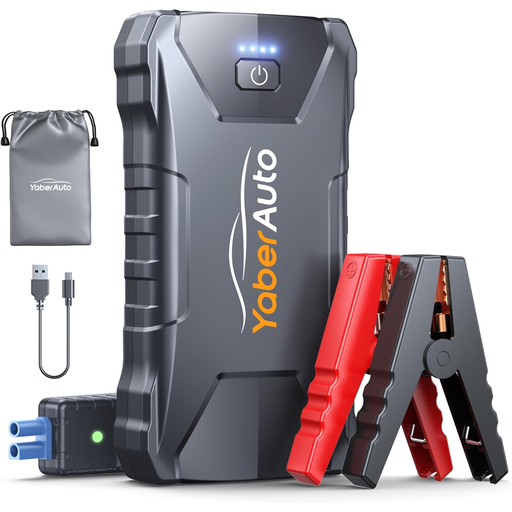
The ideal user: Perfect for drivers of compact cars or sedans. Its feather-light weight (340g) and small size allow it to be slipped into the glove box, while still being tough enough for most medium-sized petrol engines.
This model advertises realistic compatibility (up to 7.0L petrol / 5.5L diesel) and includes 10 safety protections. A far cry from the fanciful promises of some competitors.
Extreme Compactness: One of the smallest and lightest in its class. Safety: Smart clamps with audible and visual alerts for incorrect connections.

The ideal user: Built for large vehicles, this booster delivers a peak current of 4000 A, capable of starting almost all petrol engines and diesels up to 10.0L. The peace-of-mind choice for owners of SUVs, 4x4s, RVs, or vans.
It doesn't just boast a high peak amperage; it backs it up with clear compatibility for large engines. Its "BOOST" mode allows for a forced start on the most stubborn batteries.
High Power: Capable of starting large displacement engines without breaking a sweat. Robust Construction: All-metal clamps and a reinforced shell for enhanced durability.
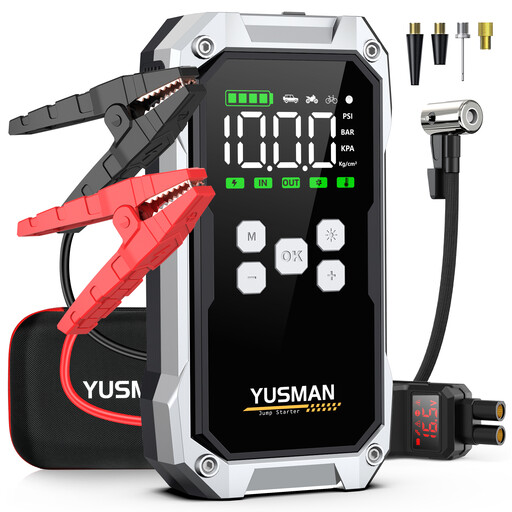
The ideal user: For those who often go away for the weekend, go camping, or want a do-it-all tool. This jump starter with an integrated air compressor (150 PSI) not only starts the car but also re-inflates a tyre, an air mattress, or the kids' ball.
Unlike low-end gadgets, this model combines high starting power (5000 A peak) with a genuinely effective compressor, complete with an LCD screen to monitor pressure in real time.
2-in-1 Versatility: Combines a powerful jump starter and a high-performance air compressor. LCD Screen: Clearly displays battery status and pressure for simple and quick monitoring.
Discover our full selection of jump starters that meet our quality charter and current safety standards.
1. What power (in amps) should I choose for my booster? It all depends on your engine. For a petrol car under 3.0L, a model with 1000 to 1500 A (peak current) is usually enough. For diesel engines or large displacement petrol engines, it's better to opt for a model with at least 2000 A to ensure a smooth start, especially in cold weather.
2. How long does a jump starter hold its charge? Most modern lithium-ion boosters have a very slow self-discharge rate. They can retain over 80% of their charge for 6 to 12 months. We still recommend checking and fully recharging it every 3 to 4 months to ensure it's always ready for use. Some recent models with sodium-ion technology even promise a standby time of several years.
3. Can you leave a jump starter permanently in your car? Yes, most are designed for that. Just check the operating temperature range recommended by the manufacturer (e.g., from -20°C to 60°C). Avoid leaving it in direct sunlight behind the windshield in the middle of summer: extreme heat can prematurely degrade the battery.