
Livraison le jour même ou le lendemain

Qualité garantie

Débloquez vos offres de bienvenue: Livraison GRATUITE | Jusqu'à -80 % | 30 jours d'essai gratuits à JoyPlus
Téléchargez l'application
It's a freezing winter morning. You turn the key in the ignition and... nothing. Just that infuriating clicking sound. A dead battery is the scenario every driver dreads: delays, stress, and the prospect of costly roadside assistance. Faced with this problem, the jump starter, or portable starter, has become the essential accessory for ensuring your self-reliance.
The problem is, the market is flooded with often misleading marketing claims. Some devices, despite impressive spec sheets, prove to be completely ineffective at the critical moment. To avoid buyer's remorse, it's crucial to know how to sidestep the common pitfalls and invest in truly reliable equipment.
The 2 Pitfalls to Avoid When Buying a Jump Starter:
To make an informed choice, you need to focus on objective data rather than marketing claims. Here are the technical criteria that truly matter.
Forget peak amps; that's just marketing. The only number that really counts is the starting current (or cranking amps), measured in amperes (A). It represents the power the jump starter can deliver continuously for several seconds to start your engine.
The capacity, expressed in milliampere-hours (mAh), determines how many starts you can perform before needing to recharge the booster. But that's not all: a generous capacity also turns your starter into a true power bank for your other devices. Most modern models include USB ports to charge a smartphone or tablet, a lifesaving feature on the go or in an emergency. The most versatile ones even integrate a jump starter with an air compressor to reinflate a tyre, or a powerful LED flashlight with different modes (light, strobe, SOS).
This is a non-negotiable criterion. A portable car starter worth its salt must include multiple protections to avoid any risk of damage to your vehicle's electronics (often fragile and expensive) or to the device itself. Make sure the following safety features are present:
Sturdy, well-insulated alligator clips are also a sign of safety and durability.
Rather than an exhaustive list, we have identified models that meet specific user profiles, based on the performance and reliability criteria discussed.
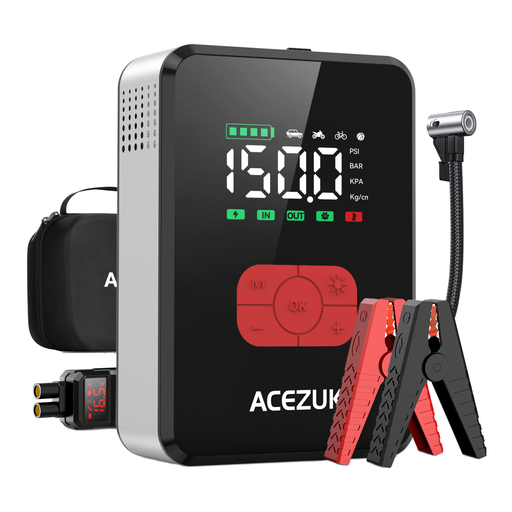
User Profile: Perfect for families and outdoor enthusiasts who want a Swiss Army knife for the road. It combines colossal starting power, compatible with almost any vehicle, and a 150 PSI air compressor to handle car tyres, bikes, or air mattresses.
Its 7000A peak rating isn't just for show: it's backed by a 26,800 mAh battery, ensuring real and sufficient starting power even for very large diesel engines (up to 12.0L). It thus avoids the trap of inflated numbers with no real performance to back them up.
Integrated smart air compressor with automatic shut-off at the desired pressure. Smart clamps with an LCD screen for real-time diagnostics and maximum safety.

User Profile: Designed for owners of SUVs, vans, and diesel vehicles who can't afford to take chances and demand raw power. Its ability to start any petrol engine and diesel engines up to 10.0L makes it a safe bet for larger vehicles.
It includes a "BOOST" button to force-start even completely dead (0-volt) batteries, an essential feature often missing from less capable models, rendering them useless in the most critical situations.
Massive and reliable starting power for large engines. Heavy-duty all-metal clamps and 10 levels of protection for safe and long-lasting use.
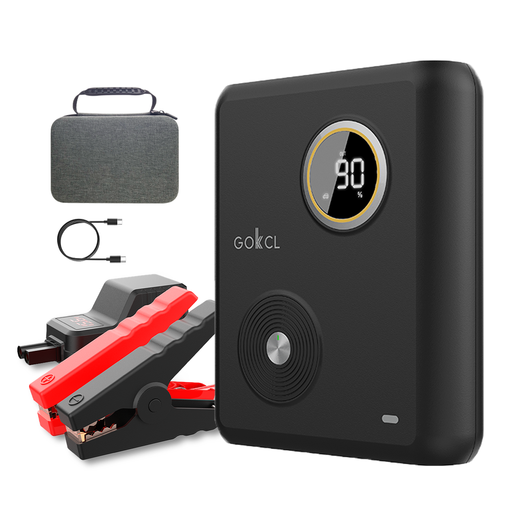
User Profile: The perfect device for those who want to buy it, put it in the trunk, and forget about it. Its sodium-ion battery technology allows it to hold a charge for up to 5 years, eliminating the need for quarterly recharges. It's absolute peace of mind.
It directly tackles the Achilles' heel of conventional jump starters: self-discharge. Unlike lithium batteries, its near-zero self-discharge (~1% per month) ensures it will be operational even after several years in the trunk.
Record-breaking standby time (up to 5 years). Extreme operating temperature range (-40°C to 80°C), making it as reliable in the dead of winter as in a summer heatwave. More stable and safer battery chemistry.
We have compiled a complete selection of jump starters that meet our performance criteria and current safety standards.
A battery charger plugs into a wall outlet to slowly recharge a battery over several hours. It's a maintenance tool, ideal for reviving a weak battery but not for an emergency jump start. The jump starter, conversely, is a portable device that delivers a very intense burst of current to start an engine instantly, with no outlet needed.
Most lithium-ion jump starters require recharging every 3 to 6 months to compensate for their natural self-discharge. Without this, they may not be effective when needed. However, new technologies like sodium-ion batteries are changing the game, with a charge that can be held for several years, reducing maintenance to a bare minimum.
No, provided you use a quality model equipped with the essential safety features. Protections against reverse polarity, short circuits, or power surges are specifically there to protect your vehicle's on-board computer and sensitive electronics. The most important thing is to choose a certified device and always follow the user manual.