
Livraison le jour même ou le lendemain

Qualité garantie

Débloquez vos offres de bienvenue: Livraison GRATUITE | Jusqu'à -80 % | 30 jours d'essai gratuits à JoyPlus
Téléchargez l'application
A dead battery: every driver's nightmare. Whether it's on a freezing winter morning or after simply forgetting to turn off your headlights, being stranded is a situation we all want to avoid. Fortunately, the jump starter has become the essential accessory for getting back on the road in minutes, completely on your own, without needing another vehicle or a tow truck.
The problem? The market is flooded with models making often misleading claims. Between exaggerated power figures and a plethora of gadgets, it's easy to make the wrong choice. As the Head of Product Recommendations at Joybuy, my role is to help you see things more clearly. Here's a breakdown of the pitfalls to avoid and the essential criteria for selecting a reliable car starter that truly fits your needs.
Before you even look at the spec sheet, learn to see through the most common marketing ploys.
To ensure you make the right choice, focus on these three key points that determine your booster's performance and safety.
The required power directly depends on the displacement and type of your vehicle's engine.
This is a non-negotiable point. A quality jump starter must include smart jumper clamps. These integrate multiple protections to prevent damage to the vehicle's battery or the booster itself. Essential protections include:
These safeguards make the process risk-free, even for a complete novice in car mechanics.
Expressed in milliampere-hours (mAh), the internal battery's capacity determines its autonomy. A high value guarantees multiple consecutive starts or full recharges for your portable devices.
If you opt for a multi-function model, check the performance of its features:
To move from theory to practice, here are three models that meet our performance and safety criteria, each tailored to a specific user profile.
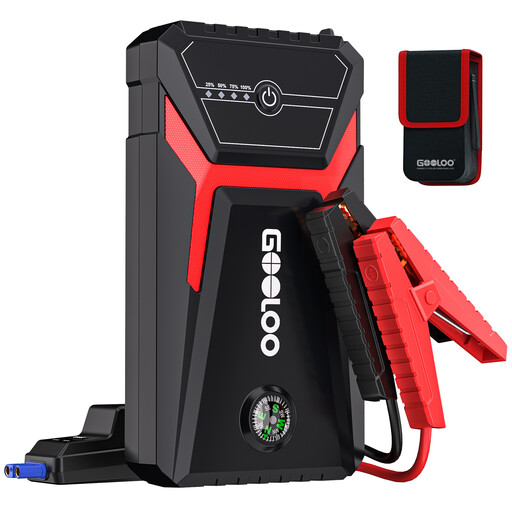
Why we recommend it: Compact, affordable, and packing 1500 A, it's perfect for most gasoline cars and small diesel vehicles. It's the peace of mind you keep in your glove box to handle any unexpected situation without breaking the bank.
It focuses on the essential: its jump-starting function. It delivers reliable performance for its price, without being weighed down by superfluous gadgets that would compromise its quality.
Excellent power-to-price ratio, comprehensive safety protections, ultra-compact design.

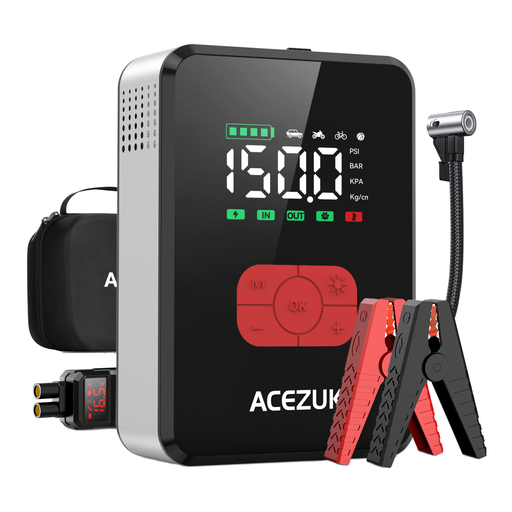
Why we recommend it: The perfect all-in-one solution for families with an SUV, minivan, or diesel vehicle. Its 4500 A of power ensures stress-free starts, while its integrated compressor is a real daily bonus, whether for maintaining tires or for recreational activities (bikes, balls).
Here, the compressor isn't an afterthought. Featuring a digital display and automatic shut-off, it's a precise and genuinely useful tool that fully justifies its multi-function status.
High power (4500 A), efficient 150 PSI digital compressor, complete electronic safety features.
Why we recommend it: With its colossal 7000 A of power, this model is built for the most extreme uses. Capable of starting very large diesel engines (up to 12L), it's aimed at owners of vans, RVs, and even small trucks. It's the ultimate performance choice for those who refuse to compromise.
Its peak power isn't just marketing hype; it's calibrated to meet the real-world needs of the most power-hungry vehicles. Its smart clamps, with their integrated control screen, offer a superior level of safety and control.
Extreme power (7000 A), compatible with all engines up to 12L (gas and diesel), smart clamps with a diagnostic screen.
Discover our full selection of jump starters that meet our quality criteria and current safety standards.
A well-maintained lithium jump starter can last for several years. To maximize its longevity, fully recharge it every 2 to 3 months, even when not in use. Also, avoid storing it in your car during extreme temperatures (heatwaves or deep freezes), which can degrade the battery.
Absolutely not, as long as you choose a model equipped with smart jumper clamps. These feature multiple protections (against reverse polarity, short circuits, over-voltage, etc.) that safeguard your vehicle's sensitive electronics, as well as the booster itself.
Diesel engines are more power-demanding. As a general rule, a jump starter of at least 2500?A is the minimum required for a mid-size diesel. For large SUVs, vans, or RVs, it's safer to opt for a 4000?A model or higher to ensure a flawless start, even in the middle of winter.