
Livraison le jour même ou le lendemain

Qualité garantie

Débloquez vos offres de bienvenue: Livraison GRATUITE | Jusqu'à -80 % | 30 jours d'essai gratuits à JoyPlus
Téléchargez l'application
A dead battery: every driver's nightmare, and one of the most frustrating surprises on the road. That sinister little click when you turn the key, followed by dead silence… It's enough to turn an ordinary day into a real headache. Fortunately, the days of relying on the kindness of another driver and a pair of jumper cables are over. The battery booster, also known as a portable starter or jump starter, has established itself as an essential piece of safety equipment.
Compact, powerful, and often multifunctional, this device allows you to restart your vehicle on your own in just a few minutes, wherever you are. But with an overwhelming number of options on the market, it's hard to know where to start. Our mission: to guide you with clear, practical advice to choose the model that truly fits your needs, without drowning you in marketing jargon.
Before diving into our selection, let's review the essential criteria for making the right choice.
Power is the number one criterion for a jump starter. Expressed in amps (A), it comes down to two key values:
A small gasoline engine obviously doesn't have the same needs as a large diesel one. As a general rule, a jump starter for a diesel engine requires a higher peak current, especially in cold weather when batteries are put to the test. For a motorcycle, a more compact model with a moderate peak current will be more than enough. The concept of a powerful jump starter is therefore relative: it all depends on what's under your hood.
Today, the best jump starters do more than just start cars. Most double as a power bank to charge your electronic devices (smartphones, tablets, etc.) via their USB ports.
Some even integrate a jump starter with an air compressor, an ultra-practical tool for topping up tyre pressure, but also for inflating a camping mattress or a ball. The presence of an LED light with multiple modes (flashlight, strobe, SOS) is a real bonus for nighttime operations or emergencies.
Safety first. Check that the model you choose includes multiple protections: against short circuits, reverse polarity, overcharging, overheating, etc. So-called "smart" clamps, which detect and signal a bad connection, are an almost indispensable safety feature to prevent user error.
The internal battery technology also plays a crucial role in the device's performance and longevity. While lithium-polymer (Li-Po) batteries dominate the market, new technologies like sodium-ion (Na-ion) are emerging. They offer significant advantages in terms of safety, lifespan, and resistance to extreme temperatures.
We have selected three models that stand out, each catering to a specific user profile.
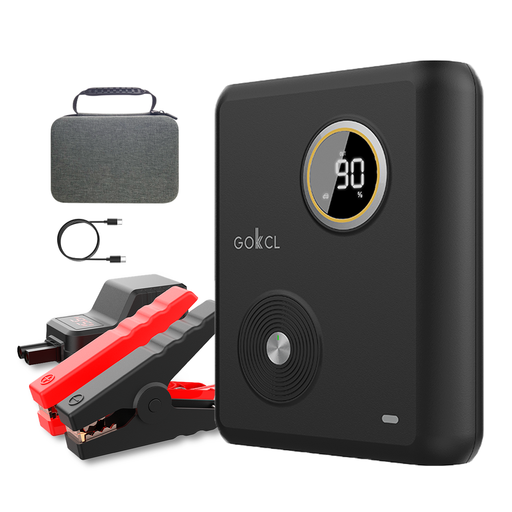
What sets it apart: The GOKKCL GK03 stands out thanks to its internal sodium-ion battery. This technology gives it exceptional stability and durability. Capable of holding a charge for up to 5 years on standby, it's the kind of equipment you can truly forget about in your trunk… until the day it becomes indispensable.
Key Features:
Who is it for? For the forward-thinking driver looking for a "hassle-free," reliable, and maintenance-free solution. Its resistance to extreme temperatures and incredible standby time make it the perfect ally for those who want a device that's always ready, whether they live in the mountains or in very hot regions.
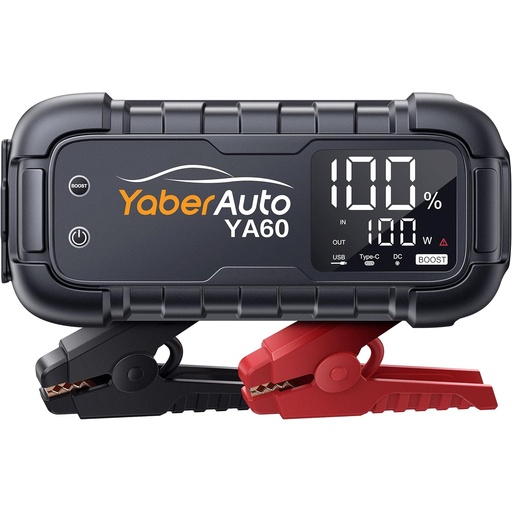
What sets it apart: With its 8000A peak current, the YaberAuto YA60 is a powerhouse built for the most extreme situations. It can start any gasoline engine and diesel engines up to 12.0L, including those in trucks, RVs, and other large SUVs. Its 65W two-way fast charging function is another of its major strengths.
Key Features:
Who is it for? For owners of large vehicles (SUVs, 4x4s, utility vehicles, RVs) and professionals who need a powerful and versatile jump starter. Its ability to recharge quickly and power other devices makes it a perfect companion for the road or the job site.
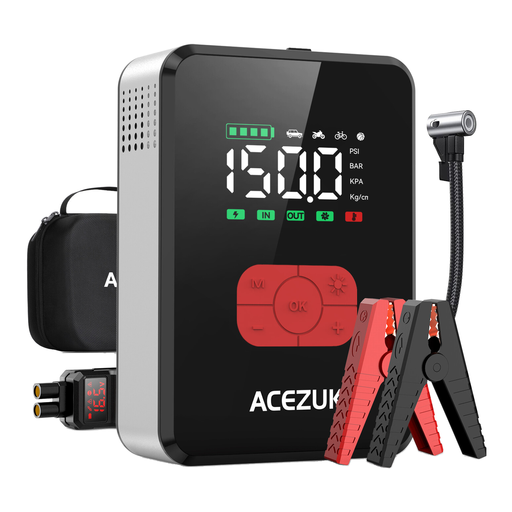
What sets it apart: The ACEZUK M06 is a true Swiss Army knife for the driver. In addition to its colossal starting power, it integrates a jump starter with a 150 PSI digital air compressor. It's the all-in-one solution for handling both dead batteries and flat tyres.
Key Features:
Who is it for? For travellers, campers, and families who want a single tool to handle any eventuality. The integrated compressor saves valuable space in the trunk and provides complete peace of mind on the way to your holiday destination.
Our selection covers the essentials, but every driver has specific needs. If you don't find what you're looking for among these three models, whether in terms of power, features, or budget, other solutions exist.
? Explore our full selection of jump starter bundles to find the right equipment for your needs.
The required power depends directly on your engine size. Here are a few guidelines:
Yes, modern jump starters are designed for this. However, you should check the operating and storage temperature range recommended by the manufacturer. Sodium-ion models, like the GOKKCL GK03, are champions in this category with a tolerance of -40°C to 80°C (-40°F to 176°F), making them perfect for staying in the trunk all year round. For more traditional lithium models, simply avoid leaving them in direct sunlight behind the windshield in the middle of summer.
The procedure can vary slightly between models, but the main steps remain the same:
Golden rule: Always read your device's user manual before using it. It's the best safety measure.