
Livraison le jour même ou le lendemain

Qualité garantie

Débloquez vos offres de bienvenue: Livraison GRATUITE | Jusqu'à -80 % | 30 jours d'essai gratuits à JoyPlus
Téléchargez l'application
A dead battery: every driver's nightmare. On a freezing morning or just after returning from holiday, your car won't start... it's a scenario guaranteed to cause stress and delays. The battery booster, also known as a portable jump starter, has established itself as THE ultimate emergency solution. The problem? The market is flooded with confusing marketing promises and misleading technical specs. To help you see clearly and make the right choice, here are the pitfalls to avoid and the essential criteria to check before you buy.
Navigating the jungle of options is a real headache. Many models boast impressive specs on paper that fail to deliver once you pop the hood. Here are the red flags you should never ignore.
To ensure you buy a reliable device that's right for your vehicle, focus on these key technical points.
Rather than a long, drawn-out list, we've matched proven models to typical user profiles, based on our criteria for reliability and relevance.
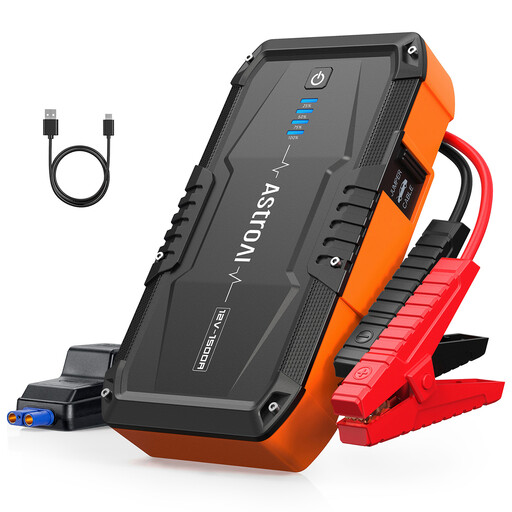
Who is it for? For drivers of city cars and compact saloons (up to 6.0L petrol, 3.0L diesel) who want a simple, reliable "just-in-case" solution that's compact enough to keep in the glove box.
This model gets straight to the point: starting your car. No useless amp promises, just calibrated power for the majority of light vehicles, with well-made clamps and all the essential safety features.
Compact and lightweight: Stores and handles effortlessly. "BOOST" Mode: An essential override function for very weak or completely dead batteries.
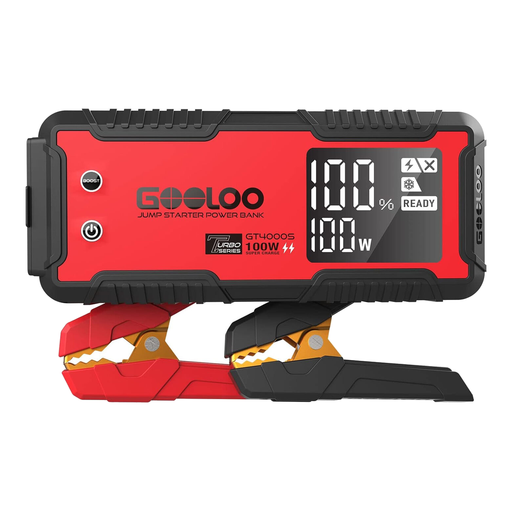
Who is it for? For owners of large vehicles (SUVs, 4x4s, vans up to 10L diesel) and those looking for an ultra-high-performance, all-in-one solution for long journeys, capable of charging a laptop as fast as a wall outlet.
It avoids the misleading capacity trap thanks to its 100W two-way fast charging. In practice, it can charge a laptop at full speed, but more importantly, it recharges itself in record time (around 1 hour 15 minutes).
100W Fast Charging: Charges a laptop via USB-C, a rare and incredibly practical feature for travel. Colossal Power: Starts the largest petrol and diesel engines for absolute peace of mind.
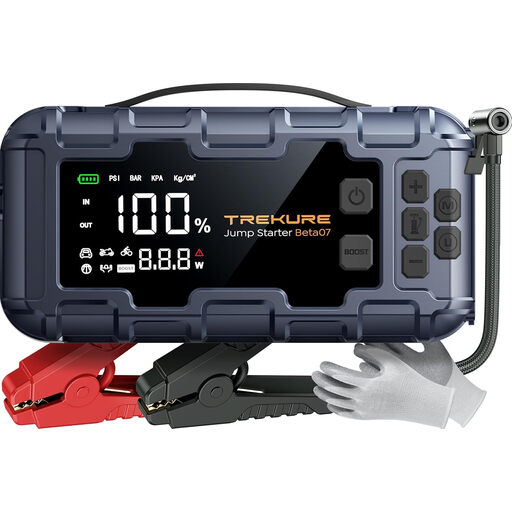
Who is it for? Designed for owners of motorhomes, large 4x4s, and outdoor enthusiasts. It combines massive starting power with a genuinely powerful air compressor for complete off-grid autonomy.
It avoids the "gimmick" trap by integrating an air compressor (160 PSI, 45 L/min) that isn't just for show: it's capable of re-inflating a car tyre in minutes. Its large 3.3-inch screen displays clear and useful information, which is a nice bonus.
The true Swiss Army knife: A super-powerful starter (up to 12L diesel) AND an effective compressor. 45W PD Fast Charging: Recharges quickly and can power other devices on the go.
Discover our full selection of products that meet our selection criteria and current safety standards.
The lifespan of a lithium jump starter is measured in charge cycles (typically between 500 and 1000). But its worst enemy is inactivity and the resulting self-discharge. To preserve its battery, it's crucial to fully recharge it every 3 to 6 months, even if you haven't used it. A well-maintained jump starter can last for many years.
It's strongly discouraged, especially in extreme temperatures. In summer, the temperature inside the cabin can exceed 60?°C and irreversibly damage the lithium battery. In winter, intense cold temporarily reduces its performance and its ability to deliver the necessary current for a jump start. The ideal solution is to store it at room temperature and only put it in your car when you need it.
No, they are two distinct and complementary tools. The battery jump starter provides a very intense, brief burst of current to start the engine: it's an instant emergency solution. A car battery charger, on the other hand, is designed to slowly and safely recharge a flat battery, or to maintain its charge during long periods of inactivity (winter storage). After a jump start, it's advisable to drive for at least 30 minutes to allow the alternator to recharge the battery. If the battery is old or weak, using a dedicated charger afterwards is highly recommended to properly restore it.