
Livraison le jour même ou le lendemain

Qualité garantie

Débloquez vos offres de bienvenue: Livraison GRATUITE | Jusqu'à -80 % | 30 jours d'essai gratuits à JoyPlus
Téléchargez l'application
A dead battery: every driver's nightmare. Whether it's on a freezing winter morning or after returning from holiday, being unable to start your car is always a source of stress and hassle. In these situations, the jump starter, also known as a portable starter, has become an essential accessory. The catch: the market is flooded with models making often-misleading marketing claims.
My role, as Head of Product Recommendations at Joybuy, is to guide you through this jungle. To prevent this smart purchase from turning into a costly disappointment, let's review the most common pitfalls.
The 3 Pitfalls to Avoid When Buying a Jump Starter?:
To make the right choice, forget the marketing hype and focus on the technical specifications that truly matter for the performance and reliability of your future portable car battery charger.
This is THE non-negotiable criterion. The required power depends directly on the size and type of your vehicle's engine.
All consumer-grade jump starters are designed for 12V systems, the standard for virtually all passenger vehicles.
The clamps, often called "smart clamps," are the direct link to your battery, so their quality is paramount. Clamps worth their salt must include a series of protections to avoid damaging your car's onboard electronics or the starter itself. Ensure the following safety features are present:
A good set of clamps will alert you with an audible or visual signal in case of an incorrect connection.
A multifunction jump starter can be an excellent investment, but only on one condition: its secondary functions must be genuinely high-performing, not just gimmicks.
To help you choose, we've selected several models that cater to different needs while meeting our strict criteria for performance and safety.
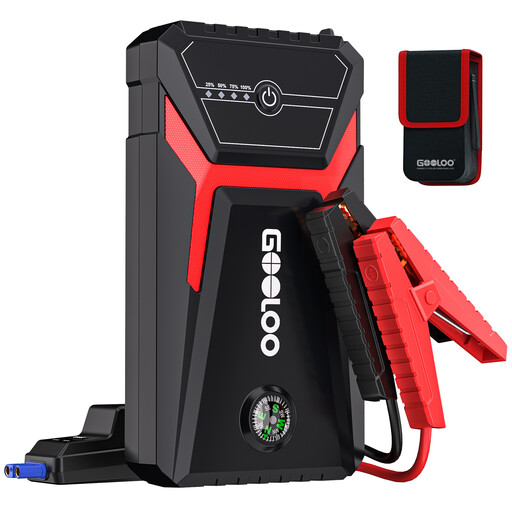
Why it stands out : Perfect for drivers of city cars and petrol sedans looking for a reliable and affordable backup solution. Its compact size allows it to slip into the glove box, so it's always within reach.
It gets straight to the point : jump-starting. No superfluous gadgets, just 1500A of peak power, which is more than enough for most vehicles (up to 6.0L petrol engines). It thus avoids the trap of ineffective "Swiss army knife" models.
It includes 10 levels of protection and USB ports to serve as a backup power bank. An excellent performance-to-price ratio.

Why it stands out : Designed for large engines (SUVs, vans, diesel jump starters) and frequent travellers who need serious firepower and rock-solid versatility.
Here, the power is no bluff. This 4500A starter delivers a real and massive starting current, capable of reviving engines up to 9.0L petrol / 8.0L diesel. Its compressor is a genuine tool, not a gimmick.
Its very high starting power and its built-in 150 PSI digital car jump starter with air compressor (with auto-shutoff). The LCD screen makes it very intuitive to use.
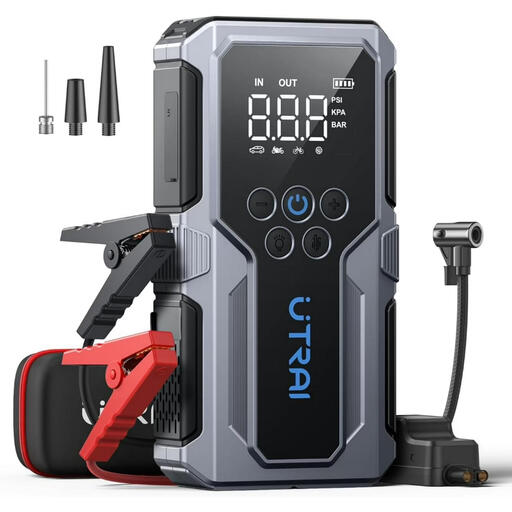
Why it stands out : Designed for those seeking a single tool for the car and for leisure activities (camping, mountain biking, DIY). Its high-performance compressor is just as comfortable inflating an air mattress as it is a car tyre.
It strikes the right balance. This multifunction jump starter doesn't compromise on the essentials : its 3000A starting power is solid, and the 150 PSI compressor with an LCD screen is a real bonus, a far cry from the anemic compressors found on low-end models.
The perfect balance of good starting power, an effective air compressor, and a power bank function equipped with fast-charging ports.
We have selected a full range of products that meet our criteria for performance and safety.
A lithium jump starter has an average lifespan of 3 to 5 years, or several hundred charge cycles. To maximise its longevity, remember to recharge it every 3 to 6 months, even if you haven't used it. Avoid complete discharge and store it in a cool, dry place, away from extreme temperatures (that means not leaving it in a hot car in summer!).
No, as long as you choose a quality model equipped with all the necessary protections. Modern jump starters feature smart clamps that prevent short circuits, reverse polarity, and power surges. These safeguards ensure that current is sent only if and when the connection is correct, thereby protecting the car's often-delicate onboard electronics.
The easiest way is to check your vehicle's manual or the information on the battery itself. As a general rule, here are some guidelines: