
Livraison le jour même ou le lendemain

Qualité garantie

Débloquez vos offres de bienvenue: Livraison GRATUITE | Jusqu'à -80 % | 30 jours d'essai gratuits à JoyPlus
Téléchargez l'application
A dead car battery is a frustrating experience, especially when it happens at the worst possible time. The jump starter has become an essential piece of equipment for many drivers, offering a quick and independent jump-starting solution. The problem: the market is flooded with models whose marketing claims are often misleading.
As the Head of Product Selection at Joybuy, my mission is to help you cut through the noise. Here are the most common pitfalls to avoid so you don't invest in a device that will let you down when you need it most.
To make an informed choice, focus on these key technical specifications. They are the true measure of a jump starter's performance and reliability.
Don't be blinded by peak amps (A). Look for the starting current (sometimes called cranking amps or CA). This value measures the power the booster can deliver continuously for several seconds to start the engine.
Capacity, expressed in milliampere-hours (mAh), determines the booster's autonomy: the number of starts it can provide or its ability to recharge your electronic devices. A capacity of 12,000 to 20,000 mAh represents an excellent balance for most uses.
Always cross-reference this information with the engine compatibility stated by the manufacturer (e.g., "for gas engines up to 8.0 L and diesel up to 6.0 L"). This guarantees the device is properly sized for the power your vehicle requires.
A good portable starter must include essential protections to prevent accidents. Check for the following safety features:
Secondary features must be up to par. A USB port with fast charging (QC 3.0 or Power Delivery) is a real bonus, as is a powerful LED light with an SOS mode. If you opt for a model with a compressor, look for a digital pressure gauge and an auto-shutoff function at the desired pressure.
Rather than an endless list, here are three models that cater to specific user profiles, all selected based on our performance and reliability criteria.
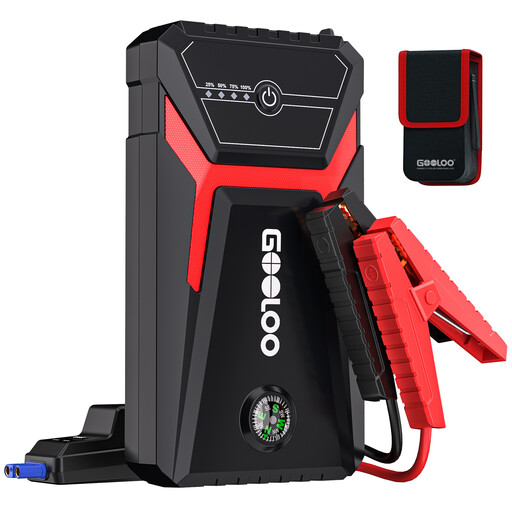
Why it's a great choice: Perfect for drivers of city cars or gas sedans who want a reliable and compact emergency solution. It delivers enough power for the majority of today's cars, without the superfluous gadgets that drive up the price.
This model doesn't rely on inflated peak amp ratings. Its 1500 A are calibrated for gas engines up to 6.0 L and diesel engines up to 4.0 L, covering a wide range of vehicles without false promises.
Compact and lightweight, it slips easily into the glove box. It includes 10 essential safety protections and a power bank function with two USB ports.

Why it's a great choice: Built for owners of SUVs, commercial vans, RVs, or large-displacement diesel vehicles. Its raw power ensures an effective start, even with severely weakened batteries or in extreme cold.
It solves the engine incompatibility problem. Capable of starting any gas engine and diesel engines up to 10.0 L, it offers complete peace of mind for drivers of large vehicles.
Its "BOOST" function allows for a forced start on a nearly dead battery. The all-metal clamps are built to last.
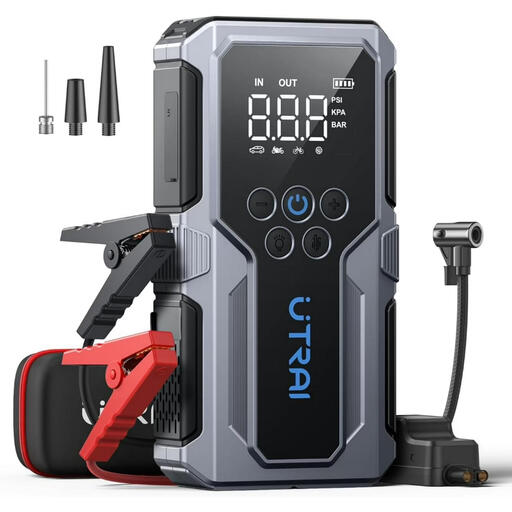
Why it's a great choice: This is the ultimate versatile tool for road trips, camping, or simply having an all-in-one solution in the garage. It combines a powerful starter with a truly functional air compressor.
It avoids the "useless gadget" trap by integrating a 150 PSI digital air compressor with auto-shutoff that is genuinely capable of reinflating a car tire, in addition to its 3000 A jump-starting function.
Its LCD screen clearly displays the battery level and tire pressure. Its fast-charging USB and USB-C ports make it a true portable power station.
We have curated a complete, up-to-date selection of jump starters that meet our selection criteria and safety standards.
Most modern lithium jump starters hold their charge for 3 to 6 months. However, self-discharge rates vary depending on the model and storage temperature. It's advisable to check the charge level and top it up every 3 months to ensure it's ready when you need it.
Yes, many recent models can start a vehicle even if the battery's voltage is very low or zero. Some have a "Boost" or manual override function specifically for this scenario. It bypasses the automatic voltage detection to send current directly. However, it must be used with caution, strictly following the manufacturer's instructions.
No, in fact, it's one of the least reliable metrics when taken in isolation. A powerful jump starter is the result of a balance between a high and sustained starting current, an appropriate battery capacity (mAh), quality battery technology, and effective protection circuits. Instead, rely on the engine compatibility (gas/diesel displacement) stated by the manufacturer: it's a much more tangible indicator of its real-world performance.