
Livraison le jour même ou le lendemain

Qualité garantie

Débloquez vos offres de bienvenue: Livraison GRATUITE | Jusqu'à -80 % | 30 jours d'essai gratuits à JoyPlus
Téléchargez l'application
A dead battery: every driver's nightmare. It's a classic scenario that's as common as it is frustrating. Waiting for a tow truck or a helping hand from another driver isn't always an option. This is precisely where a jump starter becomes your most valuable ally. The problem: the market is flooded with models making tempting promises, but they often prove to be disappointing, or even dangerous.
As the Head of Product Recommendations at Joybuy, my mission is to help you cut through the noise. Here are the pitfalls to avoid and the essential criteria for choosing a reliable portable car starter that will never leave you stranded.
To make the right choice, rely on objective technical specifications rather than marketing hype.
Don't just look at the peak current. The most important thing is to check the manufacturer's recommended compatibility with your engine's displacement (in litres) and fuel type (petrol or diesel).
The capacity, expressed in milliampere-hours (mAh), determines how many starts you can get on a single charge, as well as its runtime as a power bank. A model with at least 10,000 mAh offers a good balance between compactness and performance, also allowing you to recharge your smartphone or tablet in a pinch.
This is a non-negotiable feature. A good car jump starter must be equipped with smart clamps that offer a full suite of protections for risk-free use, even for beginners. Essential safety features include:
Instead of an endless list, we've selected models that meet specific user profiles, based on our criteria for reliability and safety.
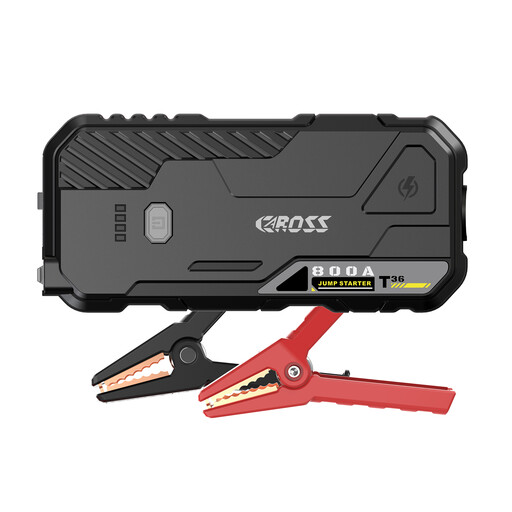
Why we chose it: Perfect for occasional use and for petrol-powered compact cars or sedans. Its compact size lets you slip it into the glove box so it's always on hand for emergencies.
It advertises a realistic 800A output that matches its target vehicles and includes essential protections (anti-spark, reverse polarity) without overpromising.
Its compact design and storage case make it a "ready-to-go" solution that takes up no space. The 18W QC fast-charging function is a real bonus for topping up a smartphone.
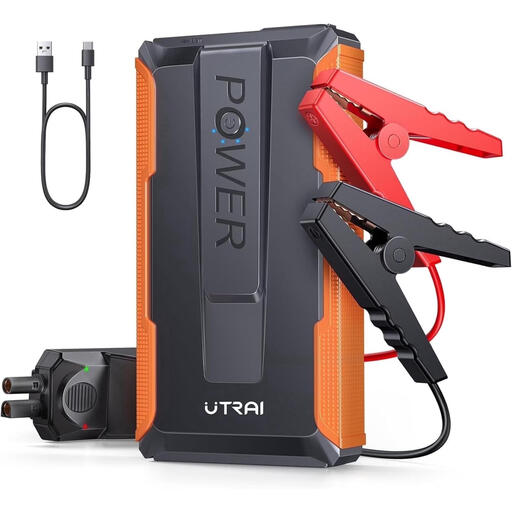
Why we chose it: Built for demanding vehicles, this model delivers 2000A of peak current, capable of starting petrol engines up to 7.5L and diesel engines up to 5.5L, even in the harshest conditions.
Its power is clearly matched to engine displacement, providing a reliable benchmark. Its smart clamps feature an audible alert that warns you immediately of a connection error.
Its rugged build and wide operating range (-20°C to +60°C) make it a reliable tool for those who depend on their vehicle daily, in any weather.
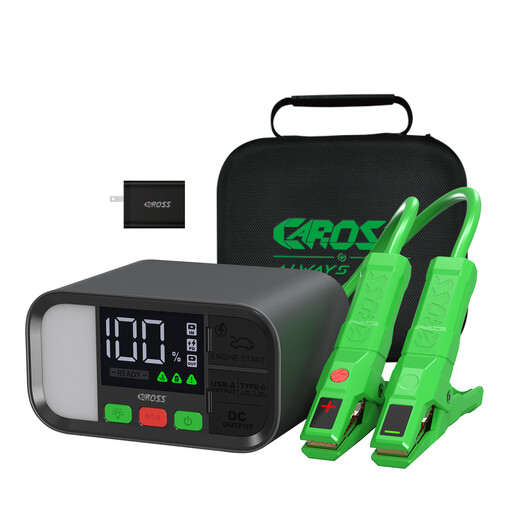
Why we chose it: This is the ultimate multi-tool. It combines ample starting power (1600A) with a high-capacity power bank function, thanks to its 65W PD two-way charging capable of recharging a laptop.
Unlike gimmicky gadgets, its charging function is the real deal: the 65W output is a game-changer. The 3-inch LED screen displays clear, reliable information, leaving no room for guesswork.
The Smart Connect technology with its non-polarised clamps makes connection literally foolproof. The 65W PD two-way charging also allows the jump starter itself to be recharged at top speed.
We have curated a complete, up-to-date selection of products that meet our strict selection criteria and safety standards.
It all depends on your engine. For a standard petrol car, a model between 800A and 1500A is sufficient. For a diesel engine, a large SUV, or a utility vehicle, it's better to aim for a model with at least 1500A to 2000A to ensure an effective start, especially in winter.
A lithium jump starter can last for several years if well-maintained. The good news is that maintenance is very simple:
Yes, most modern jump starters are designed for this scenario. Some models even have a "Boost" or "Override" function for batteries with a very low voltage (below 2V), a situation where a standard starter might not detect the battery. In any case, carefully read your device's manual to understand the exact procedure.