
Livraison le jour même ou le lendemain

Qualité garantie

Débloquez vos offres de bienvenue: Livraison GRATUITE | Jusqu'à -80 % | 30 jours d'essai gratuits à JoyPlus
Téléchargez l'application
By Joybuy, your product selection expertPublished August 26, 2026
It's an all-too-familiar scenario: on a frosty morning, you turn the key in the ignition and... nothing. Just a faint, dry click. Your battery is dead. A jump starter is the modern solution to skip the tow truck, but choosing the right one can be a real headache. The market is saturated with marketing promises that don't always hold up.
Before you decide, let's review the most common pitfalls that can turn a smart purchase into wasted money.
To cut through the noise, let's focus on the features that make a real difference for safely jump-starting a car with a dead battery.
Don't be fooled by the numbers on the packaging. The only true measure is the jump starter's ability to start your engine.
A good jump starter is, above all, a safe one. Modern models include a suite of smart protections that are simply non-negotiable. Insist on protections against:
Robust clamps and sufficiently thick cables are also a sign of both safety and performance.
A modern jump starter is much more than just an emergency tool. It often doubles as a true car power bank. Some of the most useful features include:
Here are a few models that check all the boxes for performance and safety, tailored to different types of users.
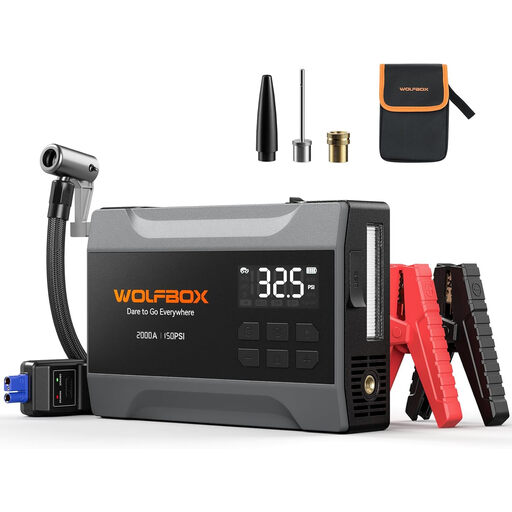
Why we love it: Perfect for those looking for an all-in-one emergency tool. It combines a reliable starter for gas engines up to 5.0L with a 150 PSI air compressor to reinflate a tire, all in a compact design.
Its dual function (jump-starting + inflation) makes the investment worthwhile and keeps it from being forgotten in the trunk. It remains useful for everyday tasks, even when your battery is healthy.
Integrated 150 PSI air compressor. 2000A power suitable for most gas cars.
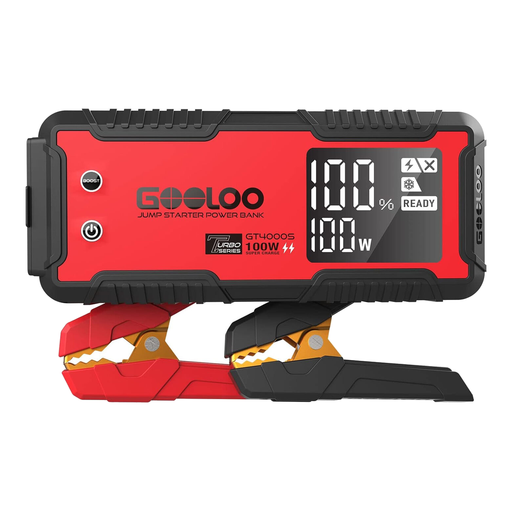
Why we love it: Built for extreme situations. With its 4000 peak amps, this GOOLOO jump starter can start any gas engine and diesel engines up to 10.0L. This makes it perfect for LCVs, RVs, and even boats.
It debunks "marketing amps" by delivering raw, real power sufficient for large engines. Its 100W ultra-fast two-way charging solves the dead-starter problem: 5 minutes of charging is enough for a jump-start.
Peak power of 4000A. 100W fast charging (fully charged in 1.2h). Easy-to-read LED screen.
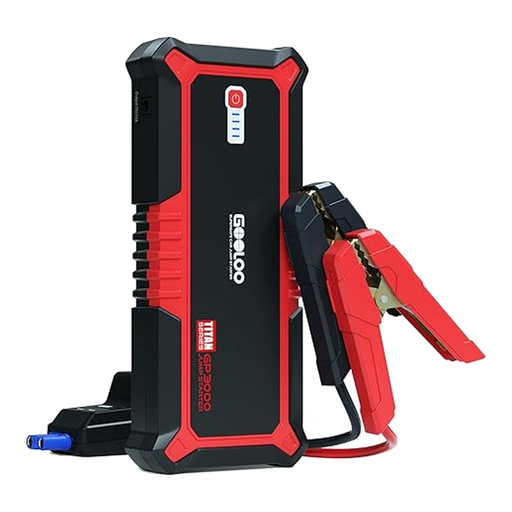
Why we love it: The excellent power-to-price balance for most drivers. Its 3000A is powerful enough for common cars, SUVs, and LCVs (up to 9.0L gas / 7.0L diesel), giving you complete peace of mind.
It tackles the safety trap head-on by integrating 10 levels of protection, including spark-proof clamps and a reverse polarity alert. Its rugged casing is built for real-world use.
10 safety protections. "BOOST" mode for completely dead batteries. Portable car battery charger function with QC 3.0 USB ports.
We have curated a complete, up-to-date selection of jump starters that meet our strict selection criteria and the highest safety standards.
1. What is the lifespan of a jump starter? A quality 12V lithium jump starter is designed to last for several years. Its longevity depends on the frequency of use and how well the charging cycles are managed. Most manufacturers recommend recharging it every 3 to 6 months to preserve the internal battery, even when not in use.
2. Can you leave a jump starter in your car permanently? Yes, but with a few precautions. Good models are designed to withstand extreme temperatures (e.g., from -20°C to 60°C / -4°F to 140°F). However, leaving the device in an overheated car cabin in summer or in extreme cold can reduce its battery's lifespan. Always check the operating temperature range specified by the manufacturer.
3. How do I choose the right power (in amps) for my vehicle? The easiest way is to look at your engine's displacement.