
Livraison le jour même ou le lendemain

Qualité garantie

Débloquez vos offres de bienvenue: Livraison GRATUITE | Jusqu'à -80 % | 30 jours d'essai gratuits à JoyPlus
Téléchargez l'application
A dead battery is every driver's nightmare, especially in the middle of winter or the middle of nowhere. The market is flooded with solutions, but how do you tell the difference between a reliable jump starter and a gadget that will fail you when you need it most? Many devices promise the world, but their real-world performance is often disappointing.
Before you pull out your credit card, it's best to know the pitfalls to avoid. Some manufacturers inflate their peak power ratings, which then prove incapable of starting a diesel engine in freezing temperatures. Others add on secondary features, like an air compressor, that are so ineffective they become useless. Finally, entry-level models often sacrifice essential safety protections, exposing you to risks of short circuits or reverse polarity. This guide is here to help you navigate the options.
To ensure you don't regret your purchase, focus on a few non-negotiable technical specifications. These are what guarantee the real-world performance and safety of your device.
Starting power, measured in amps (A), is THE number one criterion. It's the maximum current the booster can deliver to start your engine.
Capacity, expressed in milliamp-hours (mAh), corresponds to the device's energy reserve. A high capacity (over 20,000 mAh) will allow you to perform multiple jumps before needing to recharge the booster, or to use its power bank function for your electronic devices.
A good jump starter is often a true Swiss Army knife. However, be aware that the quality of these additional features varies enormously.
Never compromise on safety. Smart jump clamps are designed to prevent the most common handling errors. Make sure the model you choose includes at least the following protections:
An integrated screen on the clamps or the unit, which displays real-time status, is a welcome bonus for total peace of mind.
To guide you, we have selected products that meet different needs, based on their technical specifications and their relevance for specific user profiles.
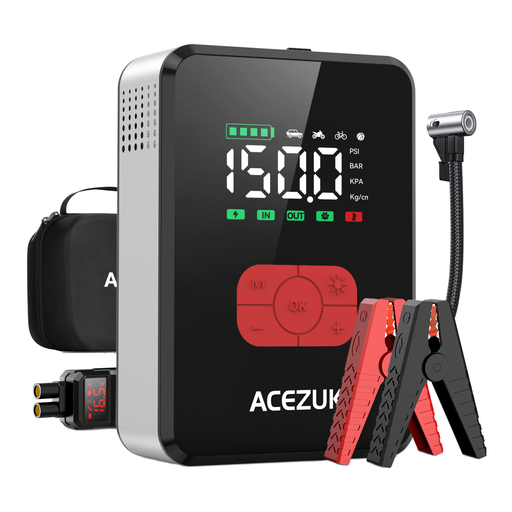
Why we chose it: This is the all-in-one solution to be prepared for any eventuality. Ideal for owners of SUVs, vans, or motorhomes, but also for large families who need a reliable solution for starting their vehicle, inflating tyres, and charging their devices.
Unlike devices with inflated spec sheets, it delivers a true peak power of 7,000 A and a capacity of 26,800 mAh, enough to start large diesel engines up to 12L. Its 150 PSI compressor is functional and precise, not just a gimmick.
High power for all vehicle types; integrated digital air compressor; smart clamps with a screen and comprehensive protections.
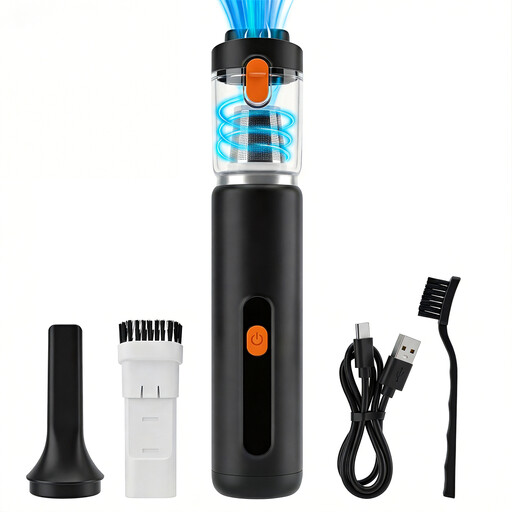
Why we chose it: For the driver who believes a clean cabin is as important as the mechanics. This compact vacuum is the perfect accessory to keep in the glove box for a consistently spotless interior.
It avoids the trap of mini-vacuums with weak suction. Its brushless motor delivers a real 10,000 Pa of power, enough to handle dust, crumbs, and pet hair where entry-level models would give up.
Powerful suction with two modes; ultra-compact design that fits in a cup holder; fast charging via USB-C.
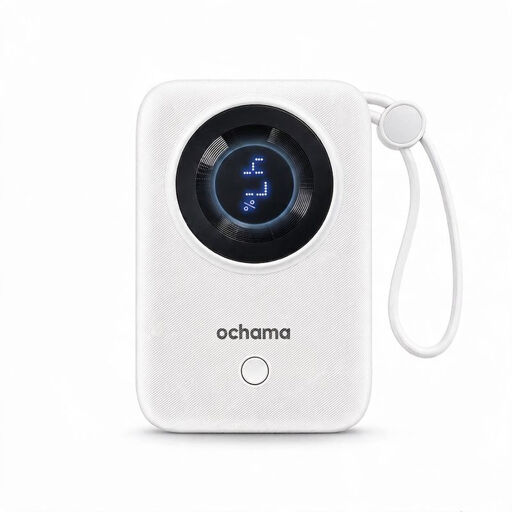
Why we chose it: For those whose smartphone is their main navigation and communication tool. This compact power bank ensures your devices never run out of juice, even if your jump starter's USB port is already in use.
It solves the problem of slow, bulky power banks. With 22.5W fast charging and built-in Lightning and USB-C cables, it's the ultimate portable charging solution, without the clutter of extra cables.
Intelligent fast charging; built-in cables for universal compatibility; battery level monitoring screen.
We have compiled a complete and up-to-date list of products that meet our strict selection criteria and current safety standards.
The required power depends on the engine's displacement. For a small diesel engine (up to 3L), a 2,000 A booster may be sufficient. For larger engines (vans, 4x4s, up to 7L), it is recommended to choose a model with at least 3,000 A to 4,000 A. For heavy-duty trucks and engines up to 12L, a power of 5,000 A or more is strongly advised, especially if you live in a region with harsh winters.
It is not recommended to leave a jump starter permanently in a car, especially in direct sunlight or freezing conditions. Extreme temperatures can damage its internal lithium-ion battery and reduce its lifespan. It's better to store it in a temperate place and only take it with you on long trips. Remember to recharge it every 3 to 6 months to keep it operational.
The lifespan of a jump starter depends on its build quality, frequency of use, and storage conditions. A high-quality, well-maintained model can last for 3 to 5 years. The key component is its internal battery. To maximise its longevity, avoid complete discharges and recharge it regularly, even when not in use.