
Livraison le jour même ou le lendemain

Qualité garantie

Débloquez vos offres de bienvenue: Livraison GRATUITE | Jusqu'à -80 % | 30 jours d'essai gratuits à JoyPlus
Téléchargez l'application
A dead battery: every driver's nightmare. Waiting for a tow truck or the kindness of a passing driver is nobody's idea of fun. The jump starter, also known as a portable starter or battery booster, has become an essential ally to ensure you're never caught off guard again. The problem: the market is flooded with often misleading marketing claims.
Before you invest, it's best to know the pitfalls to avoid so you don't end up with a useless device when you need it most.
To make an informed choice, focus on the objective data that guarantees the performance and safety of your jump starter.
It's crucial to distinguish between two values:
For the same engine size, a diesel engine requires significantly more starting power than a petrol engine. Make sure the diesel jump starter you're considering is compatible with your vehicle's engine. If the cranking amperage is insufficient, your battery starter will be completely useless.
Forget mAh! Watt-hours (Wh) are the most reliable unit of measurement for comparing the actual stored energy. This value is normally indicated on the device or its spec sheet.
The battery technology is another decisive factor:
A jump starter worthy of the name must be equipped with smart clamps featuring multiple protections. These safety features are non-negotiable: they protect the user as well as your vehicle's electronics. Check for the following protections:
An audible or visual signal must alert you in case of an incorrect connection.
We have selected three models that cater to distinct user profiles, based on these reliability criteria.
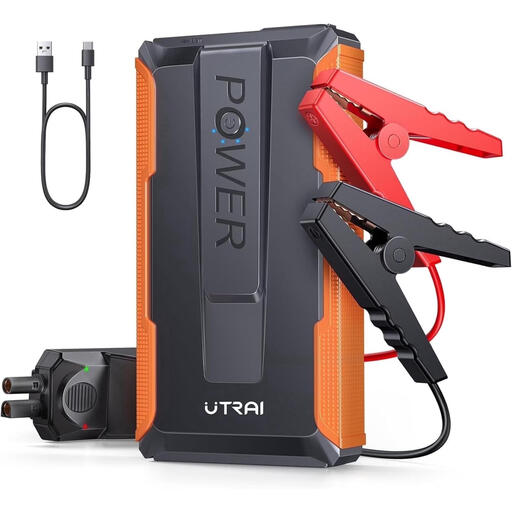
Why we chose it: Ideal for drivers of city cars or compacts (petrol up to 7.5L, diesel up to 5.5L) who want a simple, compact solution to keep in the glove box for emergencies. It gets straight to the point: starting the vehicle and charging a smartphone.
This model doesn't bother with superfluous features. It offers 2000A of peak power, more than enough for most light vehicles, without getting into a numbers war. Its power bank function is a practical and reliable bonus.
Its smart clamps with audible and visual alerts ensure risk-free use. Convenient charging via a standard USB-C port. Robust and compact design.
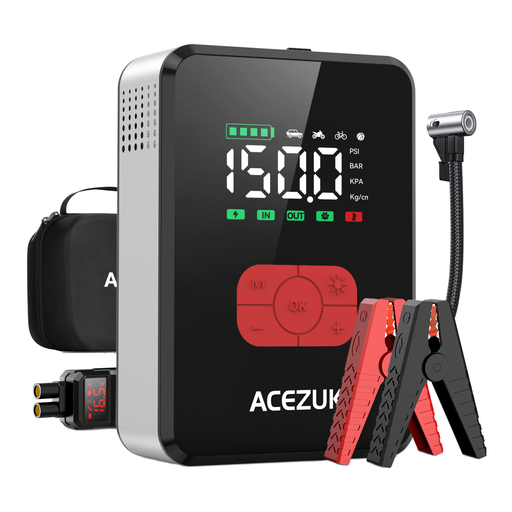
Why we chose it: Perfect for owners of large vehicles (SUVs, vans, diesel engines up to 12L) and outdoor enthusiasts. The combination of very high starting power and a digital air compressor makes it the ideal road trip companion.
Unlike low-end gadgets, this booster with compressor integrates a high-performance inflator with a digital screen, automatic shut-off, and preset modes. Here, the 7000A power is fully justified for very large engines.
150 PSI compressor with a precise display. Compatibility with almost all 12V vehicles. Smart clamps with an integrated screen for real-time monitoring.

Why we chose it: For those who want to make no compromises on long-term safety and reliability. This is the device you can forget in your car for years, through summer and winter, with the certainty that it will work when the day comes.
It tackles the Achilles' heel of lithium boosters: self-discharge and temperature sensitivity. Its sodium-ion technology guarantees a standby time of several years and safe use from -40°C to 80°C (-40°F to 176°F).
Virtually zero self-discharge (ready to use even after years). Superior chemical safety (no fire risk). Exceptional lifespan (over 6000 cycles).
We have curated a complete selection of products that meet our selection criteria and safety standards.
The required power depends on the engine size and type. Here are some guidelines to help you choose:
When in doubt, and especially if you live in a cold region, always opt for a model that is slightly more powerful than you need.
It all depends on its battery technology.
Again, maintenance depends on the technology:
In any case, after jump-starting a vehicle, it is recommended to systematically recharge your device to 100%.