
Livraison le jour même ou le lendemain

Qualité garantie

Débloquez vos offres de bienvenue: Livraison GRATUITE | Jusqu'à -80 % | 30 jours d'essai gratuits à JoyPlus
Téléchargez l'application
A dead battery: every driver's nightmare. That faint click from the ignition, followed by dead silence, has a way of turning a normal day into a real headache. This is precisely where a portable jump starter proves to be your best ally. The problem: the market is flooded with marketing promises and intentionally confusing spec sheets.
As a product expert for Joybuy, my mission is to help you decode this jargon. Before you jump on the first model you see, it's crucial to understand the common traps that turn a good deal into a useless purchase.
Understanding these subtleties is the key to choosing a portable car starter that won't let you down when you need it most.
To make the right choice, forget the marketing hype and focus on these key technical data points. They are what guarantee compatibility with your vehicle and the jump starter's real-world effectiveness.
Forget peak amps. The only value that matters is the starting current (sometimes listed as cranking amps or CA). This is the power the jump starter can deliver continuously for several seconds to turn the starter motor and fire up the engine.
Expressed in milliamp-hours (mAh) or watt-hours (Wh), the capacity determines your jump starter's autonomy: the number of starts possible on a single charge, or the number of full recharges for your smartphone.
A good 12V jump starter does more than just start your car. The best models transform into true toolkits for the road and recreation.
To help you see how these criteria apply in practice, here are a few options tailored to different user profiles.
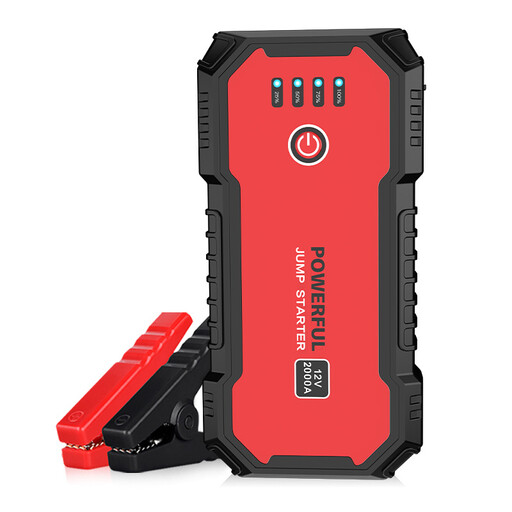
Its profile: Perfect for drivers of city cars and gasoline sedans who want a compact and affordable solution to slip into the glove box. Peace of mind, without the bulk.
Its spec sheet has the merit of distinguishing between the rated capacity (14,000 mAh) and the usable capacity (10,000 mAh)—a rare and appreciated level of transparency. Its 1500A peak is consistent for passenger vehicles, without making false promises.
Ultra-compact and lightweight (430g). It includes a QC3.0 18W output to fast-charge your devices.
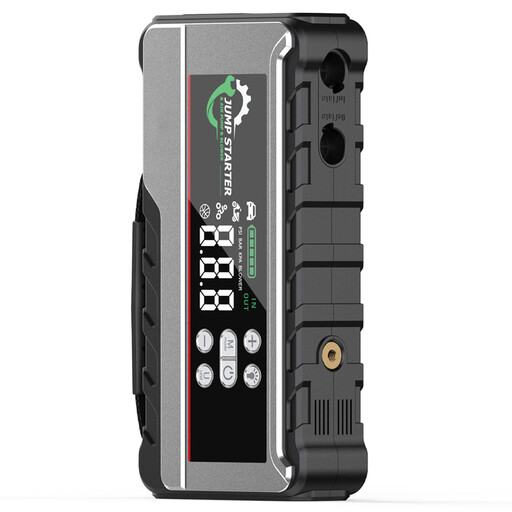
Its profile: For owners of SUVs, vans, or road trip enthusiasts. The combination of a powerful starter and an air compressor makes it the ideal road companion, useful for both the car and recreational activities.
It doesn't just boast a big number for starting power. Its real strength is its versatility: the 150 PSI compressor and blower function are tangible assets that justify its power and size.
A true Swiss Army knife: jump starter, compressor, blower, and a PD 65W power bank powerful enough to charge a laptop.

Its profile: For those seeking "zero-hassle" equipment that is reliable for the very long term and can be left in the car year-round. It's the ultimate peace-of-mind investment.
It tackles the main drawback of lithium batteries: its sodium-ion technology withstands extreme temperatures and holds its charge for years. No more maintenance charging headaches!
Sodium-ion battery technology. Record-breaking temperature range (from -40°C to 80°C) and virtually no self-discharge. Capable of reviving a completely dead battery (0V).
Explore our full selection of products that meet our selection criteria and European safety standards.
A diesel engine requires more starting torque than a gasoline engine, especially in winter. Therefore, you need a jump starter with a higher starting current. For most diesel cars and SUVs, a model providing at least 800 A of starting current is a good baseline. For commercial vans or large diesel engines (over 4.0L), it's better to aim for 1000 A or more for peace of mind.
Its longevity depends on its technology and how you maintain it.
This is a critical safety question. Lithium-ion batteries do not handle extreme temperatures well. Leaving them in a car in direct sunlight (where the cabin can exceed 60°C) or in extreme cold can damage their cells and, in rare cases, pose a risk. Sodium-ion battery models, on the other hand, are designed to withstand a much wider temperature range (typically from -40°C to 80°C), making them ideal for permanent storage in a vehicle. In any case, always check the storage temperatures recommended by the manufacturer.