
Livraison le jour même ou le lendemain

Qualité garantie

Débloquez vos offres de bienvenue: Livraison GRATUITE | Jusqu'à -80 % | 30 jours d'essai gratuits à JoyPlus
Téléchargez l'application
By our Joybuy product experts – Published on August 26, 2026
A dead battery: every driver's nightmare, synonymous with stress and unexpected expenses. To combat this hassle, the jump starter has become the essential accessory to ensure you're never caught off guard. The problem is, the market is flooded with models making often-misleading marketing claims.
To avoid buyer's remorse (or worse, putting yourself in danger), here are the 3?pitfalls you absolutely must avoid:
This guide is here to teach you how to read between the lines of spec sheets and choose the model that TRULY meets your needs.
To find an effective and reliable jump starter, forget the marketing jargon and focus on the few numbers that actually count.
A booster's real power isn't measured in Peak Amps, but in its Starting Amperage (also called Starting or Cranking Amps). This is the stable current, delivered over several seconds, that has the muscle to turn over your engine, especially when the temperature drops.
For a city car or petrol sedan, a booster offering 400A to 600A of starting current is usually sufficient. For a diesel jump starter, an SUV, or a van, aim for a minimum of 800A.
Expressed in milliamp-hours (mAh), the internal battery's capacity determines its energy reserve: how many jump-starts you can attempt, or how many times you can recharge your smartphone. But what good is a huge capacity if it drains away by itself in your trunk?
This is where the often-overlooked criterion of self-discharge rate comes in. A standard lithium-ion battery can lose 5% to 10% of its charge each month, requiring a top-up every 3 to 4 months. Newer technologies, like sodium-ion, are a game-changer with a very low self-discharge rate (around 1% per month, according to manufacturers), allowing you to confidently leave it in your car for months on end.
Always check that the booster is compatible with your engine's displacement (in litres). Reputable spec sheets will indicate the maximum size of petrol and diesel engines supported. A powerful jump starter is non-negotiable for large displacement engines (V6, V8, and diesels over 2.0L).
Finally, NEVER compromise on safety. A good portable car battery charger must include the following protections:
These safeguards protect the user, the booster itself, and the increasingly sensitive electronics in modern vehicles.
Instead of an endless catalogue, here is our curated selection: one model for every type of user, all validated against our performance and safety criteria.
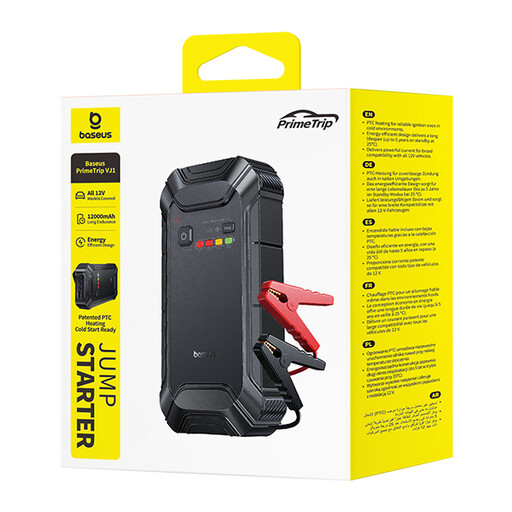
Why we chose it: Ideal for drivers of city cars and compact sedans (petrol engines). Its ultra-compact design allows it to be slipped into the glove box, so it's always within easy reach.
It doesn't over-promise on peak amps, instead delivering a starting power perfectly calibrated for its target vehicles, while remaining easy to maintain.
Its tiny form factor and IP65 waterproof certification make it the ideal companion, safe in the glove box and protected from the elements.
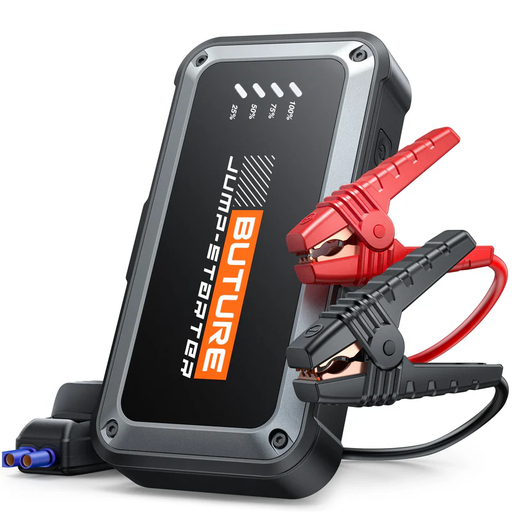
Why we chose it: Built for owners of SUVs, vans, motorhomes, or vehicles with large diesel engines. Its power reserve ensures reliable starts, even in freezing temperatures or with stubborn batteries.
Here, the power isn't just on paper. It delivers a massive starting current capable of reviving the most demanding engines (petrol up to 9.0L, diesel up to 8.5L), where standard models fail.
A powerful punch of 3000A and rock-solid endurance, operational from -20°C to 60°C for all-season reliability.

Why we chose it: This is the Swiss Army knife for the adventurous driver, perfect for long road trips or camping. It combines a jump starter, an air compressor for tyres, and a fast-charging power bank.
No more dead battery anxiety! Its sodium-ion battery technology crushes the self-discharge problem. According to the manufacturer, it can remain operational for up to 5 years on standby.
A true 4-in-1 with its 150 PSI air compressor and resistance to extreme temperatures (from -40°C to 80°C).
We have selected a full range of products for you that meet our strict criteria and safety standards.
Diesel engines are more demanding. Due to their high compression ratio, they require a much higher starting current. For a diesel, aim for a model with at least 1500A of peak current, but more importantly, verify that the actual starting amperage is sufficient and that the booster is explicitly compatible with your engine's displacement.
It all depends on its technology. A conventional lithium-ion model loses its charge over time and needs to be checked and recharged every 3 to 6 months to ensure it will work when needed. The new generation of sodium-ion models are a game-changer: their self-discharge rate is so low that, according to manufacturers, they can remain operational for several years without a recharge.
Yes, but not just any model! You must check the operating temperature range specified by the manufacturer. A car's interior can turn into an oven in the summer (over 60°C) or a freezer in the winter. Most lithium boosters operate between -20°C and +60°C. Outside this range, their performance and lifespan will drop. For total peace of mind, models designed for extreme ranges (e.g., from -40°C to +80°C) are the best option for permanent storage in the vehicle.