
Livraison le jour même ou le lendemain

Qualité garantie

Débloquez vos offres de bienvenue: Livraison GRATUITE | Jusqu'à -80 % | 30 jours d'essai gratuits à JoyPlus
Téléchargez l'application
By the Joybuy expert team – Published August 28, 2026
It's a classic scene: you turn the ignition key and... all you hear is a feeble clicking sound. Dead battery. Whether it's on a freezing morning or in a crowded supermarket car park, it's always a uniquely frustrating experience. A jump starter might seem like the perfect solution, but the market is flooded with models making often-exaggerated claims.
Before you pull out your credit card, it's wise to know how to spot the marketing traps that can cost you dearly and leave you stranded at the worst possible moment.
To make an informed choice, focus on the technical specifications that truly make a difference. Ignoring these points means risking buying a device that is ineffective or dangerous.
Peak Amperage (in amps, A) is the maximum power the booster can deliver in a very short burst. It's an indicator, but the starting current (sometimes called cranking amps) is far more relevant: it's the power the device can sustain for several seconds to turn the engine over.
The internal battery's capacity, ideally expressed in Watt-hours (Wh)—a much more reliable metric than mAh—determines your device's endurance. A high capacity will not only allow you to make multiple start attempts but also turn your booster into an external battery or power bank to charge your devices (phone, tablet) via its USB ports.
Some models go a step further and include a jump starter with an air compressor. This is an extremely practical feature for adjusting your tyre pressure, whether in an emergency or for a routine check.
A good emergency starter must be equipped with robust smart clamps. These integrate multiple electronic protections that are non-negotiable:
An indicator light or a screen shows you if the connection is good, making this jump-starting aid easy for anyone to use, even beginners.
We have analysed several models based on these objective criteria to offer you options suited to different needs.
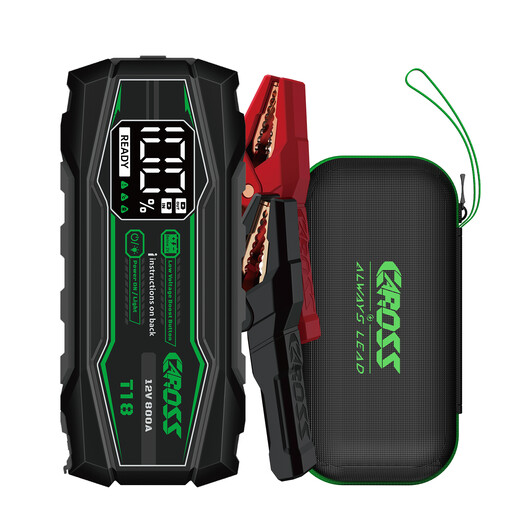
Why we chose it: Perfect for drivers of city cars and compact saloons (petrol engines up to 6.0L). It offers a reliable and simple backup solution, without the superfluous gadgets that drive up the price.
It advertises a realistic and sufficient 800 A, far from exaggerated marketing promises. Its smart clamps include essential protections (reverse polarity, anti-spark).
Its 2.3-inch LED screen clearly displays the battery status and instructions, making it very easy to use, even in the heat of the moment. Its compact size fits easily in the glove box.

Why we chose it: Ideal for long trips, camping, or active families. The built-in digital air compressor (150 PSI) is a major asset for tyre maintenance or inflating air mattresses and balls.
This model doesn't just boast colossal power (4500 A); it pairs it with a genuinely useful and high-performance compressor function, perfect for large engines (up to 9.0L petrol / 8.0L diesel).
It's a true 5-in-1 Swiss Army knife (starter, compressor, power bank, 500-lumen LED light, 10 protections). The LCD screen displays tyre pressure and automatically stops once the target is reached.

Why we chose it: Designed for 4x4s, SUVs, motorhomes, or vans with large engines (especially diesel) that need maximum cranking power on startup, even in cold weather.
It delivers a peak power of 4000 A, tailored for diesel engines up to 10.0L. This raw power is backed by robust, all-metal clamps designed for durability and heavy-duty use.
Its "BOOST" function allows you to force a start even if the battery is completely dead, a real plus in critical situations. Its endurance allows for multiple starts on a single charge.
Discover our full selection of jump starters that meet our selection criteria and the strictest safety standards.
The lifespan of a lithium-battery jump starter is typically 3 to 5 years, depending on its use and maintenance. To maximise its longevity, remember to fully recharge it every 2 to 3 months, even if it's just sitting in your boot. Avoid letting it completely discharge and store it in a cool, dry place, away from extreme temperatures.
Absolutely not, provided you choose a quality model equipped with smart clamps. Their built-in protections are specifically designed to prevent short circuits, power surges, and reverse polarity. Power is only released once the connection is deemed safe, making the operation risk-free for your car.
It depends on the model. Standard boosters may struggle to detect a battery with a voltage that is too low. Fortunately, many recent models, like the GOOLOO GP4000 mentioned above, feature a "Boost" or "Override" function. This manual mode allows you to force power to a very deeply discharged battery to attempt a start. This feature should be used with caution, double-checking that the polarity is correct.