
Livraison le jour même ou le lendemain

Qualité garantie

Débloquez vos offres de bienvenue: Livraison GRATUITE | Jusqu'à -80 % | 30 jours d'essai gratuits à JoyPlus
Téléchargez l'application
By the Joybuy team, automotive equipment experts
The dreadful silence of an engine that won't turn over... It's a situation every driver dreads, especially at the worst possible time: on a busy morning or in the middle of the night. The culprit is almost always the same: a dead battery. Instead of depending on another car and traditional jumper cables, the modern battery booster has become the go-to solution—it's self-contained, compact, and incredibly effective.
This guide is designed to help you make sense of the options. We'll break down the key criteria for choosing the right portable car starter and introduce our favourite models, all without any unnecessary technical jargon.
Lost in a jungle of spec sheets? Don't worry. Let's focus on three essential criteria to find the perfect booster for your needs.
Expressed in amps (A), the peak current is the number one indicator of a booster's power. Simply put: the higher the number, the more powerful the booster.
Always check the compatibility listed by the manufacturer (e.g., "up to 9.0L gas / 7.0L diesel") to ensure it matches your vehicle's engine.
Most modern boosters are equipped with a lithium battery. The advantage? A high energy capacity in a compact, lightweight design, which also has a very slow self-discharge rate when not in use.
But power isn't everything: safety is a non-negotiable feature. Make sure the model you choose includes several key protections:
A good booster often doubles as a true Swiss Army knife for drivers. Some of the most useful options include:
Let's get to the specifics. Here are three models that caught our eye, each tailored to a specific user profile.
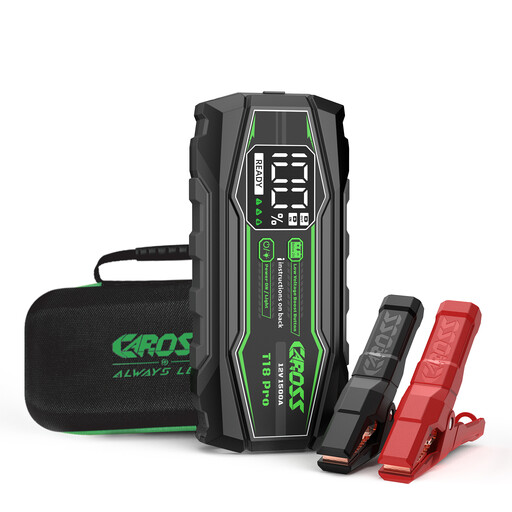
Its standout feature: This model focuses on simplicity and readability. Its large 2.3-inch LED screen displays all key information at a glance, making it stress-free to use, even for beginners. The dedicated "Boost" function is a real plus for reviving the most stubborn batteries.
Advantages:
Who is it for? Perfect for drivers of compact cars, gas-powered sedans, or small diesel vehicles who want a reliable, hassle-free device. Its carrying case makes it a ready-to-go kit to keep in the trunk.

Its standout feature: This GOOLOO booster plays in the big leagues. Built for power and durability, its 3000A peak current makes short work of large engines, even in freezing temperatures. Its rugged design and 10 levels of protection make it a powerful ally in critical situations.
Advantages:
Who is it for? Essential for owners of SUVs, 4x4s, vans, RVs, or even boats. It's also the sensible choice for those who live in regions with harsh winters and cannot afford a breakdown.
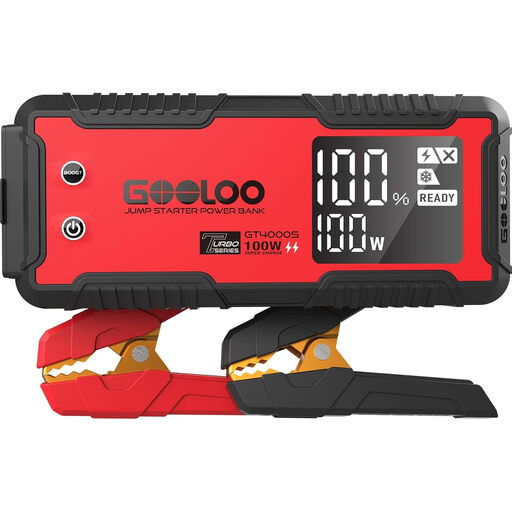
Its standout feature: The GT4000S is the ultimate performer in the world of boosters. It shatters speed records with its 100W two-way charging, allowing it to fully charge in just over an hour. Capable of powering a laptop via its USB-C port, it transforms into a true portable power station.
Advantages:
Who is it for? For the most demanding users, professionals, and tech enthusiasts who want the best in power and speed. If you need to start very large engines and charge all your devices (including a laptop) at top speed, this is the model for you.
A jump starter is a fantastic emergency tool. But for the daily charging of your portable devices, more compact solutions are available.
To keep your smartphone, tablet, or headphones always charged on the go, check out our selection of power banks and find the perfect model for your needs.
It all depends on the engine size and type of your vehicle. For a standard gas-powered car, 1000A to 1500A is sufficient. For an SUV, a van, or a diesel engine, it's safer to aim for 2000A or more, especially in cold regions where batteries struggle more.
Yes, most modern boosters have a "Boost" (or "Override") function. This allows you to force a current to a battery even if its voltage is nearly zero (close to 0V). Be aware that this function bypasses certain safety features, so use it with caution and only by following the manufacturer's instructions to the letter.
Their main advantage is their low self-discharge rate. A lithium booster can hold most of its charge for months, or even over a year for the best models. As a precaution, it's still a good idea to check its battery level and recharge it every 3 to 6 months. Better safe than sorry.