
Livraison le jour même ou le lendemain

Qualité garantie

Débloquez vos offres de bienvenue: Livraison GRATUITE | Jusqu'à -80 % | 30 jours d'essai gratuits à JoyPlus
Téléchargez l'application
A dead battery. It's every driver's nightmare, especially when it happens at the worst possible moment. Fortunately, modern jump starters are here to get you back on the road independently. The problem: the market is a jungle of models with tempting marketing promises and often opaque spec sheets. To help you see more clearly, our editorial team has broken down the pitfalls to avoid and the criteria that really matter before you buy.
As the Head of the Auto Accessories section, my job is to cut through the marketing jargon to give you concrete advice. Follow this guide to choose the portable car starter that truly fits your needs and say goodbye to nasty surprises.
Marketers love big, flashy numbers that often hide a much less impressive reality. Keep an eye out for these three points?:
To make the right choice, forget the marketing hype and focus on these three essential parameters. They determine the performance, safety, and versatility of your future portable car battery charger.
A small petrol city car and a large diesel SUV obviously don't have the same power requirements.
As a general rule, here are some guidelines for choosing a jump starter compatible with both petrol and diesel engines?:
Most modern jump starters use a lithium battery (Li-Ion or Li-Po), which is much more compact and lightweight than older lead-acid batteries. The capacity, expressed in mAh, influences two main aspects?:
But don't just focus on the raw number. Check for fast-charging ports (like Quick Charge) and, most importantly, a USB-C port to recharge the jump starter itself much more easily.
A quality jump starter must be simple and safe to use, even for a mechanical novice. Ensure the model you choose includes at least the following protections, usually managed by a box on the so-called "smart" clamps?:
Rather than an endless list, we've selected models that cater to specific user profiles, strictly applying the criteria and warnings we've just detailed.
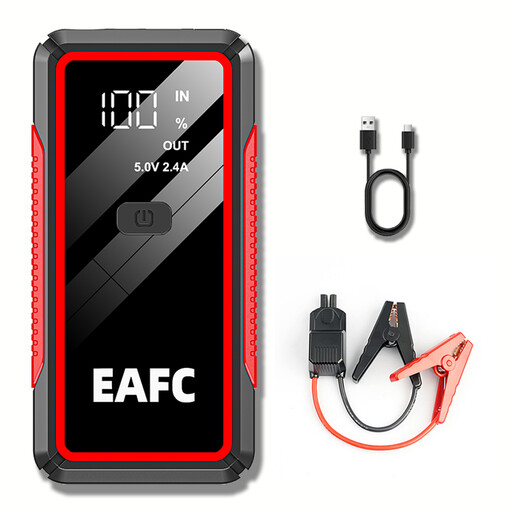
Our verdict: Perfect for drivers of city cars and compacts (petrol or small diesel) who want a reliable backup solution without breaking the bank. Its compact size ensures it has a prime spot in the glove compartment.
It doesn't just rely on a flashy peak number, instead advertising clear compatibility (up to 6.0 L petrol / 4.0 L diesel). Most importantly, it includes smart clamps with all the essential safety features.
An excellent performance-to-price ratio for occasional use. Its 10,000 mAh capacity and USB port also make it a very handy backup power bank.

Our verdict: Built for owners of SUVs, 4x4s, utility vehicles, motorhomes, or vehicles with large engines (petrol or diesel up to 10.0 L). It delivers the raw power needed for the most difficult starts, even in freezing weather.
Its 4000 A peak current isn't just for show: it's backed by the real-world ability to start engines up to 10.0 L, a true performance indicator. Its "BOOST" button allows you to force a start on completely dead batteries.
Its raw and reliable starting power. Its all-metal clamps are a sign of durability and safety for heavy-duty use.
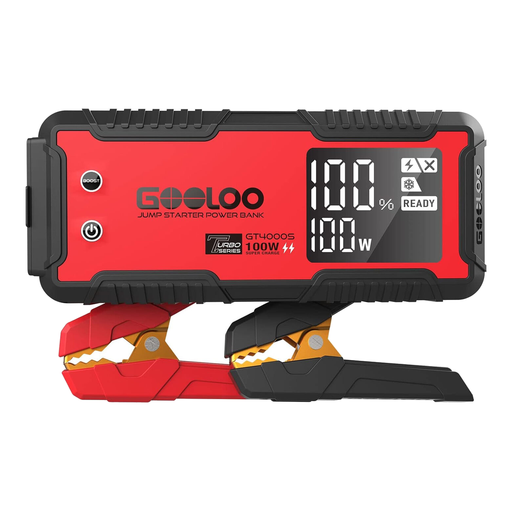
Our verdict: For those who want the Swiss Army knife of jump starters. It combines colossal starting power with a super-powered power bank function, capable of charging a laptop thanks to its 100 W Power Delivery USB-C port.
It goes beyond promises and delivers a feature as rare as it is decisive: 100 W two-way fast charging. In practical terms, this means the jump starter itself can be fully recharged in just over an hour with a compatible charger.
Its phenomenal charging speed. Five minutes plugged into the mains is enough to give it sufficient energy for an emergency start. A decisive advantage for professionals and frequent travellers.
Discover our full selection of products that meet our strict selection criteria and current safety standards.
A lithium jump starter has an average lifespan of 3 to 5 years, or several hundred charge cycles. To preserve its longevity, it's advisable to recharge it every 3 to 6 months, even when not in use. Avoid leaving it in a car in direct sunlight and preferably store it in a cool, dry place, like the glove compartment.
No, as long as you use a quality model equipped with smart safety features. Protections against reverse polarity, short circuits, or power surges are specifically designed to prevent any damage to the ECU (the engine's computer) and other sensitive electronic components in the vehicle. This is why it's crucial to steer clear of entry-level models that lack these protections.
Yes, most modern jump starters are designed for this scenario. Many have a "Boost" or "Override" function. This feature forces a current to be sent even when the jump starter no longer detects any residual voltage in the vehicle's battery (a typical case of a completely discharged battery). Be aware that this function should be used with caution, double-checking the clamp connections, as it temporarily bypasses some automatic safety features.