
Livraison le jour même ou le lendemain

Qualité garantie

Débloquez vos offres de bienvenue: Livraison GRATUITE | Jusqu'à -80 % | 30 jours d'essai gratuits à JoyPlus
Téléchargez l'application
A dead battery: every driver's nightmare. That sinister little click that replaces the familiar roar of the engine, always at the worst possible moment. A jump starter then presents itself as the miracle solution, but be warned: the market is a jungle of marketing promises and misleading spec sheets. As the Head of Product Recommendations at Joybuy, my role is to guide you through this jungle. Together, let's navigate the pitfalls to ensure your purchase is a success.
Before you fall for the first model you see, beware of these three classic traps that too many drivers fall into:
To make the right choice, focus on a few non-negotiable technical specs. These are the true indicators of the quality and reliability of your future portable car starter.
Forget peak amps. The only information that matters is the compatibility with your engine's displacement (expressed in litres). A good manufacturer will clearly state: "Suitable for petrol engines up to 8.0L and diesel engines up to 6.0L." This data, being much more concrete, is your most reliable guide. For a small petrol city car, a 1500A to 2000A model will suffice. For a diesel SUV, an RV, or a utility vehicle, aim for 2500A and above. The internal 12V battery technology, such as a LiFePO4 battery (Lithium Iron Phosphate), often ensures better stability and a longer lifespan than conventional lithium-ion batteries.
If you opt for a multi-function model, look closely at the specs of each tool:
Don't get them confused: a jump starter is an emergency tool, while a car battery charger is a maintenance tool. Some devices combine both, but it's often wiser to invest in a dedicated smart battery charger. This type of device, also known as a battery maintainer, analyses your battery's condition and applies an optimised charging cycle to desulfate it and extend its life, something a simple jump starter cannot do.
Rather than an endless list, we've selected three models that meet specific needs, each chosen for its excellent features-to-reliability ratio.
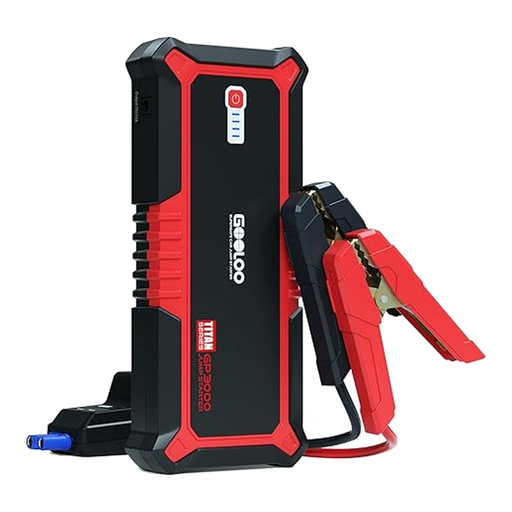
Why we chose it : A reliable, compact, and affordable emergency solution. Its power is more than sufficient for the vast majority of cars on the road (city cars, sedans, SUVs), and it fits easily in the glove box.
No vague marketing numbers. The spec sheet is clear and precise: compatible with petrol engines up to 9.0L and diesel up to 7.0L. This concrete data allows you to check compatibility at a glance.
Its "BOOST" mode tackles even the most stubborn dead batteries. It integrates 10 well-documented safety levels, and its USB-C (15W) and Quick Charge 3.0 ports make it a perfectly decent power bank.
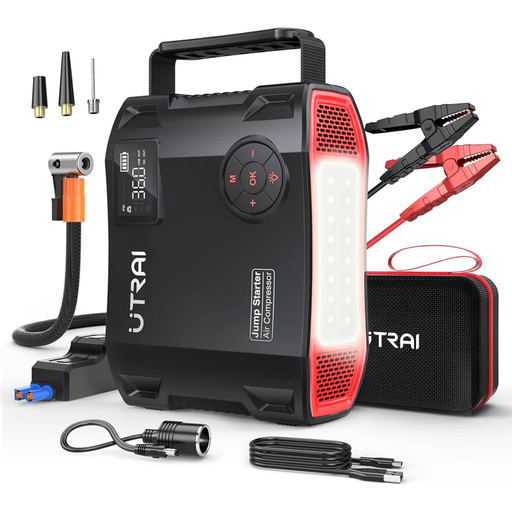
Why we chose it : Much more than a jump starter, this is a true portable power station. Essential for owners of RVs, camper vans, or large 4x4s, it combines colossal starting power with a genuinely effective air compressor.
Here, versatility is not a gimmick. The compressor is a real asset: with a flow rate of 45 L/min and a pressure of 150 PSI (with auto-stop), it's perfectly capable of reinflating a tire quickly. These aren't just empty numbers.
Its raw power can start diesel engines up to 10.0L. Most importantly, its 160W DC output is a major asset on the road: it can power a portable cooler, a car vacuum, or other 12V equipment.
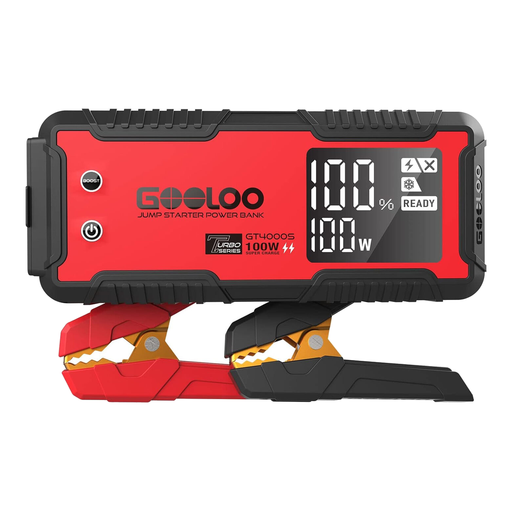
Why we chose it : This isn't just a starter; it's a powerhouse of technology. It combines phenomenal starting power with an ultra-fast charging feature that puts it in a class of its own. The ultimate tool for pros or enthusiasts who make no compromises on performance.
It shatters the concept of a gimmicky power bank. With its 100W two-way charging, it recharges to 100% in just 1 hour and 15 minutes and can power a laptop as fast as its wall charger. A game-changer.
Its trump card: ultra-fast charging. Plug it in for 5 minutes, and you have enough juice for an emergency start. Its compatibility with petrol engines up to 12.0L ranks it among the most powerful on the consumer market.
For regular maintenance of your battery or to explore other starting solutions, discover our complete selection of products. All have been chosen according to strict performance and safety criteria.
A quality jump starter with modern protections poses no risk to your vehicle's electronics. The built-in safety systems (anti-reverse polarity, anti-short circuit, anti-overvoltage) are specifically designed to prevent any damage. The one golden rule: strictly follow the manufacturer's instructions, especially the order for connecting the clamps.
Its lifespan depends on the quality of its internal battery (usually lithium) and its maintenance. On average, a good jump starter remains effective for 3 to 5 years. To keep it in top condition for as long as possible, remember to recharge it every 3 to 6 months, even if it's not used, and store it in a cool, dry place, away from extreme heat and frost.
That's a very bad idea. Extreme temperatures (both hot and cold) are the number one enemy of lithium batteries: they degrade their performance and drastically reduce their lifespan. The best practice: store it in its case, in the trunk or glove box, and only take it out to use it or for its periodic recharge.