
Livraison le jour même ou le lendemain

Qualité garantie

Débloquez vos offres de bienvenue: Livraison GRATUITE | Jusqu'à -80 % | 30 jours d'essai gratuits à JoyPlus
Téléchargez l'application
A dead battery?: every driver's nightmare, and it always seems to happen at the worst possible moment. That sinister click from the ignition, followed by dead silence, has a way of turning an ordinary day into a major headache. In the face of this common problem, the battery jump starter has emerged as the essential accessory for getting back on the road. The problem?: the market is flooded with often misleading marketing promises.
Before you pull out your credit card, it's crucial to know how to sidestep the most common traps. Too many buyers end up with a disappointing or unsuitable device, falling victim to misleading marketing claims. Here are the three mistakes you shouldn't make?:
To invest in a device that will bring you true peace of mind, ignore the advertising slogans and focus on these key technical specs.
Don't get hypnotised by the peak current. The only figure that truly matters is the starting current (often shown in smaller print), which measures the power the booster can deliver continuously for several seconds to start the engine.
Expressed in milliampere-hours (mAh), the internal battery capacity determines how many starts you can get on a single charge, as well as its endurance as a car power bank.
The LED light with SOS mode has become a virtually standard feature for nighttime breakdowns. An integrated air compressor is also a huge plus, as long as its pressure (in bars or PSI) is adequate for your tyres.
A worthy car jump starter must integrate multiple safety protections. So-called "smart" clamps feature built-in electronics that prevent the most common and dangerous user errors?:
An indicator light or beep confirms the connection is correct before you even turn the key, making the entire operation much more stress-free.
Because every driver is unique, we have selected models that meet specific profiles and needs, based on the objective criteria detailed above.
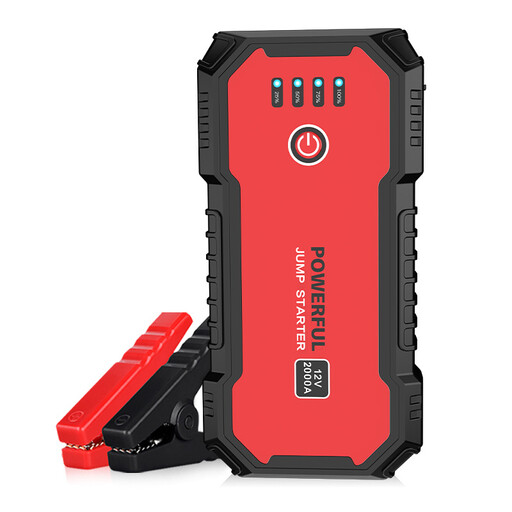
Why it's a match : Perfect for anyone looking for a simple, compact, and reliable solution for their daily driver. Its feather-light weight (around 430 g) lets it slip into the glove box, offering peace of mind without the bulk.
This model doesn't over-promise on peak current. It advertises 1500 A, a realistic power level suitable for most mid-size gas and diesel vehicles, without promising the moon.
The perfect balance of compactness, sufficient power for daily use, and an affordable price. The 18 W QC3.0 fast charging is a real bonus.
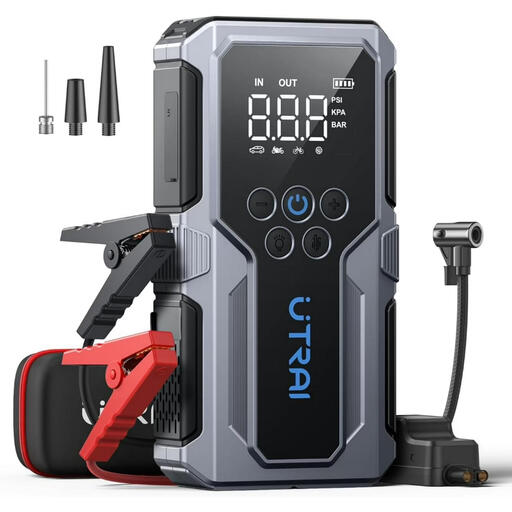
Why it's a match : The perfect road companion for SUV and van owners or camping enthusiasts. Its high power (3000 A peak) tackles large engines, while its built-in 150 PSI compressor is a major asset for inflating a tyre or recreational gear.
It avoids the "gimmick" trap by integrating a truly functional air compressor with pressure presets and auto-stop. It's a genuine 5-in-1 Swiss Army knife, not just a marketing ploy.
The combination of a powerful starter, an efficient compressor, and a fast-charging power bank makes it the ultimate survival kit for road trips and unexpected events.
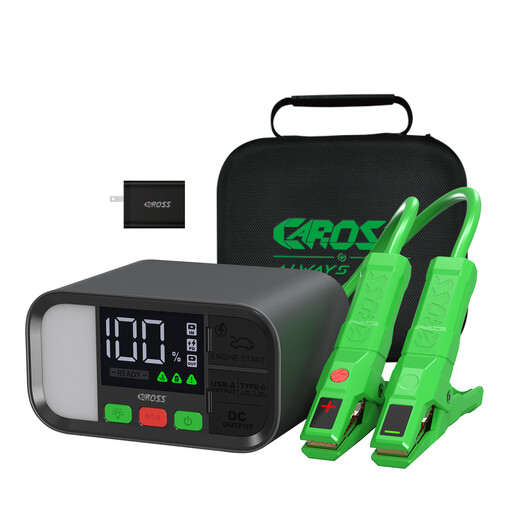
Why it's a match : For those who want top-tier technology combined with disarming simplicity. Its aluminium chassis, large 3-inch screen, and ultra-fast PD65W two-way charging make it a beautiful object that's as powerful as it is elegant.
It shatters the trap of fragile clamps and connection errors. Its Smart Connect technology and non-polarised clamps make the connection foolproof : connect them any way you want, and the system handles the rest.
Its non-polarised connection technology, unique on the market, and its ultra-fast PD65W charging capable of reviving a laptop or the booster itself in record time.
We've put together a complete selection of products that meet our selection criteria and the strictest safety standards.
It all depends on your engine's displacement and type. For a small gas city car, a model with 1500?A peak (around 600?A starting) is more than enough. For a diesel SUV, aim higher?: a model with 2000?A peak or more (800-1000?A starting) is a safer bet, especially if you live in a cold region where batteries are under more strain.
Good lithium-ion jump starters have a very low self-discharge rate. They can retain over 80% of their charge for 6 to 12 months. As a precaution, we recommend checking and topping up the charge every 3 to 4 months to ensure it's ready to go when you need it.
Yes, most quality models feature a "Boost" or "Override" mode. This function allows you to send power even to a battery with almost zero voltage (close to 0?V), a situation where a standard jump start would fail. Be careful, as this mode often bypasses the automatic safety protections?: use it with extreme caution, and double-check the clamp connections before proceeding.