
Livraison le jour même ou le lendemain

Qualité garantie

Débloquez vos offres de bienvenue: Livraison GRATUITE | Jusqu'à -80 % | 30 jours d'essai gratuits à JoyPlus
Téléchargez l'application
A dead battery: every driver's nightmare, especially when you're in a hurry or far from help. A portable jump starter seems like the perfect solution, but the market is flooded with often-misleading marketing claims. As a product expert at Joybuy, my mission is to help you navigate this jungle and avoid the most common traps, so you can make a smart, safe purchase.
Before you fall for the first model you see, it's crucial to understand the false promises and hidden flaws that can turn a reassuring purchase into a wasted expense.
To avoid being misled, focus on a few key technical specifications that guarantee the effectiveness and reliability of your portable car battery charger.
Don't rely solely on peak current. Check the device's compatibility with your vehicle's engine displacement (in litres) and type (petrol or diesel).
The capacity, expressed in milliampere-hours (mAh), determines the device's autonomy. A higher value will allow you to perform multiple jump-starts or recharge your electronic devices several times. Pay close attention to the battery technology as well. While most models use lithium-ion, new technologies like sodium-ion offer very low self-discharge and better resistance to extreme temperatures—a major advantage for a device meant to be stored in a vehicle.
If you opt for a multi-function model, scrutinise the performance of each tool:
To move from theory to practice, here are a few options perfectly suited for different user profiles.
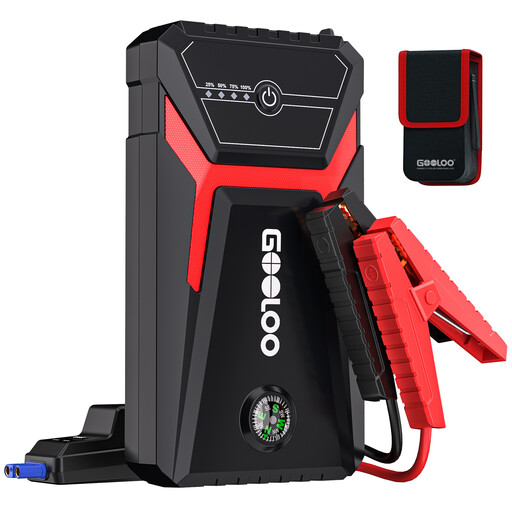
Who is it for? Ideal for owners of city cars or compact petrol saloons. Its compact size allows it to be easily stored in the glove box, and its power is more than sufficient for daily commutes, without paying for unnecessary capacity.
This model doesn't overstate its peak current. It delivers 1500 A, well-calibrated for petrol engines up to 6.0L and diesel engines up to 4.0L, thus avoiding the trap of unnecessary oversizing for urban use.
Compact and lightweight (0.88 kg), it includes essential safety protections and a power bank function with two USB ports. It gets straight to the point, with no frills.
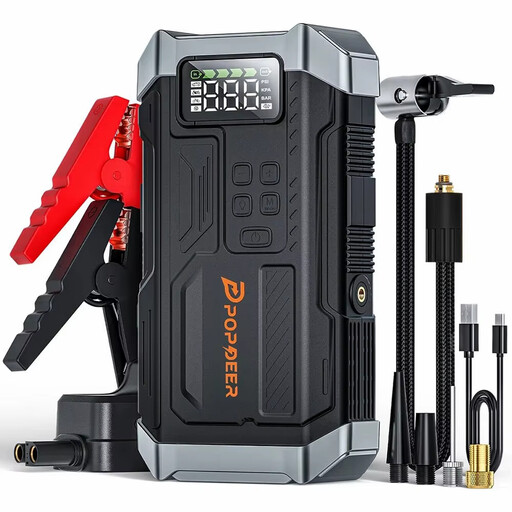
Who is it for? Perfect for those looking for a versatile tool for travel, camping, or simply to be prepared for any eventuality. It combines a powerful jump starter with a high-performance air compressor: the motorist's Swiss Army knife.
Unlike models where the extra features are mere gimmicks, this jump starter integrates a genuine air compressor with a 35 L/min flow rate and 150 PSI pressure, capable of reinflating a tyre in minutes. It sidesteps the "ineffective all-in-one" trap.
Its 5000 A power makes it compatible with very large engines (10L petrol/8L diesel). The compressor features preset modes and an automatic shut-off, making it incredibly easy to use.

Who is it for? For those who want a "ready-to-use," maintenance-free device. Its sodium-ion battery technology allows it to stay charged for years, eliminating the nightmare of finding a dead jump starter at the crucial moment.
It directly tackles the self-discharge pitfall. According to the manufacturer, its discharge rate is about 1% per month, compared to 5-10% for lithium. A single charge can last for several years, removing the need for quarterly recharging.
Its operating temperature range (-40°C to 80°C) and chemical stability make it particularly reliable and safe for long-term storage in a vehicle, in scorching heat and extreme cold alike.
We have compiled a complete, up-to-date list of products that meet our strict selection criteria and current safety standards.
It all depends on your engine. For a mid-size petrol car, 1500?A to 2000?A is sufficient. For an SUV or a diesel engine, aim for at least 2500?A. Diesel engines, due to their higher compression ratio, are more power-hungry at start-up, especially in cold weather. The easiest way is to refer to the jump starter manufacturer's recommendations for the maximum supported engine displacement (in litres).
Yes, but with a few precautions. Most lithium jump starters have an operating range of -20°C to 60°C. Leaving them in a car in direct sunlight or extreme cold can harm their performance and lifespan. Newer models, such as those based on sodium-ion, can withstand much more extreme temperature ranges (e.g., -40°C to 80°C), making them ideal candidates to be permanently stored in a vehicle.
A jump starter with a compressor can be very effective, provided you choose a quality model. To judge its effectiveness, don't just look at the maximum pressure (PSI/Bar), but more importantly, the air flow rate (L/min). A flow rate of 35?L/min or more is a guarantee of performance: it will ensure you can reinflate a car tyre in just a few minutes, not half an hour. Features like pressure presetting and automatic shut-off are also a real bonus for user convenience.