
Livraison le jour même ou le lendemain

Qualité garantie

Débloquez vos offres de bienvenue: Livraison GRATUITE | Jusqu'à -80 % | 30 jours d'essai gratuits à JoyPlus
Téléchargez l'application
A dead battery or a flat tyre at the worst possible moment can ruin your entire day. The jump starter with air compressor has emerged as the all-in-one solution to handle these unexpected setbacks. The problem is, the market is saturated with marketing promises that are often misleading.
As the Head of Product Recommendations at Joybuy, my mission is to help you cut through the noise. Together, we'll break down the most common traps so you can choose a reliable device that will never leave you stranded.
Marketers love to highlight impressive numbers that often hide critical weaknesses. Here are the red flags you should never ignore.
To avoid falling for the hype, focus on these three technical specifications that don't lie.
Peak current is an indicator, but it must be analysed in light of the engine compatibility advertised by the manufacturer. Always check which engine sizes (in litres) the device is designed for, distinguishing between gas and diesel engines. A jump starter for a small city car won't require the same power as a model for a large diesel SUV. A quality device will clearly specify: "up to 8.0L gas / 6.0L diesel," for example. This is a true mark of transparency.
A good car tyre inflator must be both powerful and durable.
The car power bank function is convenient, but its reliability depends entirely on the internal battery.
Here are a few models that stand out, selected based on the demanding criteria we've just detailed.

Why it's a match: Ideal for the driver looking for a complete and reliable solution. Its power covers a wide range of vehicles (up to 9.0L gas / 8.0L diesel) and its compressor is high-performance, making it an excellent emergency car kit to always keep in the trunk.
It avoids the underpowered compressor trap thanks to its digital display and auto-stop function. Its power is clearly linked to specific engine sizes, offering far more transparent information than just the peak current figure.
Its all-in-one design that integrates 5 functions (jump starter, compressor, LED light, power bank, safety protections) into a compact case.
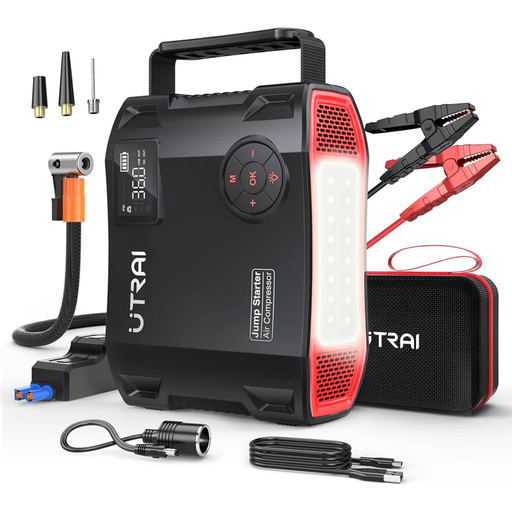
Why it's a match: Built for owners of SUVs, RVs, or vans with large diesel engines (up to 10.0L). Its 160W DC output can power other 12V devices (coolers, vacuums, etc.), making it extremely practical for camping or long trips.
It delivers starting power that meets the demands of a diesel jump starter and includes a high-flow compressor (45L/min) that inflates tyres quickly, a far cry from the disappointing performance of under-specced models.
Its 160W DC power output, which sets it apart from the competition and turns it into a true portable power station.

Why it's a match: Perfect for those who want a device they can charge once and forget about (almost). Its sodium-ion battery has virtually zero self-discharge (a single charge can last for years) and a record-breaking lifespan (over 6,000 cycles). It's the "zero mental load" option.
It completely eliminates the self-discharge problem. Unlike lithium batteries, which don't like to be left empty, this one can be reactivated even after dropping to 0V. Its operating temperature range (-40°C to 80°C) means you can leave it in the car without worry, summer or winter.
The "charge and forget" reliability and the enhanced safety of sodium-ion technology, which doesn't release oxygen and thus prevents fire risks.
We have compiled a complete and up-to-date selection of products that meet our demanding selection criteria and current safety standards.
What is the lifespan of a jump starter and how do I maintain it? The lifespan depends on the battery technology (lithium or sodium-ion) and its maintenance. For most lithium battery models, it's recommended to recharge them every 3 to 6 months to preserve the battery and ensure it's ready when you need it. Sodium-ion based models have much lower self-discharge and require less maintenance. In any case, store the device in a cool, dry place, away from direct sunlight.
Is a 1500A jump starter enough for my diesel car? That depends on your engine's displacement. Diesel engines require significantly more starting current than gas engines due to their higher compression ratio. A 1500A jump starter might be sufficient for a small diesel engine (e.g., up to 3.0L), but for larger engines (SUVs, vans), it's safer to opt for models rated at 2500A or higher. Always rely on the manufacturer's recommendations, which specify compatibility with diesel engine sizes.
Can I leave the jump starter in my car during summer or winter? This is a critical question. Most lithium battery jump starters have an operating temperature range of about -20°C to 60°C. Leaving the device in a superheated car cabin in the middle of summer can push the temperature beyond this limit, damaging the battery and posing a safety risk. Sodium-ion based models can withstand much wider temperature ranges (e.g., -40°C to 80°C), making them much safer for permanent storage in a vehicle.