
Livraison le jour même ou le lendemain

Qualité garantie

Débloquez vos offres de bienvenue: Livraison GRATUITE | Jusqu'à -80 % | 30 jours d'essai gratuits à JoyPlus
Téléchargez l'application
A dead battery on a cold morning, a flat tyre in the middle of nowhere... these are scenarios every driver dreads. The jump starter with an air compressor emerges as the all-in-one solution to get you back on the road independently. But be warned: the market is flooded with marketing promises that often hide disappointing products.
As a Product Specialist at Joybuy, I'm here to help you make sense of it all. Let's break down the common pitfalls and the essential criteria for choosing a reliable device that won't let you down when you need it most.
The appeal of a multi-function device can sometimes mask significant design flaws. Here are the three most common traps.
To make an informed choice, you must focus on a few key parameters that go beyond marketing claims.
The power you need depends directly on your vehicle's engine size.
Always check the manufacturer's stated compatibility with petrol and diesel engine sizes.
Don't just rely on the maximum pressure rating (often 150 PSI, or about 10 Bar). While this value indicates the device's capability, it's the air flow rate (measured in litres per minute, L/min) that determines its speed.
A flow rate of 20 L/min or more is recommended for an electric tyre inflator to be able to reinflate a standard car tyre in a reasonable amount of time (5 to 10 minutes) without overheating. Features like pressure presetting and automatic shut-off are also hallmarks of convenience and safety.
Above all, a good jump starter must be safe. Ensure it includes at least the following protections:
Extra features can turn your jump starter into a true multi-function power station. USB ports for charging your devices make it an effective car power bank, and a built-in LED light with an SOS mode is essential for nighttime emergencies.
Rather than an exhaustive list, here are options that cater to distinct user profiles, selected based on our performance and safety criteria.
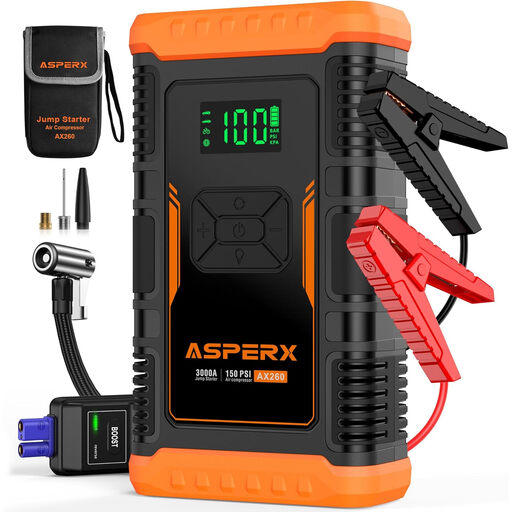
Why we chose it: This model strikes the perfect balance for the average driver. Its power is sufficient for the vast majority of petrol and diesel cars on the road, and its compressor is effective enough for emergency use, all in a compact form factor that slips easily into the boot or glove box.
It integrates 10 levels of automatic protection and an air flow rate of 35 L/min, placing it well above "gimmick" compressors and ensuring safe, effective use.
A smart balance of features and portability for everyday peace of mind, without paying for superfluous power.
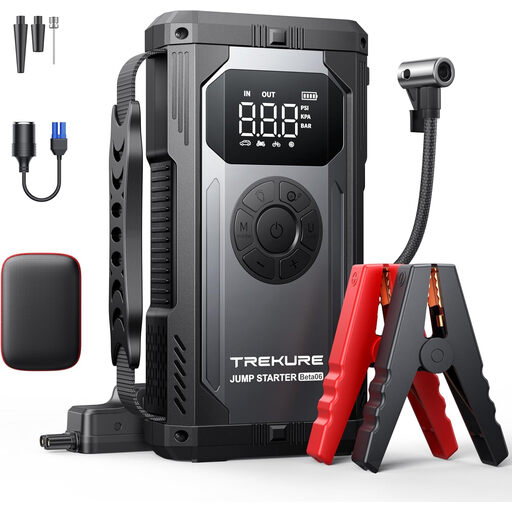
Why we chose it: For road trip enthusiasts, campers, or anyone who needs a reliable power source far from any outlet. Its high-capacity battery (23,800 mAh) and 12V DC output can power a portable cooler or a car vacuum, in addition to its jump-starting and inflation functions.
It tackles the "false promise" pitfall with 5500A of power capable of starting engines up to 10L and a manual override function for completely dead batteries, where other models fail.
A true all-in-one power station that combines high starting power, an efficient compressor, and a large battery capacity to power other devices.
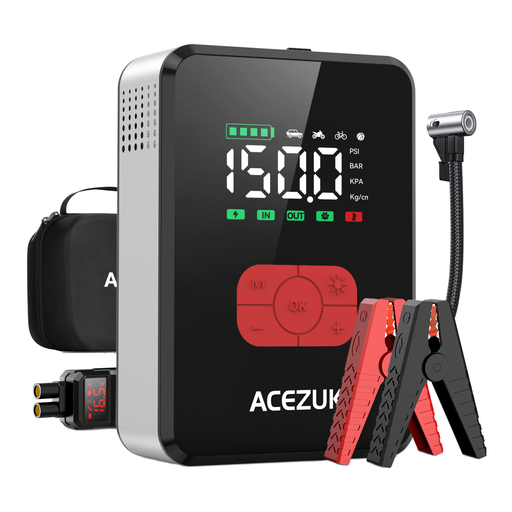
Why we chose it: Designed for owners of large SUVs, vans, RVs, or even agricultural vehicles. With 7000A peak current and compatibility with diesel engines up to 12L, it offers a considerable power reserve so you're never caught off guard, even with the most demanding vehicles.
It counters the misleading "peak amps" pitfall by delivering massive raw power. Furthermore, its smart clamps with a built-in screen display real-time status, enhancing both safety and operational clarity.
Extreme starting power for large vehicles and a rugged design built for durability and maximum safety.
Explore our full selection of products that meet our performance criteria and current safety standards.
Check your vehicle's manual or battery to find its engine size. For a small petrol city car, 1500A will suffice. For a 3.0L diesel SUV, aim for at least 3000A for peace of mind. When in doubt, choosing a slightly more powerful model is a wise precaution, especially if you live in a cold region.
A quality model with comprehensive protections (reverse polarity, anti-short circuit, etc.) is designed to be safe. The risk is virtually zero if you follow the instructions carefully. The real danger comes from low-quality budget devices that lack these safety features, or from user error (like connecting the red and black clamps incorrectly).
Most models use a lithium-ion battery designed to last for several hundred charge cycles. To maximise its lifespan, it's recommended to fully recharge it after each use and perform a maintenance charge every 2 to 3 months, even if it hasn't been used. Avoid storing it in extreme conditions, such as in direct sunlight during summer or in freezing cold during winter.