
Livraison le jour même ou le lendemain

Qualité garantie

Débloquez vos offres de bienvenue: Livraison GRATUITE | Jusqu'à -80 % | 30 jours d'essai gratuits à JoyPlus
Téléchargez l'application
A flat battery or a deflated tyre at the wrong moment can turn the most routine trip into a nightmare. The jump starter with air compressor stands out as the all-in-one solution for these unexpected events. However, the market is flooded with often misleading marketing claims. Before making your choice, it's crucial to know the pitfalls to avoid, or you could end up with a useless, or even dangerous, device.
As a Product Expert at Joybuy, I'm here to help you navigate this. Here are the main pitfalls to avoid:?
To make an informed choice, you need to understand what's behind the technical specifications. Here are the three fundamental criteria to check.
The distinction is crucial. Peak current (peak amps) is the maximum power the jump starter can deliver in a fraction of a second. Starting current (or cranking amps) is the power it can sustain for several seconds to turn the starter and crank the engine. It's this second value, which is far more telling but often buried in spec sheets, that defines the booster's true effectiveness.
For a mid-size petrol engine, a starting current of 400-600A is generally sufficient. However, a diesel battery starter or one for a large SUV will require significantly more power, often over 800A, due to the higher compression ratio of these engines.
The internal battery's capacity, expressed in milliampere-hours (mAh), determines its endurance. A high capacity will allow you to perform multiple jump-starts or recharge your electronic devices several times, turning your jump starter into a true car power bank.
As for the compressor, maximum pressure (expressed in PSI or Bar) is one thing, but its inflation speed and the inclusion of an automatic shut-off feature are equally crucial criteria. A compressor worth its salt should be able to reinflate a standard car tyre without overheating and automatically stop once the desired pressure is reached.
A quality portable car starter must include a full suite of protections. Check for the following safety features:?
Finally, features like a built-in SOS LED light with different modes (flashlight, strobe, SOS) are a real asset for your safety during a nighttime breakdown or for signalling your position.
To help you see how these criteria apply in practice, here are a few models that cater to distinct user profiles.
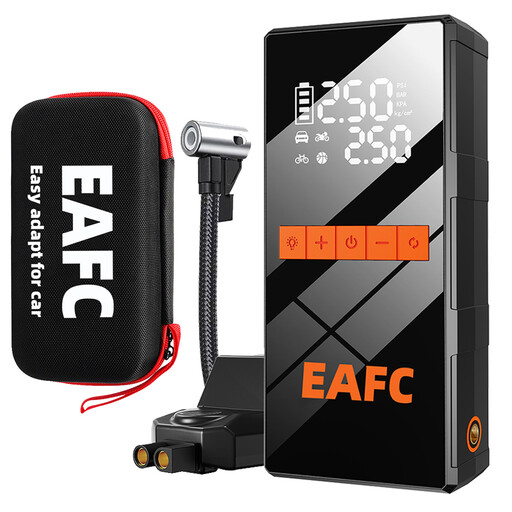
Why we chose it: For drivers of city cars or petrol sedans looking for a compact and affordable 4-in-1 solution to handle everyday mishaps. It fits easily in the glove box and covers the essentials.
Its specs are realistic and well-suited for small to medium vehicles (up to 4.0L petrol). The 150 PSI compressor with automatic shut-off is effective for roadside assistance without overstating its capabilities.
Its ultra-compact all-in-one format (starter, compressor, power bank, light) makes it the ideal entry-level safety tool.

Why we chose it: Ideal for owners of SUVs, vans, or large diesel engines (up to 8.0L). Its high power and robust design make it a powerful ally for long trips, camping, or harsh weather conditions.
The 4500A peak current isn't just a marketing number: it's capable of starting the largest engines, proving its real-world power. It integrates ten levels of protection and cooling technology to prevent the compressor from overheating.
Its raw power, capable of starting nearly any 12V vehicle on the road, and its smart compressor with 5 preset modes.
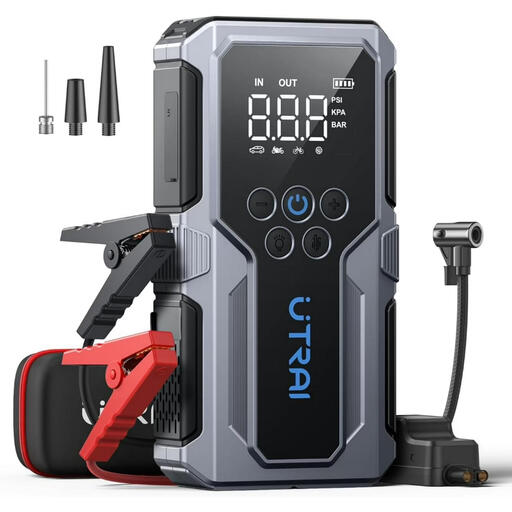
Why we chose it: For those who want a versatile and powerful device without going to extremes. It offers an excellent balance between starting power, compressor efficiency, and fast-charging power bank functions.
The LCD screen clearly displays the battery level and tyre pressure for total control without any guesswork. Its smart clamps confirm a correct connection via an indicator light, providing an added layer of safety.
Its fast-charging ports (USB-A and USB-C) turn it into an excellent travel power bank, in addition to its solid performance in jump-starting and inflation.
Although the models above include a light function, a dedicated torch will be a valuable addition to your automotive emergency kit, often providing better battery life and more powerful, focused illumination.
We have selected the best products for you that meet our demanding specifications and current safety standards.
A diesel engine is more demanding to start than a petrol engine of an equivalent size. For a 2.0L diesel, look for a model offering at least 500-600A of starting current. For larger engines (3.0L and up), a power rating of 800A or more is recommended, especially if you live in a cold region. The golden rule:?always rely on the starting current, not the peak current.
A full charge for a jump starter generally takes 3 to 6 hours, depending on its capacity and the charger used. To maintain battery health and ensure the device is ready when you need it most, remember to recharge it every 3 to 6 months, even if you haven't used it.
Most jump starters are designed to withstand a wide temperature range (often from -20°C to +60°C). Therefore, you can safely leave it in your car. However, one precaution is necessary: avoid leaving it in direct sunlight behind the windscreen in summer, as extreme temperatures can shorten the life of the lithium-ion battery. Conversely, in extreme cold, its performance may be slightly reduced, but it will remain functional.