
Livraison le jour même ou le lendemain

Qualité garantie

Débloquez vos offres de bienvenue: Livraison GRATUITE | Jusqu'à -80 % | 30 jours d'essai gratuits à JoyPlus
Téléchargez l'application
A dead battery early in the morning, a flat tire far from the nearest service station... situations every driver dreads. The jump starter with air compressor has established itself as the ultimate multifunctional emergency kit, promising greater peace of mind on the road. But with an overwhelming number of options, it's easy to fall for marketing traps and end up with an unreliable device when you need it most.
As a Product Specialist at Joybuy, my mission is to help you see things more clearly. Here are the 3 most common mistakes to avoid and the objective criteria for choosing a device that will never let you down.
To make the right choice, focus on the few technical specifications that truly make a difference in performance and reliability for a car jump starter with a compressor.
Don't be blinded by peak current. Check the compatibility with your vehicle's engine size. A jump starter for a diesel engine will require more power than a model designed for a small gasoline engine.
The maximum pressure, often advertised at 150 PSI, has become a market standard. The real differentiating factor is the air flow rate, measured in liters per minute (L/min). A high flow rate (e.g., 35 L/min) means faster inflation. Also, check for an auto-shutoff feature: you set the desired pressure, and the compressor stops on its own, preventing any risk of over-inflation.
The capacity, expressed in milliampere-hours (mAh), determines the number of possible jump-starts or smartphone recharges. A capacity of 15,000 to 25,000 mAh offers a good balance for versatile use, especially as a power bank for your other devices.
Pay close attention to the battery technology. While most models use lithium-ion, new technologies like sodium-ion are emerging. According to their manufacturers, they promise better stability in extreme temperatures and a very low self-discharge rate.
Rather than searching for the perfect "one-size-fits-all" model, it's better to choose a device that is truly suited to your needs.
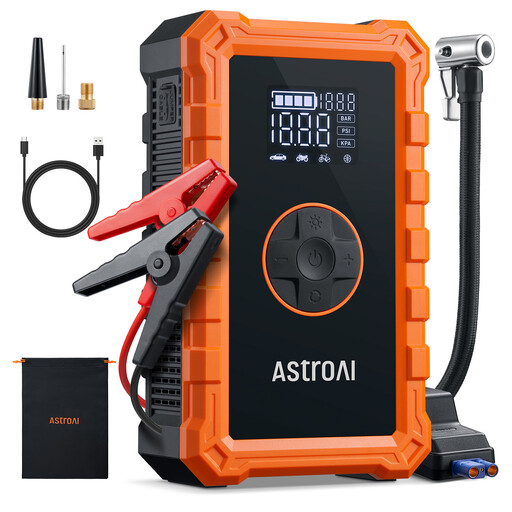
Why we recommend it: Perfect for drivers of city cars or compact sedans (gasoline engines up to 6.0L) who are looking for a reliable and easy-to-store emergency solution, without investing in oversized power they don't need.
Its compressor is designed for quick, occasional inflation, like a simple pressure top-up, without the risk of immediate overheating thanks to its well-ventilated design. The auto-shutoff feature is a real plus.
Compact and lightweight, it easily fits in the glove box. Its large 2.4-inch screen clearly displays all essential information (battery level, pressure, etc.).

Why we recommend it: Ideal for owners of SUVs, vans, or powerful diesel cars. It provides the power reserve needed to start a stubborn engine, even in extreme cold.
With its 4500A peak current, it delivers substantial, real-world starting power that goes far beyond the marketing figures of less capable models. This ensures an effective start for engines up to 9.0L gasoline / 8.0L diesel.
Its honeycomb cooling system ensures better heat dissipation during jump-starts or inflation. Its 10 intelligent safety protections make it very safe, even for a novice user.

Why we recommend it: Designed for those who want a device that is "ready to go" even after being forgotten in the trunk for months. It's also for those who prioritize safety above all and plan to leave the jump starter in their car year-round.
Its sodium-ion battery bypasses the pitfall of rapid self-discharge. According to the manufacturer, a single charge can keep it on standby for several years, whereas conventional lithium batteries require recharging every 2 to 3 months.
Exceptional thermal stability (from -40°C to 80°C according to the brand) and intrinsic chemical safety, which reduces risks related to heat or impact. The PD 60W fast charging is also a major asset.
We have compiled a complete and up-to-date selection of products that meet these strict selection criteria and current safety standards.
The lifespan depends on the quality of its internal battery and the frequency of use. A well-made model is generally designed to handle several hundred charge/discharge cycles. To extend its longevity, it is advisable to recharge it every 3 to 6 months, even if it is not used.
Yes, it is highly recommended. After jump-starting a vehicle or using the compressor intensively, the device's battery is inevitably drained. Recharging it fully ensures it will be ready and at 100% capacity for the next emergency.
It all depends on the battery technology and the manufacturer's recommendations. Traditional lithium batteries are sensitive to extreme temperatures (summer heatwaves, deep winter cold), which can affect their performance and lifespan. Some newer models, like those based on sodium-ion, are specifically designed to withstand a much wider temperature range, making them more suitable for being left in a vehicle year-round. Always check the operating and storage temperature range indicated in the user manual.