
Livraison le jour même ou le lendemain

Qualité garantie

Débloquez vos offres de bienvenue: Livraison GRATUITE | Jusqu'à -80 % | 30 jours d'essai gratuits à JoyPlus
Téléchargez l'application
A dead battery first thing in the morning, an under-inflated tyre far from any service station… These are scenarios every driver dreads. The jump starter with air compressor has emerged as the all-in-one solution to tackle these headaches. The problem? The market is saturated with products making tempting promises that often fall short. To help you make the right choice, we've broken down the pitfalls to avoid and the essential criteria to check before you buy.
While many devices look alike, their performance can vary wildly. Here are the key things to watch out for so you don't regret your investment.
To ensure you choose a reliable device, don't get lost in the spec sheets. Focus on these three key points.
Forget peak amps. The only reliable indicator is the engine compatibility stated by the manufacturer, expressed in litres (L) of displacement for petrol and diesel engines.
The maximum pressure, often around 150 PSI (about 10 bar), is a standard that covers most needs (car tyres, bikes, balls). But the spec that truly makes a difference is the airflow, measured in litres per minute (L/min). Aim for a flow rate above 25 L/min for fast and effective inflation. The best models also include an auto-shutoff function once the target pressure is reached—a real convenience.
A good emergency jump starter is, above all, a safe device. It is imperative to check for a smart control box on the cables. This box should integrate a full suite of protections:
Finally, don't overlook the physical quality of the clamps (thick copper jaws, firm springs) and cables. This is a sign of durability, as well as good electrical conductivity for optimal power transfer.
Rather than an endless list, we've selected three models that meet specific needs, all validated against our performance and safety criteria.

Why we recommend it: This is the perfect Swiss Army knife for most drivers, whether you have a petrol sedan or a diesel SUV. Its 4500A power is more than enough for everyday starts, and its 150 PSI compressor with preset modes is a real bonus for maintaining the family's tyres or inflating a paddleboard on holiday.
Its advertised power is consistent with its real-world capability (engines up to 9.0L petrol / 8.0L diesel). Most importantly, its compressor isn't just a gimmick; it's designed for regular use.
The perfect balance of power and versatility; its 10 electronic protection levels; its highly readable LCD screen that displays real-time pressure.
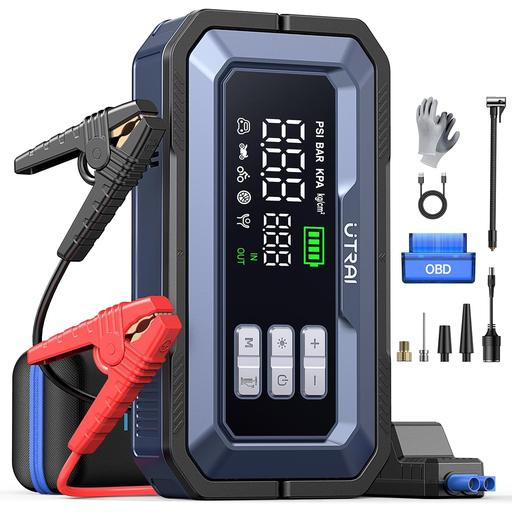
Why we recommend it: This is the heavyweight of our selection, built for large SUVs, utility vehicles, or diesel engines up to 14L. With 7000A and ultra-robust clamps, no start is too tough for it. The OBD2 fault code reader and 160W DC output are bonuses that will appeal to the most demanding users.
Here, the peak power isn't just on paper. It's genuinely delivered thanks to oversized clamps and a design built to last. The compressor is just as impressive: powerful and efficient, not just a marketing talking point.
Colossal starting power (7000A); integrated OBD2 fault code reader; 160W DC output to power a cooler, inverter, or other 12V accessories.
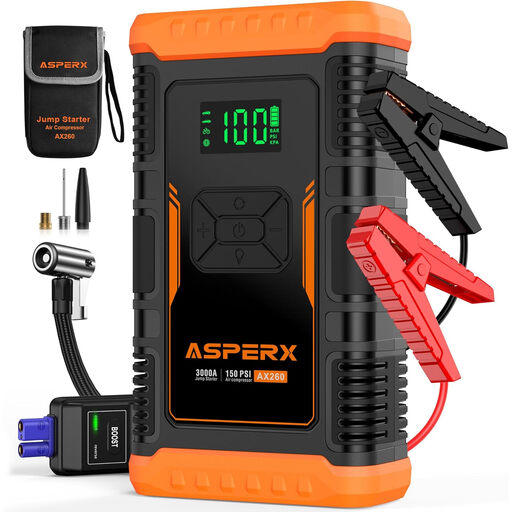
Why we recommend it: The perfect solution for drivers of compacts and sedans who want a compact, reliable, and simple emergency device. It fits in the glove box and gets straight to the point, without superfluous features that drive up the price.
It doesn't promise the moon. It focuses on the essentials: 3000A of power, which is more than enough for small to medium engines, a compressor that gets the job done, and all the indispensable safety features. All without the extra cost of gadgetry.
Its compact and lightweight design; its excellent value for money; its design optimised for heat dissipation, a sign of longevity.
Explore our full selection of products that meet our rigorous criteria for performance and safety.
It all depends on the engine size and type. As a rule of thumb:
In any case, always refer to the engine compatibility stated by the manufacturer.
Even if you don't use it, it's crucial to fully recharge your jump starter every 2 to 3 months. A lithium battery undergoes natural, albeit slow, self-discharge. Regular charging not only ensures it will be ready to go when you need it but also significantly extends its lifespan.
Yes, they are designed for that. You just need to avoid extreme temperatures. Don't let it bake in direct sunlight on the dashboard in summer or endure a deep, prolonged freeze in winter. Most models tolerate a wide operating range (e.g., -20°C to 60°C), but prolonged storage at these extremes can degrade the battery over the long term. The glove box or boot are the best places for it.