
Livraison le jour même ou le lendemain

Qualité garantie

Débloquez vos offres de bienvenue: Livraison GRATUITE | Jusqu'à -80 % | 30 jours d'essai gratuits à JoyPlus
Téléchargez l'application
A dead battery first thing in the morning, a tyre that's sneakily going flat on the way to your holiday… situations as familiar as they are frustrating. When faced with these headaches, the jump starter with air compressor emerges as the silver bullet to get you back on the road. But be warned: the market is flooded with products whose marketing claims are often misleading. Separating fact from fiction is therefore crucial to avoid ending up with a useless gadget when you need it most.
As a product expert at Joybuy, my mission is to help you see things more clearly. Let's scrutinise the pitfalls to avoid and the technical criteria that really matter to make an informed choice.
On the packaging and in product descriptions, manufacturers flaunt impressive numbers that often hide real design weaknesses. Here are the three most common pitfalls.
To ensure you invest in a reliable device, focus on these three foolproof points.
Forget the peak current plastered on the box. The essential thing is to check the booster's compatibility with your engine's displacement. A good rule of thumb is to look for a 12V petrol/diesel booster that clearly states the supported engine sizes (for example: "up to 8.0L petrol / 6.0L diesel").
Pressure (PSI/bar) indicates force, but it's the airflow rate (L/min) that determines speed. Although this rate is rarely highlighted by brands, a good electric tyre inflator should be able to reinflate a standard car tyre in 5 to 7 minutes maximum. One feature has become essential: automatic shut-off. You set the target pressure, and the compressor stops by itself once it's reached. No more risk of under-inflation or bursting.
A good modern booster is much more than a simple starter: it's a true multifunction jump starter.
Rather than aiming for a supposedly "universal" product, it's better to choose the model that is perfectly suited to your vehicle and your needs.

Why we chose it: It's the perfect balance for most drivers. Powerful enough for family cars, SUVs, and motorbikes, it offers complete peace of mind without superfluous gadgets.
Its 4500A current can start petrol engines up to 9.0L, steering clear of the inflated numbers trap. Its 150 PSI compressor is effective, and its 10 levels of protection provide genuine peace of mind.
Its 5-in-1 versatility (jump-starting, inflation, power bank, LED light) and its highly readable LCD screen that displays real-time pressure.
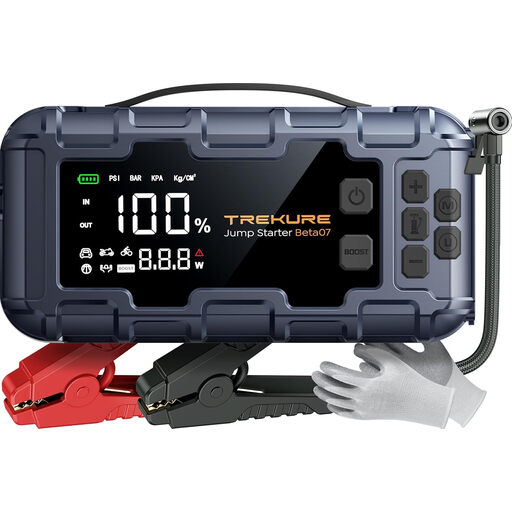
Why we chose it: Built for large displacement engines (up to 12L diesel). Its power reserve ensures flawless starts for vans, 4x4s, motorhomes, and even classic cars.
With its 6000A peak current, no stubborn engine stands a chance. Its 160 PSI compressor, paired with a high airflow rate (45 L/min), avoids the trap of endless inflation.
Massive starting power, a large 3.3-inch smart screen, and PD 45W fast charging for quickly recharging the booster itself.
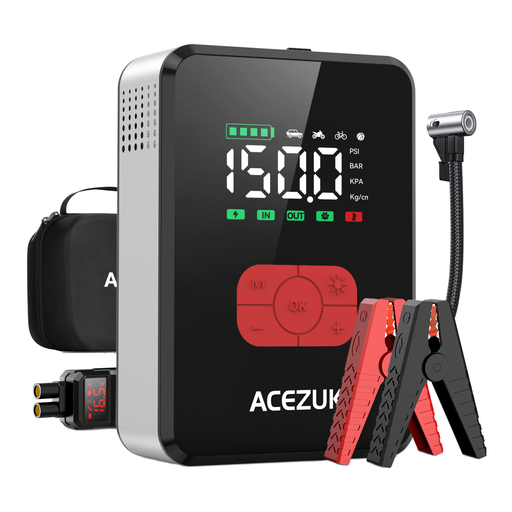
Why we chose it: For those who want the ultimate in power and smart features. The separate screen on the clamps, which provides real-time feedback, is a real plus for safety and ease of use.
It shatters the "basic safety" trap with advanced and highly practical features, like its on-clamp screen that confirms a good connection and helps with diagnostics.
A 7000A peak current, compatible with all engines on the market (up to 12L). Its smart clamps with an integrated screen are a decisive safety asset.
We have compiled a complete, up-to-date list of products that meet our strict selection criteria and safety standards.
What is the lifespan of a jump starter with a compressor? The lifespan depends on its lithium-ion battery, which typically lasts 3 to 5 years (or several hundred cycles). To maintain it, remember to recharge the device to 100% every 3 to 6 months, even if you don't use it. Store it in a temperate place, away from both frost and extreme heat.
Can I leave the jump starter in my car permanently? It's strongly discouraged, especially in the middle of summer or the dead of winter. Extreme temperatures (below -10°C or above 40°C) can irreversibly damage the battery and reduce its lifespan. The ideal solution? Keep it at home and put it in your car before a long journey or holiday trip.
Is a higher amperage always necessary? Not necessarily. The key is to choose a power level appropriate for your engine's displacement. A 2000A booster is more than enough for a small petrol city car. However, a more powerful model (4000A and up) offers greater versatility (car, motorbike, van, etc.) and, crucially, better performance in cold weather, which is when batteries are under the most strain.