
Livraison le jour même ou le lendemain

Qualité garantie

Débloquez vos offres de bienvenue: Livraison GRATUITE | Jusqu'à -80 % | 30 jours d'essai gratuits à JoyPlus
Téléchargez l'application
A dead battery on a cold morning or an underinflated tire far from any service station: it's every driver's nightmare. The jump starter with air compressor has emerged as the all-in-one solution for regaining your peace of mind. But with a market flooded with options and spec sheets full of promises, it's easy to get lost and make the wrong choice.
As a product expert at Joybuy, my mission is to help you see things more clearly. Let's cut through the marketing jargon and get straight to the point. Here are the pitfalls to avoid and the real criteria for choosing a device that won't let you down when you need it most.
The market is overflowing with models that have tempting features, but some hide weaknesses that only become apparent with use.
To avoid buying blind, focus on the key technical data that define the performance and reliability of a jump starter compressor.
The number one criterion: the ability of the portable car starter to turn over your engine.
Don't be mesmerised by the maximum pressure. Airflow, measured in litres per minute (L/min), is a much better indicator of inflation speed. A good 12V air compressor should have sufficient airflow (e.g., 35 L/min) to reinflate a standard car tire in a few minutes, not a quarter of an hour. An automatic shut-off feature at the desired pressure is an almost essential convenience to prevent over-inflation and let you work with confidence.
A good multi-function jump starter should also be useful for daily life or during your leisure activities.
Here are a few options that cater to distinct user profiles, based on the objective criteria we've just discussed.
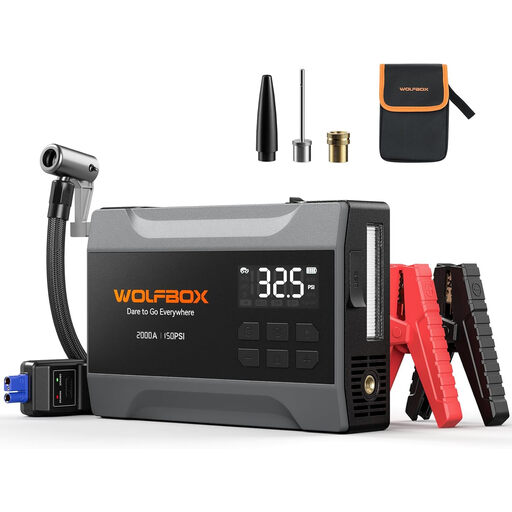
Why we chose it: Perfect for the majority of city car and gasoline sedan drivers (up to 5.0L). It gets straight to the point: jump-starting, inflating, and illuminating. All in a compact form factor that's small enough to be forgotten in the glove compartment. It's the sensible choice for preventative and occasional use.
No empty promises. Its 2000 A are perfectly calibrated for the most common gasoline cars. There's no need to pay for oversized peak power you'll never use.
Simplicity and a compact design. It focuses on its primary mission without being cluttered with gadgets, making it an accessible emergency starter for everyone.
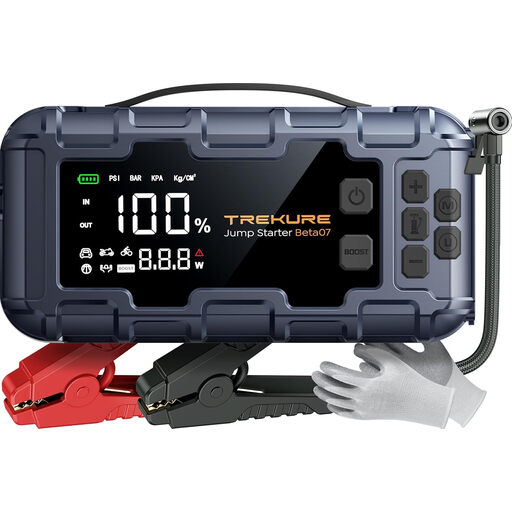
Why we chose it: Built for owners of SUVs, utility vehicles, or large diesel engines (up to 12L). Its 6000 A of power and high-flow compressor (45 L/min) make it a powerful ally for critical situations and long journeys where reliability is non-negotiable.
It sidesteps the sluggish compressor trap. Its high airflow (not just its 160 PSI pressure rating) guarantees you can reinflate a large tire quickly, where a low-end model would take an eternity... before overheating.
45W PD fast charging. In addition to starting heavy-duty engines, it recharges itself at high speed and can even power a laptop. A real bonus for digital nomads.

Why we chose it: For those who want more than just an emergency rescue tool. With its 5 preset inflation modes (car, motorcycle, bicycle, balls), its power bank function, and its LED light, it becomes the ideal companion for camping, outdoor recreation, or managing tires on your bike, motorcycle, and car.
It avoids the "gadget" trap of sacrificing the essentials. Its 4500 A starting power remains solid, and its extra features are well-integrated, not just a marketing gimmick.
Smart inflation modes. No more searching for the right pressure for the kids' bikes or a football: the device offers presets and stops automatically. Simple, precise, and effective.
Explore our complete selection of products that meet our performance criteria and current safety standards.
What is the lifespan of a jump starter with an air compressor? It all depends on the quality of its lithium battery and how well you take care of it. Generally, a good model can handle several hundred charge cycles. The golden rule for preserving its longevity: fully recharge it every 3 to 4 months, even if you don't use it. And most importantly, never let it discharge completely.
Can you leave the jump starter in your car permanently? It's a very bad idea to leave it in your car permanently, especially in the furnace of a car's interior during summer or in the freezing cold of winter. Extreme temperatures (above 60°C or below -20°C) can damage the battery, reduce its capacity and lifespan, and in some cases, pose a safety risk. It's better to store it at home in a temperate location.
Are peak amps the only criterion for a diesel engine? No, and this is a crucial point. High peak amperage isn't everything. The quality of the clamps and the gauge of the cables are just as important. Heavy-gauge cables and solid clamps ensure optimal power transfer with minimal loss between the jump starter and your battery. This is the kind of detail that makes all the difference in cold weather when batteries are already struggling.