Which criteria should you check first?
For an occasional purchase, start with the sugar content, then consider the serving size and packaging. The words ‘no added sugar’ don’t answer any of these questions on their own.
| What matters |
What to check |
Who is this for? |
| Sugars present |
Check the ingredients and the ‘sugars’ line per 100 ml, then relate that figure to the amount you’ll serve. |
I want to know what’s in the juice, even if no sugar has been added. Around 45% of consumers would make this their top check. |
| Quantity and frequency |
Consider how much you pour and where juice fits into your usual habits. Manger Bouger advises limiting juice and choosing whole fruit. |
I’d like to drink juice from time to time without the bottle making me automatically pour another glass. Managing intake would be the top priority for around 36% of consumers. |
| Recipe and packaging |
Compare the product description, ingredients and pack size, and check the storage instructions after opening. |
For my household shop, I’m looking for a clearly identifiable recipe and a pack size we can use in line with the label instructions. This would be the priority for around 19% of consumers. |
Brands to compare when checking labels
These products are examples of recipes and pack sizes to consider. The brand alone doesn’t tell you how much sugar a juice contains.
Joker
Carrefour’s product page for a Joker orange pure juice with no added sugar lists orange juice as the ingredient.
- You can identify the recipe by checking the ingredients on this product.
- The product page states that the juice contains sugars naturally present in fruit, so check its sugar content too.
Tropicana
A Carrefour product page features Tropicana orange juice with pulp and no added sugar.
- The presence of pulp is specified for this product.
- The words ‘no added sugar’ don’t replace checking the sugars per 100 ml and considering the portion you’ll serve.
Carrefour
The product page for a Carrefour Bio mixed-fruit juice with no added sugar details a recipe made with pineapple, mango and passion fruit.
- The ingredients and their proportions make it possible to identify the recipe of this product.
- ‘Organic’ and ‘no added sugar’ claims don’t remove the need to compare the nutritional information and serving size.
Auchan
Auchan offers a 2 L bottle of orange pure juice with no pulp.
- The product page states that it contains 8,4 g of sugars per 100 ml. Relate this figure to the amount you’ll serve.
- For this product, the label says to keep it in the fridge and consume it within five days of opening.
E.Leclerc (Eco+ / Marque Repère)
E.Leclerc offers orange pure juices in a range of pack sizes under its Eco+ and Marque Repère ranges.
- The Eco+ product page we checked lists orange juice as the ingredient and 8,7 g of sugars per 100 ml.
- A simple ingredient list doesn’t mean a juice is low in sugars. Check the label of the product you choose.
Juices available on Joybuy
These three Joker juices are options to consider if you’re buying fruit juice for an occasional drink. Compare their recipes and pack sizes, and check the sugars listed on the packaging in relation to the amount you’ll serve.
 Image unavailable
Joker Engagé, mixed-fruit juice with no added sugar, 1 L
If you’re looking for a mixed-fruit juice for an occasional drink, check the sugars in relation to the amount you’ll serve.
Size: 1 L. Check the ingredients on the bottle to find out what’s in the recipe.
View on Joybuy
 Image unavailable
JOKER, mixed-fruit juice with no added sugar, 1.5 L
If this size suits your household, decide how much to pour into each glass rather than judging by the size of the bottle.
Size: 1.5 L. Check the label for the ingredients, sugars per 100 ml and storage instructions after opening.
View on Joybuy
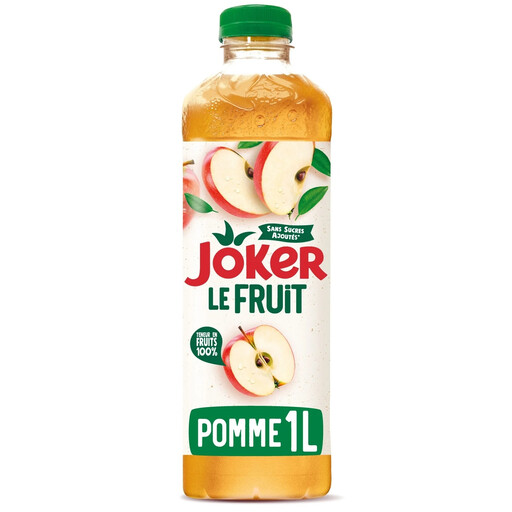 Image unavailable
JOKER, unsweetened apple juice, 1 L
If you prefer apple juice, check the ingredients and sugars listed on the bottle before choosing your serving size.
Size: 1 L. ‘Unsweetened’ doesn’t mean the juice contains no sugar.
View on Joybuy
Frequently asked questions
Does ‘no added sugar’ mean a juice is low in sugars?
No. A juice with no added sugar still contains the sugars naturally present in fruit. Carrefour’s product page for a Joker pure juice makes this clear. To compare products, check the ‘sugars’ line per 100 ml, then take your serving size into account.
What should I check if I want to buy juice for an occasional drink?
Check the product description, ingredients and sugars per 100 ml before deciding how much to serve. A pure juice and a mixed-fruit recipe may have different ingredients, so compare the products themselves rather than relying on claims on the front of the pack.
How much juice should you include in your everyday drinks?
Manger Bouger recommends limiting fruit juice, having no more than one glass a day and choosing whole fruit. If you’re living with diabetes, also follow the advice tailored to your situation by your healthcare team.
Can juice with no added sugar be used in the event of hypoglycaemia?
It may still contain sugars, despite this claim. France’s Assurance Maladie mentions using juice in its advice for children and teenagers with diabetes. For guidance on what to do in your situation, follow the plan agreed with your healthcare team.
How long can you keep an opened bottle of juice?
Follow the storage conditions and time limit stated on the bottle you choose. For example, Auchan’s product page for its 2 L orange pure juice says to keep it in the fridge and consume it within five days of opening. Don’t assume the same instructions apply to other products.


