
Livraison le jour même ou le lendemain

Qualité garantie

Débloquez vos offres de bienvenue: Livraison GRATUITE | Jusqu'à -80 % | 30 jours d'essai gratuits à JoyPlus
Téléchargez l'application
Making juice at home sounds simple… until the appliance leaves a mountain of pulp, jams on the first piece of celery, or takes longer to clean than to use. If you plan to regularly prepare fruit and vegetable drinks, choosing a juice extractor deserves a bit of thought.
A centrifugal juicer relies on a grating disc and high rotation speed to extract liquid quickly. It will delight those who want to fill a glass without waiting, but it is generally noisier and can produce more froth depending on the ingredients used.
A cold press juicer, also known as a slow juicer, presses ingredients at a reduced speed. This method is particularly well suited to leafy greens, carrots, apples and cucumber. However, speed isn't everything: the shape of the auger, the fineness of the filter and the way you feed ingredients in also affect the yield.
A large chute juice extractor cuts down on the time spent chopping ingredients. That doesn't mean you can feed everything in whole, though. Stones, hard pips, thick peels and very long fibres usually need to be removed or cut up.
Don't just look at the stated diameter – also check the usage instructions. A chute of 80 to 135 mm can make preparing apples, oranges or cucumbers easier, but it doesn't let you off removing stones or cutting up overly large ingredients.
An appliance that's fiddly to take apart often ends up at the back of a cupboard after a few uses. The number of parts, the presence of a fine filter and access to every nook and cranny matter far more than a vague promise of quick cleaning.
For a home juicing machine, choose a model with removable parts, a dedicated cleaning brush and, where the manual clearly confirms it, dishwasher-safe components. The motor base, however, must never be submerged.
Claims about nutrients or vitamin retention should be taken with a pinch of salt: these factors depend on the food itself, its storage conditions and how long it sits before consumption. A product page is not a medical endorsement.
For one person, a jug of 400 to 800 ml can be more than enough. A family would be better off choosing a larger juice jug and pulp container. Bear in mind, though: the stated volume sometimes refers to the container, not the actual amount of juice you'll get. Graduated markings help give you a clearer picture.
Power, expressed in watts, is not enough to judge a juicer's efficiency. Also check the maximum continuous running time and the required cooling period. Some machines require a break after 10 or 15 minutes, while certain centrifugal juicers operate on even shorter cycles.
Even a quiet juice extractor makes noise from its motor, the ingredients and vibrations transmitted to the worktop. A non-slip base and stable design are therefore far from unnecessary. It's also worth checking for a pusher, a reverse function in case of jamming and an anti-drip system.
For an appliance that meets the requirements applicable in the UK, check the regulatory information provided, the presence of an English instruction manual, the manufacturer's or EU responsible person's identification, and electrical instructions suitable for the 220–240 V mains supply. These details do not replace carefully reading the documentation before first use.
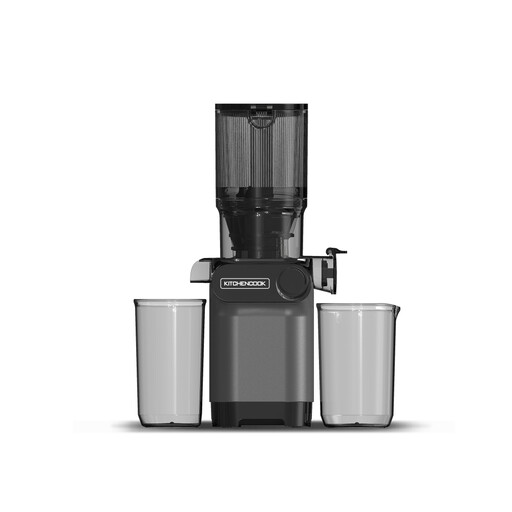
Why this choice suits this profile: This 200 W cold press juicer offers a stated speed of 45 to 70 rpm and a 108 mm feed chute. It's ideal for those who want to get started with varied juices without cluttering their kitchen with lots of accessories.
The reverse function helps free a stuck ingredient. The valve anti-drip spout minimises spills when serving.
800 ml jug, 600 ml pulp container, cleaning brush and a stated two-year warranty.
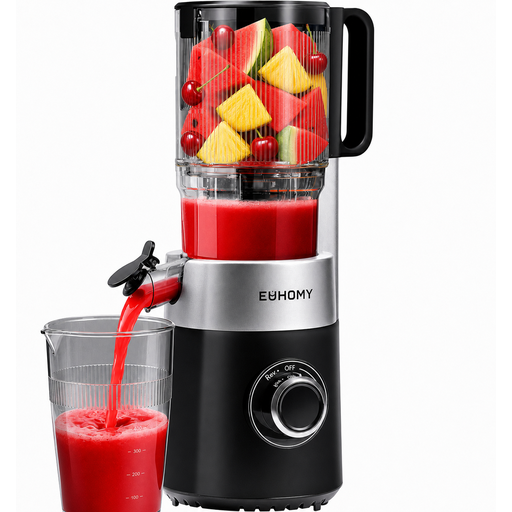
Why this choice suits this profile: Its twin stainless steel auger, 1.8 l jug and 135 mm feed chute are designed for households that prepare generous quantities of juice.
The stated three-step assembly and design focused on easy cleaning reduce the risk of the appliance being abandoned because it's too much hassle.
Large capacity, XXL feed chute and a stated 220 W motor, combined with low-speed operation.
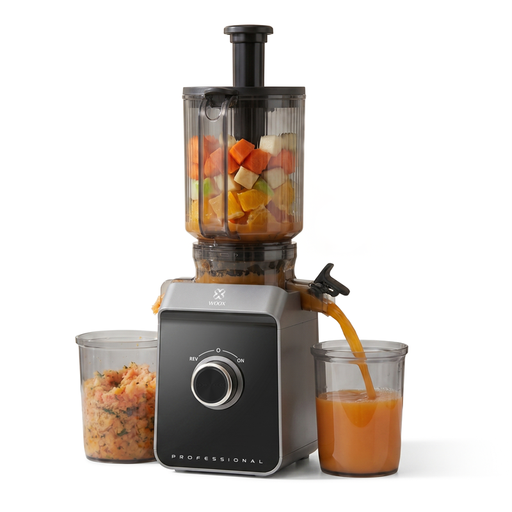
Why this choice suits this profile: This 150 W slow juicer has a 1.8 l jug, a 600 ml cup and an 836 ml pulp container – volumes designed for family-sized batches.
The manual states a maximum continuous running time of 10 minutes, followed by a 20-minute cooling period – enough to prevent the motor from being overworked.
130 mm feed chute, removable parts stated as dishwasher-safe and overheat protection.
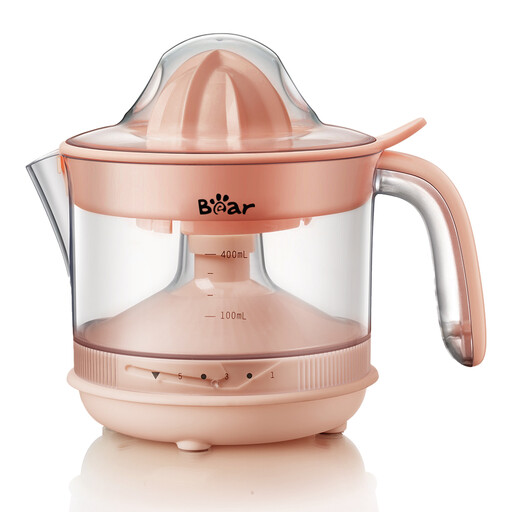
Why this choice suits this profile: This 30 W electric citrus juicer, with a 400 ml reservoir, gets straight to the point for making orange or lemon juice without pulling out a multi-function extractor.
With no blades and removable parts, it relies on simplicity and quick cleaning for occasional use.
Five stated pulp settings, non-slip base and detachable design.
We've put together a comprehensive, real-time updated selection of products that meet these exacting criteria as well as European safety regulations.
Go for a fruit and vegetable juice extractor if you regularly prepare carrots, apples, cucumbers or leafy greens. A centrifugal juicer will be better for speed with firm ingredients. If you only squeeze oranges and lemons, an electric citrus juicer will be simpler and often more compact.
Allow a few minutes, provided you rinse the parts immediately after use. Take apart the auger, filter, jug and containers, then remove any residue with the supplied brush. Avoid letting the pulp dry out, and always check the manual before putting any part in the dishwasher.
It depends on how often you use it, whether you respect the motor's rest periods and how well you maintain it. Avoid ice cubes, frozen fruit, stones and any ingredients the manufacturer hasn't intended. Only use the pusher, and unplug the appliance before any disassembly or cleaning.