Shoppers looking to compare sugar reductions
You’re looking for a stated reduction compared with standard jam, while accepting that the recipe still contains sugar. The sugar figure per 100 g then helps you compare the jars you’re interested in.


Choose reduced-sugar jam if you’re looking for a stated reduction compared with standard jam. Choose ‘no added sugars’ if avoiding added sugars is your priority. In either case, compare the ‘of which sugars’ figure per 100 g and the ingredients on the exact jar, then check its size and availability for your order.
You’re looking for a stated reduction compared with standard jam, while accepting that the recipe still contains sugar. The sugar figure per 100 g then helps you compare the jars you’re interested in.
You’re specifically looking for the words ‘no added sugars’, rather than simply a comparative reduction. Check the ingredients and nutritional information too: this claim does not mean ‘sugar-free’.
You’re choosing between several flavours and sizes for an online order. The jar you want also needs to be available at your chosen store, for your selected collection option or delivery slot.
‘Reduced sugar’ and ‘no added sugars’ refer to two different things. Once you’ve decided which matters most to you, the nutritional information and ingredients will help you compare specific products.
Choose this if: you’re looking for a stated reduction compared with standard jam.
Bear in mind: a comparative reduction alone doesn’t tell you the final sugar content per 100 g.
Choose this if: avoiding added sugars is your main priority.
Bear in mind: fruit contains naturally occurring sugars, so check the ‘of which sugars’ figure to see the amount listed.
| What to compare | What to check | Who is this for? |
|---|---|---|
| Sugar reduction | Compare the stated reduction with the ‘of which sugars’ figure per 100 g on the product page for your chosen flavour. | If I want to reduce my sugar intake but still choose a recipe that contains sugar, I need a figure to compare the jars. Around 33% of shoppers make this their priority. |
| Added sugars | Look for the words ‘no added sugars’, then check the ingredients and sugar content per 100 g. | My main priority is choosing a recipe with no added sugars, even if the fruit contributes natural sugars. This matters most to around 27% of shoppers. |
| Fruit and recipe | Check the flavour, the fruit content if listed, and the ingredients. | If I want a fruit spread I’ll enjoy, I start with the flavour and ingredients, without assuming that more fruit means less sugar. Around 20% of shoppers prioritise this. |
| Size and availability | Check the jar size and confirm it’s available at your chosen store or for your delivery slot. | I need to be able to add the flavour and size I want to my order, with a collection or delivery option that suits me. For around 20% of shoppers, this is the most important factor. |
A stated reduction compared with standard jam doesn’t mean the product contains no sugar. E.Leclerc and Auchan, for example, list products with 30% less sugar, though the final amount varies from jar to jar.
Compare the ‘of which sugars’ figure per 100 g for the products you’re interested in.
The fruit content tells you about the recipe, but it doesn’t replace the sugar figure in the nutritional information.
Look at both figures together, as well as the ingredients for your chosen variety.
A flavour listed on a product page may not be available for collection or your chosen delivery slot.
Select your store and how you’d like to receive your order, then check that the exact size is available before you place your order.
Storage instructions after opening can vary by recipe and brand.
Follow the storage instructions and use-by guidance on the jar you’ve bought.
The Intense range includes a 335 g jar of reduced-sugar strawberry jam listed by Carrefour.
This own-label brand includes reduced-sugar strawberry and apricot jams in 340 g jars.
E.Leclerc lists several 340 g reduced-sugar jams in this range, including strawberry, apricot, raspberry and blueberry.
Auchan’s reduced-sugar jam category also features products labelled ‘no added sugars’.
Andros also offers a 350 g jar of reduced-sugar apricot jam, listed by Auchan.
These Lucien Georgelin fruit spreads are options to consider if you’re looking for products with no added sugars. They’re not a substitute for comparing reduced-sugar jams if you’re looking for a reduction compared with standard jam.
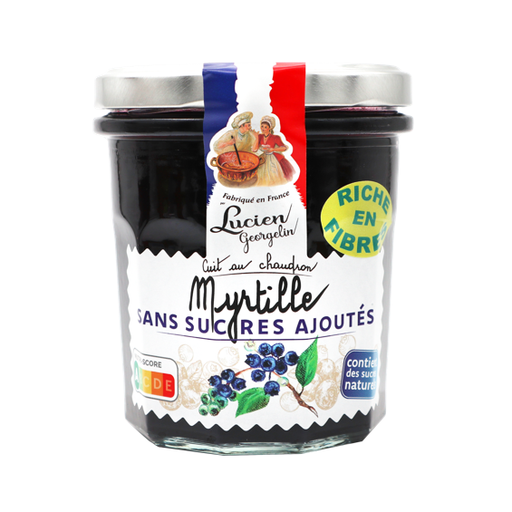 Image unavailable
Worth considering if you’re looking for a blueberry spread with no added sugars. This doesn’t mean it’s sugar-free, so check the ingredients on the jar and the storage instructions after opening.
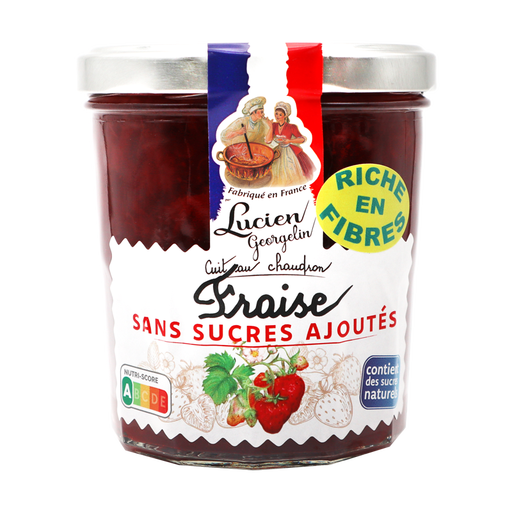 Image unavailable
Worth considering if you prefer strawberry in a spread with no added sugars. Compare the nutritional information for the exact jar and check its ingredients on the label before relying on the fruit content.
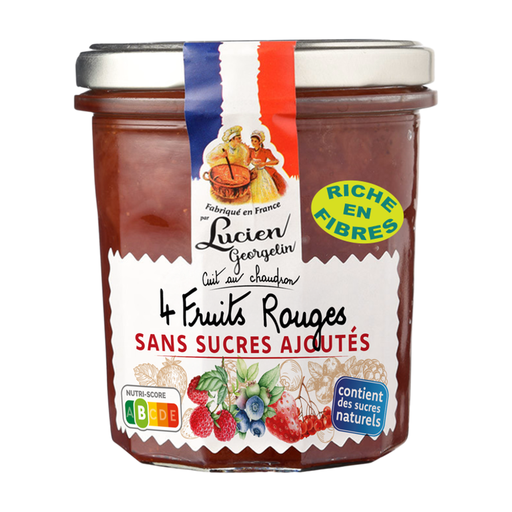 Image unavailable
Worth a look if you’re after a red-fruit spread with no added sugars. Check the flavours and pack size of the product being sold, then read the nutritional information for each flavour before comparing them.
No. ‘Reduced sugar’ describes a comparative reduction, not the absence of sugar. For some products, E.Leclerc and Auchan state that they contain 30% less sugar than standard jam; also check the sugar content per 100 g for the jar you’ve chosen.
Look for the exact words ‘no added sugars’, then check the ingredients and the ‘of which sugars’ figure per 100 g. Compare the precise flavour and size you plan to order, as the absence of added sugars doesn’t tell you the total sugar content.
Follow the instructions for the product you’ve bought. For example, Materne’s apricot product page advises keeping the jar in the fridge at +4 °C and using it within 16 days of opening, while Andros says to refrigerate the jar and consume it promptly. Don’t assume the guidance for one product applies to another.
In France, the DGCCRF says that jam labelling includes information about fruit and sugars. When choosing between two jars, look at the fruit content, ingredients and nutritional information for the exact product. Don’t infer its sugar content from the fruit percentage alone.