People doing their first food shop
You’re looking for an amount that suits how you’ll use it, and would rather not buy an extra bottle if a jar works for you.


For your first food shop, choose jam in a jar if you want to avoid buying and cleaning a separate bottle. If serving it by squeezing matters more, check the packaging of the jam you’re considering, or the specifications of a bottle suitable for food contact. A smooth recipe may suit your preferred texture, but it doesn’t guarantee that the jam will flow through a nozzle or reduce waste.
You’re looking for an amount that suits how you’ll use it, and would rather not buy an extra bottle if a jar works for you.
You want smooth-textured jam for your toast, without assuming it will pass through every type of nozzle.
You check the ingredients and the sugar per 100 g, rather than judging what’s inside by the packaging alone.
First decide whether serving jam by squeezing makes a separate container worthwhile for you. Then choose your preferred texture and compare the labels of the jams you’re interested in.
| Criteria | What to check | Who this matters to |
|---|---|---|
| Packaging | Check whether the jam is sold in a jar or a squeezable container, then look at the net quantity. If you’re considering a separate bottle, check that it’s suitable for food contact. | For my first food shop, I want to buy jam without adding a container to fill and clean. Around 46% of consumers prioritise this simplicity when shopping. |
| Texture and serving | Look for an explicit “no bits” label if that texture matters to you. Before transferring the jam, check the opening and closure of the bottle you’re considering. | I prefer a smooth texture on my toast, but don’t want to assume it will come out of a narrow nozzle. This is the top priority for around 27% of consumers. |
| Ingredients | Compare the “sugars” per 100 g and the ingredients list for the specific products. | Before choosing a flavour or format, I want to know what’s in the recipe. Around 27% of consumers put this comparison first. |
This label describes the texture of the jam, not how it will flow through a particular nozzle.
Choose jam for its recipe. If you’re thinking of transferring it to a bottle, separately check that the bottle is suitable for food contact, and that it’s easy to open, close and clean.
Filling and cleaning add extra steps compared with using a jar.
A recipe name is no substitute for checking its nutritional information and ingredients.
Compare the “sugars” per 100 g, then check the ingredients list and any allergens stated for the product you’ve chosen.
The brand offers classic jams as well as “No Bits” recipes. Carrefour, for example, sells a 310 g jar of “No Bits” strawberry jam.
Carrefour offers, among other products under this brand, a reduced-sugar strawberry jam.
This E.Leclerc Marque Repère range includes classic jams and reduced-sugar options.
The Auchan range includes extra jams and reduced-sugar recipes.
This option is for people who prefer smooth, seedless strawberry jam for their first food shop, rather than serving it by squeezing.
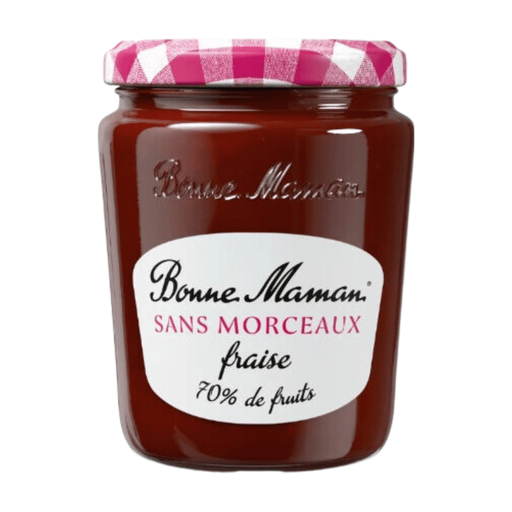 Image unavailable
If you prefer a smooth texture without seeds, this 310 g strawberry jam fits the bill. Its texture doesn’t guarantee that it can be squeezed through a nozzle.
A jar is a good choice if you don’t want another container to fill and clean. If serving jam by squeezing is your priority, check whether it’s sold in this type of packaging, or separately check that a bottle is suitable for food contact.
Only consider transferring it if the manufacturer says the bottle is suitable for food contact and its opening, closure and cleaning requirements are suitable for the jam you’ve chosen. A smooth texture alone doesn’t mean the bottle is suitable.
Check the product name, ingredients list, stated allergens, net quantity and nutritional information for the product you’ve chosen. The DGCCRF says nutritional information is given per 100 g or 100 ml, making it easier to compare products on a like-for-like basis.
Compare the “sugars” figure in the nutritional information per 100 g for each jam. Also check the ingredients list: the container size and claims on the front of the pack are no substitute for the details of the specific recipe.