
Livraison le jour même ou le lendemain

Qualité garantie

Débloquez vos offres de bienvenue: Livraison GRATUITE | Jusqu'à -80 % | 30 jours d'essai gratuits à JoyPlus
Téléchargez l'application
Are you looking for Italian coffee beans for your bean-to-cup machine, your grinder or your professional set-up? The choice isn't just about a well-known brand or a packet decorated with Neapolitan colours. The blend, the roast and the packaging all directly influence the result in your cup, how often you need to adjust your grinder, and the cost per use.
An intensity rating of 9/13, 10/13 or 12/13 generally tells you about the aromatic strength and mouthfeel. It is not a universal measure of caffeine content. A full-bodied coffee bean can be more roasted, more bitter or richer in Robusta, without its intensity rating allowing you to compare two brands precisely.
Italian coffee beans 1 kg are practical for a large family, an office, a hotel or a restaurant. However, a bag that has been open for too long gradually loses its aromas, even when it has a valve. If you don't drink much coffee, a 500 g bag often lets you refresh your beans more regularly.
Two coffees roasted in Italy can have very different profiles. A blend rich in Robusta will generally give a stronger cup with a more abundant crema. A 100% Arabica will favour aromatic notes and a softer texture. The country of roasting doesn't let you off looking at the composition.
Arabica is generally associated with aromatic, fruity or floral notes. Robusta brings more body, a more present bitterness and a denser crema. Blends of Arabica and Robusta aim for a balance between finesse, strength and texture.
For a milky drink, a blend rich in Robusta retains a pleasing taste presence in a cappuccino or latte macchiato. For a short espresso drunk without milk, an Arabica or a balanced blend will be more suitable if you prefer more nuanced cups.
A dark roast accentuates roasted, spicy or chocolatey notes. A more moderate roast preserves more aromatic nuances. Also consider your machine: some bean-to-cup machines already extract coffee quickly and intensely. With these, a very strong coffee can give a bitter cup if the grind and water volume aren't properly adjusted.
Beans intended for espresso are suitable for a bean-to-cup machine with a built-in grinder, a separate grinder or a portafilter machine. However, check the space available in the hopper, the ability to adjust the grind, and the storage conditions for the bag.
The crema depends on the blend, the freshness of the beans, the grind, the dose and the extraction pressure. A commercial promise therefore doesn't guarantee the same result on every machine.
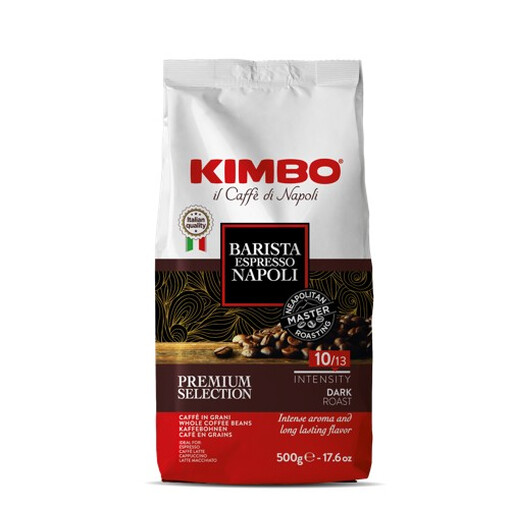
Why this choice suits this profile: With its 500 g format, this coffee limits the initial commitment and lends itself well to a first discovery of the Neapolitan style, on a bean-to-cup machine, a portafilter or with a grinder.
The composition is stated as 100% roasted coffee and the declared intensity reaches 10/13: you have concrete benchmarks, rather than just a promise of authenticity.
The product page mentions a dark roast, toasted and slightly spicy notes, and suitability for espresso and bean-to-cup machines.
Why this choice suits this profile: This reference is aimed at lovers of a 100% Arabica profile, which is softer and more aromatic, who own a grinder or a bean-to-cup machine with enough settings.
The product page specifies the 100% Arabica composition and the 1 kg format: the choice is based on identifiable characteristics, not just the brand's visual.
The product page describes a smooth, velvety and balanced profile, and mentions a Rainforest Alliance certification.
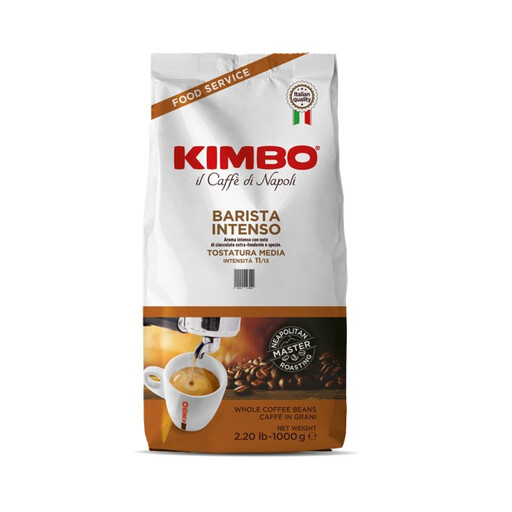
Why this choice suits this profile: The 1 kg packaging is suitable for offices, hotels, cafés and households that go through espressos, café crèmes and milky drinks.
The Arabica-Robusta blend, the 12/13 intensity and the bag's one-way valve are explicitly stated. Useful information for comparing references and better preserving the beans.
Roasted in Italy, this coffee has spicy notes according to the product page and is intended for black coffee, café crème as well as milky drinks.
We've put together a complete, real-time updated selection of products that meet these demanding criteria, while complying with European safety regulations.
After opening, keep the bag in a cool, dry place away from light, then seal it carefully. Avoid the fridge: moisture and odours can spoil the beans. Grinding only the amount you need, just before extraction, helps preserve their aromas.
With a bean-to-cup machine, start with the setting recommended by the manufacturer, then fine-tune gradually. An espresso that runs too quickly may need a finer grind. Conversely, a very slow flow or pronounced bitterness can signal a grind that's too fine, an excessive dose, or a coffee that's too roasted for the chosen setting.
Choose a coffee whose composition and profile are clearly stated. A blend of Arabica and Robusta often works well for an espresso with crema and for milky drinks. If you prefer a more aromatic cup, go for a 100% Arabica instead and make the most of your machine's grind settings.
The best-before date is on the packaging. After opening, the aromas evolve depending on storage conditions and how quickly you use them. A 500 g bag is generally suitable for occasional use, while a 1 kg format is more justified for several coffees a day or shared use.
It all depends on the dose used per cup, the price of the bag and the type of machine. Coffee beans let you grind on demand, but require a built-in or separate grinder. To compare prices, look at the cost per kilogram and the amount actually used per extraction, rather than just the price of the bag.